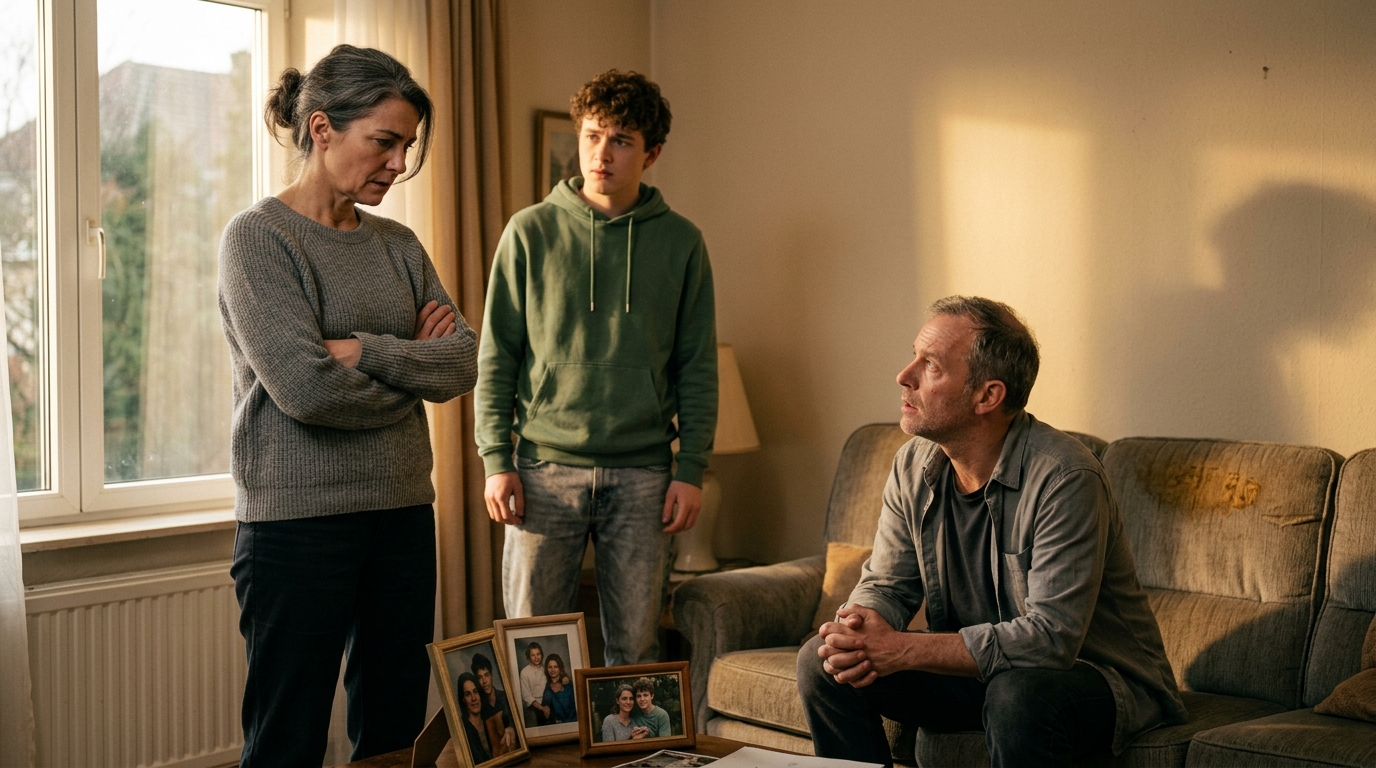
The first time Gavin Rourke left me, I was seven months pregnant and standing barefoot in our kitchen.
The second time he appeared at my door, our son was twenty years old.
And Gavin was wearing a hospital bracelet.
For several seconds, neither of us spoke.
I recognized him immediately, which surprised me. Twenty years had changed nearly everything else. His dark hair was streaked with gray. His shoulders were narrower. The confident smile that used to make strangers trust him was gone.
But his eyes were the same.
Those were the eyes I had watched while he promised he would never become like his father.
The eyes that had looked directly at my pregnant stomach before he walked out.
“Mara,” he said.
My hand tightened around the edge of the door.
Nobody had called me that way in years. Not with the soft familiarity of someone who believed he still had a claim on my memories.
“How did you find me?”
“I hired someone.”
That answer alone told me he had not come to apologize.
A person who wanted forgiveness began with regret.
A person who hired someone began with a need.
“What do you want, Gavin?”
His gaze moved past me, searching the hallway behind my shoulder.
“Is Eli here?”
I stepped farther into the doorway.
“You don’t get to say his name like you know him.”
His face tightened.
“I understand that you’re angry.”
“Angry?”
The word nearly made me laugh.
Anger was what I had felt during the first year.
Anger was temporary.
What remained after twenty years was something quieter. Harder. It was the knowledge that the man standing in front of me had missed every fever, every scraped knee, every birthday candle and every school performance.
He had not misplaced those years.
He had chosen not to be there for them.
“Why are you looking for him?” I asked.
Gavin lowered his eyes.
Only then did I notice how pale he was.
“I’m sick.”
I waited.
“I was diagnosed with acute leukemia eight months ago,” he continued. “The treatments worked for a while, but it came back.”
“I’m sorry to hear that.”
I meant it.
I did not love Gavin anymore, but I had never wished death on him.
He looked almost relieved by my response.
“My doctors believe a stem-cell transplant is my best chance. We’ve gone through the registries. We tested my family.”
His voice broke slightly.
I understood before he finished.
“You want Eli tested.”
“I want to meet him.”
“No. You want him tested.”
“Mara, please.”
“Does your wife know you’re here?”
He hesitated.
That was my answer.
Serena Vale.
The woman Gavin had left with while I was carrying his child.
I had seen photographs of her over the years without searching for them. Gavin had become successful in commercial real estate. His name appeared in business articles and charity announcements.
In those photographs, Serena was always beside him.
They had a beautiful house outside Denver, according to one magazine profile.
They also had a son.
A son Gavin had raised.
“How old is your other child?” I asked.
“Miles is seventeen.”
“And he isn’t a match?”
Gavin stared at me.
“No.”
Something cold passed through my chest.
He had tested the son he loved first.
Only after that child could not help him had Gavin gone searching for the one he abandoned.
“You didn’t come here because you finally remembered Eli,” I said. “You came because the child you chose couldn’t save you.”
“That isn’t fair.”
“Fair?”
I opened the door wider, though not to invite him inside.
“Fair would have been Eli knowing his father. Fair would have been me not working until two in the morning while pregnant because you emptied our account. Fair would have been one birthday card in twenty years.”
“I made mistakes.”
“A mistake is forgetting an anniversary. You disappeared.”
“I was twenty-seven and terrified.”
“And I was twenty-five and pregnant.”
Gavin looked toward the street.
A black SUV was parked across from my house. A driver waited behind the wheel.
Even now, he had not come alone.
“I know I don’t deserve anything from you,” he said.
“You’re right.”
“But this isn’t only about me. Eli deserves to know who his father is.”
I felt my heartbeat change.
It was subtle, but Gavin noticed.
He had always been good at finding the weakest point in a conversation.
“You don’t get to use his identity as leverage,” I said.
“I’m asking for a conversation.”
“And then?”
“If he’s willing, the hospital would test him.”
“And if he isn’t?”
Gavin did not answer immediately.
That frightened me more than anything he had said.
Finally, he whispered, “Then I may not have much time.”
The front door opened behind me.
“Mom?”
I turned.
Eli stood at the end of the hallway carrying a grocery bag. At twenty, he was taller than Gavin had ever been. His brown hair was damp from the rain, and he had the same small crease between his eyebrows that appeared whenever he sensed something was wrong.
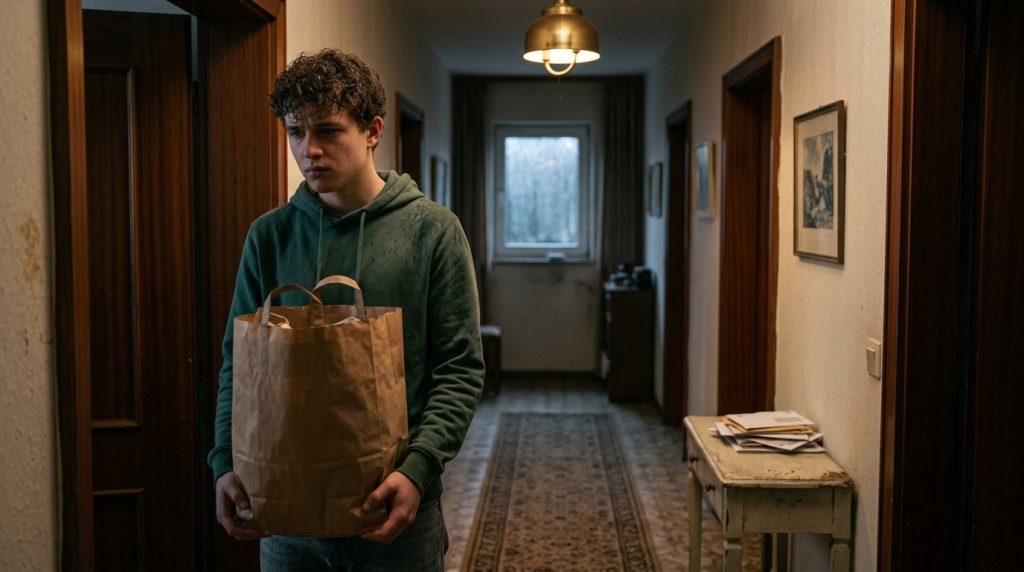
He looked at me.
Then at the stranger on our porch.
The bag lowered slowly in his hand.
“Who is this?”
Gavin took one step forward.
I moved between them.
But I could not stop what came next.
Gavin looked at the son he had never held and said, “My name is Gavin Rourke.”
Eli’s face became still.
He knew the name.
I had never lied about who his father was.
Gavin swallowed.
“I’m your dad.”
Eli studied him for a long moment.
Then he looked at the hospital bracelet.
“No,” my son said quietly. “You’re the man who left my mother.”
And he walked inside.
Gavin and I had not always been unhappy.
That was the part people found difficult to understand.
They wanted betrayal to arrive with warning signs. They wanted the villain to look cruel from the beginning so the person who trusted him would not appear foolish.
But Gavin had once been kind.
When we met, I was working at a bookstore in Sacramento while finishing a degree I could barely afford. Gavin came in every Thursday during his lunch break and bought books he admitted he rarely finished.
After three months, he confessed that he had only been returning to see me.
He made me laugh.
He remembered small things.
He carried an extra sweater in his car because I was always cold.
When my mother died unexpectedly, Gavin sat on my apartment floor until sunrise because I could not stand the thought of sleeping in an empty room.
I married him because I believed a man who could stay through grief would also stay through life.
For the first four years, we were happy.
Not perfect.
But happy.
Then Gavin accepted a position with Vale Development Group.
That was where he met Serena.
At first, she was only his boss’s daughter.
Then she became the name that appeared too often in his stories.
Serena thought this.
Serena suggested that.
Serena had invited the department to dinner.
Whenever I asked about her, Gavin smiled as though my concern amused him.
“She’s engaged, Mara.”
She wasn’t.
I learned that later.
The evening Gavin left began with a burned casserole.
I had been sick most of the afternoon. Eli had spent the day kicking beneath my ribs, and I was exhausted by the time Gavin came home.
He walked into the kitchen wearing the blue shirt I had bought him for our anniversary.
There was a suitcase in his hand.
For several seconds, I convinced myself it belonged to someone else.
“What’s that?”
He set it near the door.
“We need to talk.”
Those four words changed the temperature of the room.
I switched off the oven.
“Are you leaving for work?”
“No.”
“Then where are you going?”
Gavin looked at my stomach rather than my face.
“I can’t do this.”
“Do what?”
“This life.”
I waited for him to explain.
He didn’t.
“What are you talking about?”
“I’ve been trying to convince myself that I’m ready. I’m not.”
“The baby will be here in eight weeks.”
“I know.”
“You know?”
My voice rose.
“You know, and you packed a suitcase?”
Gavin rubbed both hands over his face.
“I feel trapped.”
The word entered me like broken glass.
Our marriage was a trap.
Our child was a trap.
I was a trap.
“Is there someone else?”
His silence answered me.
“Serena?”
“Mara—”
“Is it Serena?”
“Yes.”
The room moved beneath my feet.
I reached for the kitchen counter.
“How long?”
“It doesn’t matter.”
“It matters to me.”
“A few months.”
A few months.
While I chose names.
While we painted the nursery.
While Gavin rested his hand on my stomach and told our unborn child he could not wait to meet him.
“Does she know I’m pregnant?”
“Yes.”
“And she’s comfortable with this?”
“This isn’t about her.”
That was another lie.
It was entirely about her.
About the life Gavin imagined with money, connections and freedom from responsibility.
“I’m going to stay at a hotel tonight,” he said. “We can discuss everything when we’re calmer.”
“You’re not going to a hotel.”
He looked at me.
“You’re going to her.”
He picked up the suitcase.
I grabbed his wrist.
Not violently.
Desperately.
“Gavin, please. Whatever happened, we can fix it. We’re having a baby.”
“I don’t want this child to grow up watching us hate each other.”
“Then don’t leave.”
“I’ve made my decision.”
He pulled his arm away.
That was the last time my husband touched me.
The following morning, I learned he had withdrawn nearly all the money from our joint savings account.
He left me $312.
The rent was due in nine days.
My health insurance was connected to his job.
The crib had not been paid off.
I called him seventeen times that week.
He never answered.
When I called his office, I was told he had transferred to the company’s Colorado branch.
Serena had gone with him.
I gave birth to Eli six weeks later.
There was no dramatic emergency. No car accident. No stranger delivering the baby in a snowstorm.
There was only a long hospital night and an empty chair beside my bed.
My friend Denise held my hand while I pushed.
When the nurse placed Eli against my chest, he opened his eyes and stared at me as though I were the first safe thing he had ever known.
I made him a promise.
“I’m here,” I whispered. “I’m not going anywhere.”
For years, I kept that promise one exhausted day at a time.
I mailed Gavin a birth announcement.
It came back unopened.
When Eli was three months old, I sent photographs.
No reply.
When Eli was two, I filed for child support.
Gavin’s lawyers delayed the case, challenged the amount and claimed his income was unstable.
He eventually paid what the court required, but only after his wages were ordered to be withheld. Even then, payments arrived irregularly whenever he changed companies or reorganized his finances.
There were no notes attached.
No questions about Eli.
No request to visit.
When Eli was seven, he developed severe pneumonia.
For two nights, doctors could not promise me he would recover without complications.
I called Gavin’s office.
His assistant transferred me to him.
For the first time in years, I heard his voice.
“Gavin, it’s Mara.”
Silence.
“It’s Eli. He’s in the hospital.”
“What happened?”
For one foolish second, relief flooded through me.
“He has pneumonia. They’re watching his oxygen. I thought you should know.”
Another silence.
Then Gavin said, “I can’t get involved every time there’s an emergency.”
I stopped breathing.
“Your son may be seriously ill.”
“I have a family now.”
“So does Eli.”
“Mara, please don’t call this number again.”
The line went dead.
Eli recovered.
I did not call Gavin again.
Over the years, Eli asked questions.
Why didn’t Dad want me?
Did he ever hold me?
Do I look like him?
I told the truth in pieces appropriate for his age.
“Your father was afraid of responsibility.”
“His leaving was not your fault.”
“He made a choice that had nothing to do with your worth.”
I never called Gavin evil.
I did not need to.
Absence speaks clearly enough on its own.
After Gavin left our porch, Eli put the groceries away.
He did not ask me anything until every item was in its proper place.
That was how Eli handled pain.
He organized the world around it.
Finally, he sat at the kitchen table.
“So he’s sick.”
“Yes.”
“How sick?”
“He has leukemia. He may need a stem-cell transplant.”
“And he thinks I could be a match.”
“Yes.”
Eli stared at his hands.
I wanted to protect him.
For twenty years, protection had been my first instinct.
When he was five, protection meant checking beneath his bed for monsters.
When he was fourteen, it meant teaching him that cruelty from other people did not define him.
Now protection meant doing nothing while the man who abandoned us placed an impossible decision in front of him.
“You don’t owe him anything,” I said.
“I know.”
“You don’t have to meet him.”
“I know.”
“He may try to make you feel responsible for what happens.”
Eli looked up.
“Mom.”
I stopped.
“I need to think.”
That night, neither of us slept much.
The next morning, Eli found me drinking coffee on the back steps.
“I want to meet him,” he said.
I closed my eyes.
“Why?”
“Because I’ve wondered about him my entire life.”
“He didn’t come for the right reason.”
“I know.”
“He may lie.”
“Then I want to hear the lies myself.”
There was no anger in his voice.
That worried me.
Anger can defend you.
Curiosity leaves the door open.
“I’ll be there,” I said.
“No.”
“Eli—”
“I need to meet him without you.”
I stood.
“I don’t trust him.”
“Neither do I.”
“Then why would you go alone?”
“Because every time I look at him, I’ll also be looking at what he did to you. I need to figure out what I feel without trying to protect you.”
His words hurt because they were fair.
I had raised a thoughtful man.
Now I had to trust the man I raised.
Eli met Gavin at a coffee shop two days later.
He was gone for nearly three hours.
I cleaned the kitchen twice while waiting.
When he returned, his expression gave nothing away.
“How was it?”
“Strange.”
“What did he say?”
“He said he was sorry.”
I waited.
“He said he was young and overwhelmed. He said he thought you would be better off without him.”
“That is not what happened.”
“I know.”
“How?”
“Because he also said he tried to contact me.”
I felt my jaw tighten.
“He said what?”
“He claimed he sent letters and called several times, but you wanted him out of our lives.”
The old rage returned so quickly that I nearly dropped my coffee mug.
“That is a lie.”
“I thought it might be.”
I went to the closet in my bedroom and removed a plastic storage box.
I had not opened it in years.
Inside were court records, returned letters, hospital bills and copies of emails I had sent to addresses connected to Gavin.
I had kept them because someday I feared Eli might believe I had prevented a relationship between them.
I placed the box on the table.
“Your father had every opportunity to know you.”
Eli read silently.
He saw the returned birth announcement.
The child-support documents.
The letter I sent after his pneumonia.
Across the top, in Gavin’s handwriting, were six words:
DO NOT CONTACT ME ABOUT THIS AGAIN.
Eli ran one finger across the sentence.
“He wrote this?”
“Yes.”
His face changed.
Not dramatically.
A small part of him simply closed.
“Why didn’t you show me before?”
“Because I didn’t want your childhood filled with evidence that someone rejected you.”
“I thought maybe he had one good reason.”
“I’m sorry.”
“You don’t have to apologize.”
He placed the letter back in the box.
“Did you agree to be tested?” I asked.
“Not yet.”
“What does he want?”
“He says the doctors can explain everything. Testing doesn’t commit me to donating.”
“That’s true.”
“He also told me about Miles.”
“The other son.”
Eli nodded.
“He said Miles tried, but he wasn’t compatible enough.”
I hated how naturally Gavin had brought one son into the conversation with the other.
One raised inside a comfortable home.
One located only after the first could not provide what Gavin needed.
“What are you thinking?” I asked.
Eli looked toward the window.
“I’m thinking I don’t want him to die because I was too afraid to learn whether I could help.”
“That isn’t the same as owing him.”
“I know.”
“Being tested may create pressure.”
“I know that too.”
I reached across the table.
His hand was warm beneath mine.
“I will support whatever decision you make.”
“Even if I help him?”
“Yes.”
“Even after everything he did?”
“This is your body and your decision. I will never treat you the way he treated us.”
Eli squeezed my hand.
“I’m going to get tested.”
I nodded.
Then I went into the bathroom, locked the door and cried where my son could not hear me.
The hospital required Eli to meet with an independent donor counselor before testing.
The counselor made it clear that he could withdraw at any stage and that Gavin’s medical team was not entitled to pressure him.
I was grateful for that.
Gavin seemed less grateful.
The morning of the first appointment, he arrived wearing an expensive coat and carrying a coffee for Eli.
“You still drink it black?” he asked.
Eli glanced at the cup.
“I never told you how I drink coffee.”
Gavin’s smile disappeared.
“I must have assumed.”
He had begun doing that often.
Pretending to remember things he had never learned.
He called Eli “son” during conversations.
He spoke about lost time as though weather or distance had stolen it from him.
He sent photographs of himself at twenty-seven, trying to show Eli their physical similarities.
The more Gavin attempted to manufacture closeness, the more distant Eli became.
After the appointment, a woman was waiting in the lobby.
I recognized Serena immediately.
She was older than the photographs, but still elegant. Her blond hair was pulled into a low knot, and her coat probably cost more than my first car.
Beside her stood a thin teenage boy.
Miles.
He had Gavin’s eyes.
Serena approached cautiously.
“You must be Mara.”
I had imagined this meeting many times when I was younger.
In some versions, I screamed.
In others, Serena apologized while I delivered a perfect speech about everything she had taken from me.
But standing there twenty years later, I felt mostly tired.
“Yes.”
She glanced at Eli.
“And you’re Eli.”
Eli did not respond.
Gavin appeared from the corridor.
His face drained when he saw them.
“Serena, what are you doing here?”
“You stopped answering your phone.”
“I was in an appointment.”
“You said you were meeting a possible donor.”
Miles looked from Gavin to Eli.
The resemblance between the two young men was not obvious at first, but it was there around the mouth and eyes.
Serena followed his gaze.
Understanding entered her expression slowly.
“This is him,” she said.
Gavin lowered his voice.
“We should discuss this privately.”
Miles stepped forward.
“Discuss what?”
Nobody answered.
He looked at Eli.
“Who are you?”
Eli’s voice remained calm.
“I’m Gavin’s son.”
The lobby became silent.
Miles turned toward his father.
“You said you didn’t know where he was.”
Gavin’s eyes flashed toward me.
There it was.
The instinct to blame me before the lie had even finished collapsing.
“This is complicated.”
“No,” I said. “It isn’t.”
Serena stared at me.
“For years, Gavin told us you disappeared after the divorce.”
“I lived in the same city for eleven years.”
“He said you refused contact.”
I opened my purse.
I had brought copies of the documents, anticipating another lie.
I handed Serena the letter Gavin had returned after Eli’s illness.
She read the sentence written across the top.
Her fingers began to shake.
Gavin reached for the paper.
“Serena, that was a long time ago.”
She pulled it away.
“You told me she changed her number.”
“She did eventually.”
“After you told her not to contact you,” Eli said.
Miles looked at his father as though seeing a stranger.
“You knew where he was?”
Gavin’s voice sharpened.
“This is not the place.”
“Was he the reason you left?”
Miles asked the question without looking at me.
Gavin hesitated.
“No.”
“Yes,” I said.
Serena’s face turned toward mine.
I continued before fear could stop me.
“I was seven months pregnant when your father moved to Colorado with Serena.”
Miles looked sick.
Serena closed her eyes.
“I didn’t know she was seven months pregnant,” she whispered.
“You knew I was pregnant.”
“He told me the baby might not be his.”
Eli laughed once.
There was no humor in it.
“Of course he did.”
Gavin stepped between us.
“Everyone is emotional. This situation is about my treatment.”
“No,” Eli said. “It’s about your life. You’ve made that very clear.”
He walked toward the exit.
Miles followed him.
“Wait.”
Eli stopped.
Miles shoved both hands into his jacket pockets.
“I didn’t know.”
“I know.”
“Can we talk sometime?”
Gavin looked alarmed.
“Miles, this is not necessary.”
His son ignored him.
Eli considered the request.
Then he took out his phone.
The two brothers exchanged numbers while their father watched.
That was the first consequence Gavin had not anticipated.
He had come searching for a donor.
Instead, the sons he had kept separated found each other.
A week later, the hospital called Eli.
He was a strong potential match.
When he told me, he sat on the edge of my bed like a child waking from a nightmare.
“I thought I would feel relieved,” he said.
“But you don’t.”
“It feels more real now.”
“You can still say no.”
“I know.”
Gavin called within fifteen minutes of receiving the news.
Eli put the phone on speaker.
“This is incredible,” Gavin said. “The doctor says the results are very encouraging.”
“Testing isn’t consent,” Eli replied.
“Of course. I understand that.”
But Gavin’s voice was already lighter.
He spoke as though the decision had been made.
“We should have dinner. All of us. I want to start rebuilding properly.”
“Why now?”
“Because life is short.”
“It was also short when I was seven.”
Gavin became quiet.
Eli continued.
“Mom called you when I was in the hospital.”
“I handled that badly.”
“You told her you had a family.”
“I regret it every day.”
“That’s another lie.”
“Eli—”
“You didn’t regret it yesterday. You only regret it now because you need something.”
Gavin inhaled sharply.
“I’m trying.”
“No. You’re performing.”
The call ended shortly afterward.
I expected Eli to withdraw from the process.
He did not.
He attended every medical consultation.
He learned about the injections, the possible side effects and the collection procedure.
The donor counselor repeatedly asked whether he felt pressured.
Eli always answered honestly.
“Yes,” he said once. “But not by the hospital.”
During those weeks, he also began meeting Miles.
At first, they only exchanged messages.
Then they met at a burger restaurant.
A week later, Miles came to our house.
He was polite and nervous.
He removed his shoes without being asked and carried a bag containing expensive pastries Serena had purchased.
For several minutes, he stood in our living room examining photographs of Eli growing up.
Eli in a Halloween costume at five.
Eli holding a science-fair ribbon.
Eli beside me at his high school graduation.
Miles stopped in front of one photograph.
It showed Eli at age nine, sitting on my shoulders during a community parade.
“Dad told me he hated crowds,” Miles said.
“He does,” I replied.
“Then he probably would have hated this.”
“Probably.”
Miles looked at me.
“I’m sorry.”
“You didn’t do anything.”
“I had him.”
The words were so quiet that I nearly missed them.
“I had a dad while Eli didn’t.”
I walked closer.
“That was not something you took from him. It was something Gavin refused to give.”
Miles nodded, though guilt remained in his eyes.
He told us that Gavin had been a present father to him.
He attended soccer games.
He taught Miles to drive.
He stayed up all night helping him build a model bridge for school.
Each story hurt Eli, but he listened.
That was the cruelty of abandonment.
It did not only make a child miss what never existed.
It forced him to see proof that his father had been capable of love all along.
He had simply spent it elsewhere.
One evening after Miles left, I found Eli sitting alone on the porch.
“He sounds like a good father,” Eli said.
“To Miles, perhaps.”
“That almost makes it worse.”
“I know.”
“Had he been terrible to everyone, I could believe he was broken.”
I sat beside him.
“But he chose.”
“Yes.”
Eli leaned forward, his elbows resting on his knees.
“I think I’m still going to donate.”
I turned toward him.
“Why?”
“Not because he deserves it.”
“Then why?”
“Because Miles loves him.”
I said nothing.
“If Gavin dies,” Eli continued, “Miles loses his father. I know what growing up without one feels like. I don’t want to choose that for him.”
Tears filled my eyes.
The son Gavin had abandoned was considering saving him for the sake of the son Gavin had raised.
That was not weakness.
It was a kind of strength Gavin would never understand.
“Promise me one thing,” I said.
“What?”
“Do not confuse compassion with reconciliation.”
“I won’t.”
“And do not let anyone call your body a family obligation.”
“I promise.”
He rested his head against my shoulder.
For one brief moment, he was my little boy again.
Three weeks before the scheduled collection, Gavin’s company released an online statement.
Miles sent the link to Eli.
The headline read:
LOCAL DEVELOPER REUNITES WITH LONG-LOST SON DURING CANCER BATTLE.
Beneath it was a photograph of Gavin leaving the hospital with Eli.
Neither Eli nor I knew the photograph had been taken.
The statement described “a painful family separation caused by circumstances beyond anyone’s control.”
It said Gavin had spent years hoping to reconnect.
It praised the “healing power of family.”
Near the bottom, it mentioned that Eli was being evaluated as a possible donor.
My son’s private medical decision had become part of Gavin’s public-relations campaign.
Eli read the article twice.
Then he called Gavin.
“Take it down.”
Gavin sounded confused.
“What?”
“The article.”
“It came from the foundation team. I didn’t write it.”
“Your name is attached to it.”
“It’s raising awareness for the donor registry.”
“It says you searched for me.”
“I did eventually.”
“It says our separation was beyond your control.”
“That language was chosen to protect everyone.”
“Protect you.”
“Eli, people don’t need the ugly details.”
“The ugly details are the truth.”
Gavin lowered his voice.
“You don’t understand how public perception works.”
“I understand exactly how it works. You’re using me to make yourself look like a loving father.”
“That is not what this is.”
“Then correct it.”
“We can revise a few lines.”
“Tell them you left my mother while she was pregnant.”
“That’s personal.”
“You made my donation public.”
“I never named the procedure.”
“You named me.”
Gavin became impatient.
“I’m trying to turn something painful into something positive.”
“You’re trying to erase what you did.”
“Do you want me to die apologizing?”
The question landed exactly as Gavin intended.
It turned truth into cruelty.
It made Eli’s boundary sound like a death sentence.
I reached for the phone, but Eli moved away.
“No,” he said. “I want you to live honestly.”
“I am fighting for my life.”
“And I’m the one you expect to risk my health.”
“The doctors said the risks are limited.”
“That doesn’t give you ownership of me.”
Gavin exhaled.
“You sound like your mother.”
“Good.”
Eli ended the call.
Later that night, Miles came over.
His face was pale.
“I need to show you something.”
He handed Eli his phone.
There was a message chain between Miles and Gavin from several days earlier.
Miles had asked whether Eli would be included in the family after the transplant.
Gavin’s response read:
LET’S KEEP THE DONOR SITUATION SEPARATE FROM FAMILY MATTERS. ONCE THE PROCEDURE IS OVER, WE CAN DECIDE WHAT LEVEL OF CONTACT IS APPROPRIATE.
Another message followed.
YOUR MOTHER IS ALREADY UNCOMFORTABLE. DO NOT MAKE PROMISES TO HIM.
Eli read the messages silently.
Miles looked ashamed.
“I didn’t know whether to show you.”
“You did the right thing.”
“He keeps calling you my brother in public.”
“But not in private.”
Miles sat at our kitchen table.
“He said the article would help the company. Investors have been nervous because he’s sick.”
Everything became clear.
The touching reunion.
The photographs.
The language about healing.
Gavin was not only searching for a donor.
He was using Eli to protect his business and reputation.
My son had become a medical resource and a public-relations opportunity.
“Serena knows about the article?” I asked.
Miles nodded.
“She told him not to publish it.”
That surprised me.
“Why?”
“She said Eli hadn’t agreed to be part of it.”
For the first time, I understood that Serena was not fully standing beside Gavin anymore.
His lies had begun costing him the people he had once chosen over us.
The next morning, the article disappeared.
But screenshots had already spread.
The damage remained.
So did the words Gavin had written privately.
The donor situation.
Not his son.
Not Eli.
The donor.
Eli requested a meeting at the hospital.
Gavin arrived with his attorney.
That told us everything.
I sat beside Eli. The donor counselor was present, along with a member of Gavin’s medical team.
Serena came alone and sat at the opposite end of the room.
Miles waited outside.
Gavin looked weaker than he had several weeks earlier.
For a moment, I felt sorry for him.
Then his lawyer opened a folder.
“We’d like to clarify the misunderstandings surrounding the public statement.”
Eli looked at Gavin.
“Why is he talking?”
“My attorney is here to protect everyone involved.”
“I’m not signing anything.”
“No one is asking you to.”
The attorney removed a document.
“This is simply a confidentiality agreement concerning private family and medical information.”
Eli stared at him.
“You want me to keep quiet.”
“It protects your privacy as well.”
“My privacy was already published online.”
“That was an unfortunate communication error.”
Eli turned to Gavin.
“Tell him to leave.”
Gavin hesitated.
“Eli, this is standard.”
“Then the meeting is over.”
He stood.
Gavin raised one hand.
“Wait.”
The attorney left after Gavin whispered something to him.
When the door closed, Eli sat again.
“I have two conditions before I continue,” he said.
Gavin’s face hardened.
“What conditions?”
“First, you correct the public statement. You say there were no circumstances beyond your control. You left before I was born and chose not to have contact.”
Gavin shook his head.
“That would create unnecessary damage.”
“To whom?”
“My company employs hundreds of people.”
“This isn’t about them.”
“My reputation affects more than me.”
Eli nodded slowly.
“That’s why you published the story.”
“I didn’t approve every word.”
“But you approved the lie.”
Gavin looked toward Serena.
She did not defend him.
“What is the second condition?” he asked.
“You tell Miles the full truth.”
“He already knows enough.”
“No. You tell him you knew where I was. You tell him Mom didn’t keep me away. You tell him you called me a donor and planned to decide later whether I belonged in your family.”
Gavin’s face reddened.
“You are trying to humiliate me.”
“I’m asking you to stop lying.”
“I came here to save my life, not participate in some punishment designed by your mother.”
My chair scraped backward.
Eli placed a hand on my arm.
He did not need me to defend him.
“This is my decision,” he said. “Not hers.”
Gavin leaned forward.
“I made terrible choices. I admit that. But you are holding a dying man to words he wrote while under extraordinary stress.”
“You wrote them last week.”
“I was trying to protect my marriage.”
“By using me.”
“By preventing more damage.”
Eli’s voice remained quiet.
“I’m not the damage.”
Nobody spoke.
Serena turned her face away.
Gavin’s eyes filled with tears.
“Please.”
It was the first honest word he had spoken.
Not because it contained regret.
Because it contained fear.
Eli looked at him for a long time.
“I was willing to help you,” he said. “Not because you were my father. Because Miles loves you.”
Gavin glanced toward the door.
“I was willing to go through the injections and the procedure because I didn’t want my brother to lose someone he loves.”
“You can still do that.”
“No.”
The room became still.
Gavin gripped the edge of the table.
“What do you mean?”
“I’m withdrawing.”
“Mara.”
He said my name as though I had done this.
I shook my head.
“This is Eli’s choice.”
“You poisoned him against me.”
Eli stood.
“She spent twenty years protecting me from the truth about you. You poisoned yourself.”
Gavin’s breathing became shallow.
“You would let me die over an article?”
“No. I am refusing to give part of my body to a man who still doesn’t see me as a person.”
“I am your father.”
“You are biologically related to me.”
“Eli, please.”
“You had twenty years to become my father.”
Gavin looked toward the doctor.
“There must be something you can do.”
The donor counselor answered firmly.
“Donation must be voluntary. Eli has withdrawn consent. That decision is final unless he independently chooses otherwise.”
Gavin began crying.
Not quietly.
Not gracefully.
He covered his face with both hands.
For a second, I saw the young man I had once loved.
Then I remembered myself standing in our kitchen, seven months pregnant, begging him not to leave.
I remembered the suitcase.
The empty bank account.
The unopened birth announcement.
The words written across my letter.
DO NOT CONTACT ME ABOUT THIS AGAIN.
Gavin lowered his hands.
“You’ll regret this,” he told Eli.
My son looked at him with heartbreaking calm.
“No. You will.”
Eli walked out of the room.
I followed him.
Miles was waiting in the hallway.
He looked at his brother’s face and understood.
“You said no.”
“Yes.”
Miles nodded.
Then he hugged Eli.
Gavin could be heard arguing inside the conference room.
The two sons stood together while the father who had divided them discovered that neither belonged to him.
Gavin’s doctors found another donor four months later.
The match was not as strong as Eli’s, but the transplant went forward.
Gavin survived.
I was glad.
Not for him.
For Eli.
My son would never have to wonder whether his decision had killed someone.
Recovery was difficult, but Gavin eventually returned home.
The home was no longer the same.
Serena moved out before the transplant.
She did not leave because she suddenly became innocent. She had known enough twenty years earlier to understand that another woman was being hurt.
But the full truth forced her to confront the marriage she had built.
Gavin had lied about my pregnancy.
He had lied about searching for Eli.
He had lied to Miles.
Then, while asking my son to save him, he had planned to discard him again when the procedure was finished.
Serena filed for separation.
Miles went with her.
He continued visiting us.
Over the following year, he and Eli became close.
They attended basketball games, argued over music and discovered they both hated olives.
Miles began calling me when he needed advice.
The first time he did, he apologized afterward.
“I know you’re not my mother.”
“No,” I said. “But you’re always welcome to call.”
Gavin’s company removed the reunion story from every page it controlled.
When journalists questioned the accuracy of the original statement, the company described it as an internal error.
Gavin stepped away from his public role during recovery.
His name disappeared from charity events and business profiles.
The image he had spent twenty years protecting cracked under the weight of one truth he refused to tell.
He wrote Eli several letters.
Eli returned the first two unopened.
He read the third.
I never asked what it said.
One evening, I found the letter torn into small pieces in the kitchen trash.
“Was it an apology?” I asked.
“He said he forgave me.”
I stared at him.
“For not donating?”
“For turning Miles and Serena against him.”
Eli shook his head.
“He still thinks losing them was something I did.”
“Some people would rather lose everyone than admit they were wrong.”
“He said he wants another chance.”
“What do you want?”
Eli considered the question.
“I don’t hate him.”
“That’s good.”
“But I don’t want him in my life.”
“That’s also okay.”
He looked at me.
“Do you think that makes me cruel?”
“No.”
“Even though he almost died?”
“You are not required to surrender your peace because someone else finally experienced consequences.”
Eli folded his arms across his chest.
“I used to imagine meeting him.”
“What did you imagine?”
“Different things. Sometimes he would apologize. Sometimes he would have a good explanation.”
He smiled sadly.
“Sometimes he didn’t know I existed.”
“I’m sorry.”
“I’m not.”
That surprised me.
“Why?”
“Because wondering about him made him seem bigger than he was. Now I know.”
“Know what?”
“He’s just a man who kept choosing himself.”
A year after Gavin came to our door, Eli graduated from college.
Miles attended the ceremony.
So did Denise, the friend who had held my hand during Eli’s birth.
When Eli’s name was called, we stood and cheered so loudly that people turned toward us.
He walked across the stage, accepted his diploma and searched the crowd until he found me.
For one moment, the room disappeared.
I saw the newborn who had opened his eyes against my chest.
The little boy asking why his father never called.
The teenager pretending Father’s Day did not bother him.
The young man who had been asked to risk his body for someone who had never protected his heart.
After the ceremony, we took photographs beneath a row of oak trees.
Miles stood beside Eli.
Denise hugged both of them.
As we walked toward the parking lot, Eli slipped his arm around my shoulders.
“Do you ever wish things had happened differently?” he asked.
“Sometimes.”
“Do you wish he stayed?”
I thought about the life Gavin might have given us.
Then I thought about the life we had built without him.
“I wish you never had to feel unwanted,” I said. “But I have never wished for a different son.”
Eli stopped walking.
“He didn’t lose me when I refused to donate.”
“No?”
“He lost me the night he left you alone.”
My eyes filled with tears.
Eli pulled me into his arms.
For twenty years, I had believed I had raised a fatherless child.
But standing there with my son holding me, I finally understood the truth.
Eli had never lacked a family.
Family was Denise sleeping in a hospital chair beside me.
Family was Miles choosing honesty over loyalty to a lie.
Family was every teacher, neighbor and friend who showed up when Gavin did not.
And family was the promise I made the first night I held my baby.
I’m here.
I’m not going anywhere.
Gavin had spent his entire life believing family was something blood entitled him to claim.
He learned too late that blood might make someone a possible match.
It could not make him a father.
A father was the person who stayed.
And Gavin Rourke had walked away.
END