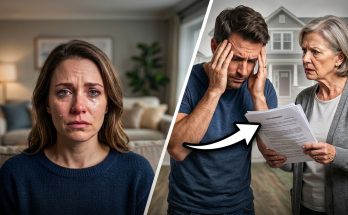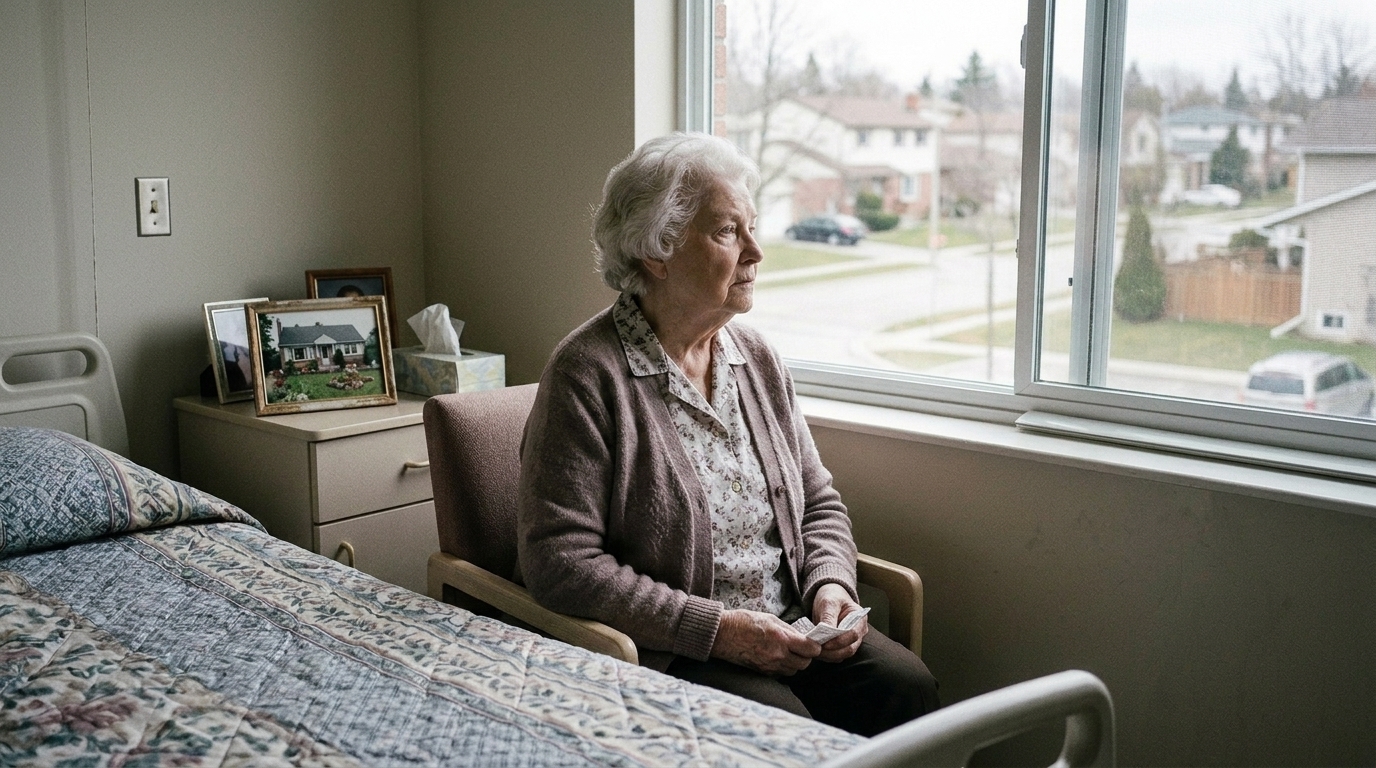
The first person to tell me my house had been sold was not my son.
It was a nurse named Tessa, who stood in the doorway of my room holding a small cardboard box.
“Mrs. Hale,” she said carefully, “your family asked us to pack the rest of your personal things.”
I looked at the box.
Inside were three blouses, my reading glasses, and the framed photograph that had sat beside my bed for twenty-two years.
My husband, Richard, was standing behind me in the picture with both hands resting on my shoulders. We were smiling in front of our house on Hawthorne Lane.
The house where we raised our son.
The house where Richard died.
The house I had planned to return to as soon as my hip was strong enough.
“What do you mean, the rest of my things?” I asked.
Tessa hesitated.
I could tell from her face that she knew something I did not.
“Your son said you’ll be staying here permanently.”
I stared at her.
“No, he didn’t.”
“He completed the long-term residency forms yesterday.”
My hand tightened around the edge of the blanket.
“There must be a mistake.”
Tessa placed the box on the chair.
“I’m sorry, Mrs. Hale.”
I reached for the telephone beside my bed.
It had been disconnected.
That was when fear entered the room.
Not confusion.
Not sadness.
Fear.
“Where is my phone?”
“Your son took it last week.”
“He said it was being repaired.”
Tessa lowered her voice.
“There was also a call from a real estate company this morning. They wanted to know whether anyone here had a forwarding address for you.”
The room seemed to tilt.
“What real estate company?”
“They said the property on Hawthorne Lane closed yesterday.”
For several seconds, I could hear nothing except the air conditioner humming above the window.
Then I asked the only question that mattered.
“Who sold my house?”
Tessa looked at me with pity.
“Your son did.”
My son, Daniel, had placed me in a nursing home, told everyone I was losing my mind, and sold the house his father and I had spent forty years building.
He believed the money would be transferred into his account by Friday.
What Daniel did not know was that the house had never belonged to him.
Legally, it did not even belong to me.
And somewhere in Columbus, a woman he had never met had already received an alert that someone was trying to steal it.

My husband Richard used to say that Daniel had two kinds of smiles.
There was the smile he gave when he loved you.
And there was the smile he gave when he needed something.
For most of my life, I pretended I could not tell the difference.
Daniel was our only child. He had Richard’s dark hair, my brown eyes, and the kind of charm that made strangers forgive him before he had even done anything wrong.
As a boy, he could break a neighbor’s window and somehow leave with a plate of cookies.
As an adult, that charm became more expensive.
There was the restaurant he opened at twenty-eight, which failed after eighteen months.
The fitness franchise he bought at thirty-four.
The real estate course that promised to make him financially independent.
Each time something collapsed, Daniel arrived at our kitchen table with plans, apologies, and reasons none of it had truly been his fault.
Richard stopped lending him money.
I did not.
“You aren’t helping him,” Richard told me once. “You’re teaching him that someone else will always absorb the damage.”
“He’s our son.”
“He’s forty-one, Margaret.”
That conversation happened six years before Richard died.
Daniel had forged Richard’s signature as a guarantor on a business loan.
He claimed it had been a misunderstanding.
Richard called it fraud.
For almost a year, father and son barely spoke.
I was the one who pushed them back together. I told Richard that losing Daniel would hurt us more than the money.
Richard eventually agreed to let him return for holidays, but something between them never healed.
Then Richard developed pancreatic cancer.
He was gone nine months after the diagnosis.
The morning after his funeral, Daniel sat beside me on the living room couch and held my hand.
“You’re not alone, Mom,” he said. “I’m going to take care of you.”
At the time, I believed him.
Two years later, I slipped on the back steps and fractured my hip.
The surgeon said the operation went well, but I would need physical rehabilitation before I could safely live alone.
Daniel found a place called Cedar Grove.
“It’s not a nursing home,” he told me. “It’s a rehabilitation center. Four weeks, maybe six.”
His wife, Vanessa, brought me a brochure filled with photographs of smiling silver-haired couples playing cards.
“You’ll have your own room,” she said. “There’s a garden and a salon.”
“I don’t need a salon.”
“It was just an example.”
Daniel completed most of the paperwork because I was taking pain medication and could not focus for long.
Whenever a nurse brought me a form, he leaned over and pointed to the signature line.
“This one allows them to speak to me about your treatment.”
“This one lets me handle the insurance company.”
“This one is just in case the pharmacy needs approval.”
I signed some of them.
I refused others.
At least, I believed I had.
The first two weeks at Cedar Grove were exactly what Daniel had promised.
Physical therapy every morning.
Lunch in the dining room.
Daniel visited nearly every day.
Then the visits became shorter.
He began taking things from my purse.
My checkbook disappeared first.
Then my insurance card.
Then my house keys.
“I need them so I can check the furnace,” he said.
When I asked for them back, he laughed.
“You’re not exactly going anywhere, Mom.”
The words bothered me, but his tone was playful.
I told myself not to be sensitive.
A few days later, I asked him to drive me past the house.
“I want to see the garden.”
“We don’t have time today.”
“Tomorrow, then.”
“Maybe.”
Tomorrow became the following week.
Then Daniel told me repairs were being done.
“What repairs?”
“The roof.”
“There is nothing wrong with the roof.”
“There was storm damage.”
“What storm?”
He sighed as though I were the difficult one.
“Mom, this is why I’m handling things. You need to focus on getting better.”
The next morning, a doctor I had never met entered my room and asked me what year it was.
I answered correctly.
He asked who the president was.
I answered correctly.
He gave me three words to remember and asked me to repeat them five minutes later.
I remembered two.
I was tired, medicated, and angry.
Daniel later told the staff that I had been showing signs of dementia for months.
That was a lie.
But once the word dementia entered my file, everything changed.
Staff began explaining simple things to me twice.
They stopped allowing me to leave the building without Daniel’s permission.
When I asked to see my medical records, I was told my designated representative would need to approve the request.
My designated representative was Daniel.
The same son who kept promising I would go home soon.
After Tessa told me about the sale, I asked her to close the door.
She did.
“Do you have a cellphone?” I asked.
Her eyes widened.
“Residents aren’t supposed to use staff phones.”
“I am not asking as a resident.”
I pulled myself upright.
“I am asking as a woman whose property may have been stolen.”
Tessa looked toward the hallway.
Then she removed her phone from her pocket.
“You have five minutes.”
The first person I called was my neighbor, Helen Cooper.
Helen and I had lived across from each other for thirty-one years. She answered on the fourth ring.
“Hello?”
“Helen, it’s Margaret.”
There was silence.
“Margaret?”
“Yes.”
“Oh, thank God.”
My stomach dropped.
“What happened?”
“I’ve been trying to reach you for over a week. Daniel said you weren’t accepting calls.”
“That’s not true.”
Helen’s voice changed.
“Margaret, there’s a sold sign in your yard.”
I closed my eyes.
“When did it appear?”
“Two days ago. Before that, there were people walking through the house. I asked Daniel what was happening, and he told me you had decided to move permanently.”
“I decided no such thing.”
“I knew it.”
“Who bought it?”
“I don’t know. A company, I think. Yesterday, a truck took furniture from the garage.”
My breathing became shallow.
“What furniture?”
“Richard’s workbench. The red tool cabinets. Some boxes.”
The workbench had belonged to Richard’s father.
Daniel knew I wanted our granddaughter, Sophie, to have it one day.
“Tessa,” I whispered, covering the phone. “I need a pen.”
She handed me one.
Helen read the name and number from the real estate sign.
The listing agent was a man named Nolan Briggs.
I recognized the name immediately.
Nolan had attended Daniel and Vanessa’s Christmas party the year before. He bought distressed houses, renovated them cheaply, and resold them.
Daniel had once described him as someone who could “make paperwork flexible.”
I called Nolan’s office.
A receptionist answered.
“My name is Margaret Hale,” I said. “I am the owner of 418 Hawthorne Lane.”
The woman became quiet.
“One moment, please.”
A man came onto the line.
“This is Nolan Briggs.”
“You sold my house.”
“Mrs. Hale?”
“Yes.”
Another pause.
“I was told you were residing in long-term care.”
“That has nothing to do with my house.”
“Your son acted under a valid power of attorney.”
“I never authorized a sale.”
“Mrs. Hale, the closing documents were properly executed.”
“By whom?”
“Your legal representative.”
“You mean Daniel.”
“Yes.”
“For how much?”
Nolan hesitated.
“Financial information should be discussed with your attorney.”
“How much?”
“Three hundred and eighty thousand.”
My house was worth at least five hundred and twenty.
Daniel had sold it to one of his friends for far below its value.
“Who received the money?”
“The closing company is processing the disbursement.”
“So it has not been released?”
“I can’t discuss that.”
That answer told me everything.
The money was still somewhere between the buyer and Daniel.
I had very little time.
“Listen carefully,” I said. “That sale is fraudulent. I did not sign a deed, and I did not authorize my son to sell anything.”
“Mrs. Hale, with respect, your son informed us that your cognitive condition sometimes causes you to forget decisions.”
I felt something cold settle inside me.
It was not panic anymore.
It was anger.
Clear, steady anger.
“My memory is good enough to remember your name, Mr. Briggs.”
I ended the call.
Tessa took the phone.
“What are you going to do?”
“I need to contact an attorney.”
“Do you have one?”
Richard and I had used the same attorney for nearly twenty years, a man named Samuel Greer.
But Samuel had retired, and the office number I remembered had been disconnected.
Then I remembered a letter.
Six years earlier, after Daniel forged the loan guarantee, Richard had spent several weeks meeting privately with Samuel.
One evening, Richard placed a sealed envelope in my sewing cabinet.
“If anything happens to me,” he said, “this is important.”
After his death, I opened it.
Inside was a summary of a property trust.
At the time, I had been too consumed by grief to understand every page.
Samuel explained that I would always have the right to live in the house, but certain legal protections had been placed around it.
I remembered asking why.
“Because Richard wanted to make sure no one could pressure you into selling it.”
I had been offended.
I told Samuel that Daniel would never do that.
Samuel looked at me for a long time before saying, “Then the protection will never be needed.”
The original documents were not in my house.
They were held by an independent trustee.
A woman named Grace Mercer.
I had met her once, briefly, after Richard’s funeral.
I did not know where she worked.
But I remembered the company name printed on the bottom of her card.
Mercer Fiduciary Services.
Tessa searched the name on her phone.
The office was in Columbus.
She dialed the number and placed the phone on speaker.
A receptionist answered.
“I need to speak with Grace Mercer,” I said. “My name is Margaret Hale.”
The receptionist put me on hold.
Less than thirty seconds later, a woman answered.
“Margaret?”
“Yes.”
“I’ve been trying to reach you.”
My grip tightened around the pen.
“Why?”
“Because three days ago, I received an automated notice that someone had recorded a deed against the Hawthorne Lane property.”
“You knew?”
“I knew someone was trying. I did not know whether you were safe.”
“My son sold the house.”
Grace’s voice became firm.
“No, Margaret. He attempted to sell it.”
“He had a power of attorney.”
“A power of attorney does not give Daniel the authority to transfer trust property.”
“Then the sale is invalid?”
“Yes.”
Relief hit me so quickly that I almost cried.
But Grace had not finished.
“The deed is invalid,” she said. “The other documents may also be forged. However, the closing company is scheduled to release the funds tomorrow morning.”
“Can you stop them?”
“I can.”
There was a brief pause.
“But before I do, I need to ask you something difficult.”
“What?”
“Do you want me only to stop the sale?”
I looked at Richard’s photograph inside the cardboard box.
“What is the alternative?”
“We let Daniel believe the transaction is proceeding while investigators document exactly what he has done.”
Grace arrived at Cedar Grove that afternoon.
She was younger than I remembered, perhaps forty-five, with short dark hair and a gray suit. Beside her was a woman named Detective Laura Ruiz from the county’s financial crimes unit.
The facility director refused to let them see me.
“My son controls my visitors,” I explained through the partly opened door.
Grace’s expression hardened.
“No, he does not.”
Within twenty minutes, Cedar Grove’s director changed her mind.
Grace had brought a certified copy of the trust, along with documentation showing she was my fiduciary advocate regarding the property.
Detective Ruiz asked the director whether there was a court order declaring me incompetent.
There was not.
Whether Daniel had been appointed my guardian.
He had not.
Whether a physician had determined I could not make personal decisions.
Again, no.
The director began blaming “miscommunication.”
Ruiz wrote down every word.
When we were finally alone, Grace placed a folder on the table.
“Richard created the trust after Daniel forged his signature.”
I looked down at the first page.
THE HALE RESIDENCE PROTECTION TRUST.
“Why didn’t Richard explain all of this to me?”
“He tried.”
“I would remember.”
Grace did not argue.
Instead, she opened a letter.
It was written in Richard’s handwriting.
Margaret,
I know you believe Daniel will change. I hope you are right. But hope is not a legal plan.
My throat tightened.
Grace continued explaining.
Richard had transferred the house into an irrevocable residence trust.
I was its lifetime beneficiary. I could live there for the rest of my life.
The house could be sold if I genuinely wished to move, but only with the trustee’s approval and an independent confirmation that I was acting voluntarily.
Daniel had no authority over it.
Even after my death, he would not receive the property directly.
The remaining value would pass into a separate trust for Sophie, his daughter.
Daniel had not spoken to Sophie in nearly three years.
She had stopped answering his calls after he opened a credit card using her information.
I had known they were estranged.
I had not known why.
“He stole from his own daughter?” I asked.
Grace looked at me carefully.
“Sophie believed you knew.”
I felt ashamed.
Daniel had told me Sophie was being dramatic. He said the account had been opened by mistake during a loan application.
Once again, I had accepted the version that allowed me to keep loving him without asking harder questions.
Detective Ruiz spread several documents across the table.
The first was a durable power of attorney carrying my signature.
I stared at it.
“That looks like mine.”
“Did you sign it?”
“I don’t know.”
The admission frightened me.
Ruiz pointed to the date.
It had supposedly been signed six days after my surgery.
I remembered that day.
Daniel had visited while I was heavily medicated.
He gave me a tablet and said the rehabilitation center needed authorization to submit an insurance claim.
I may have signed the screen.
“But I never saw this document.”
“The electronic signature was transferred onto several files,” Ruiz said.
The power of attorney contained broad authority over my finances, but even that document specifically excluded trust property.
Daniel had ignored the limitation.
There was also a physician’s letter claiming that I suffered from progressive cognitive impairment.
The doctor’s name was Dr. Charles Weller.
I recognized him as the man who asked me to remember three words.
“Did he diagnose me with dementia?”
“No,” Ruiz said. “His original report said you displayed mild temporary confusion consistent with medication and recovery.”
Daniel had submitted an altered version.
The final document was a deed transferring the house from me personally to an LLC called Hawthorne Redevelopment Group.
The company had been created eleven days earlier.
Its registered owner was Nolan Briggs.
The deed had been notarized remotely.
“The notary says you appeared by video,” Ruiz told me.
“I never appeared before any notary.”
“We believe someone used a recording taken during one of your video calls.”
Vanessa had called me from Daniel’s phone twice during my first week at Cedar Grove.
Both times, she asked me to confirm my full name and date of birth because she was “helping with insurance.”
They had planned this before I even entered the facility.
Maybe before my surgery.
“How much does Daniel owe?” I asked.
Ruiz and Grace exchanged a look.
“How did you know he owes someone?”
“Because Daniel never steals until he has already spent the money.”
Ruiz opened another folder.
Daniel and Vanessa had taken out multiple short-term loans to fund a luxury home renovation business.
They owed nearly two hundred and seventy thousand dollars.
One lender had filed suit.
Their own house was heading toward foreclosure.
Selling my property for three hundred and eighty thousand would solve everything.
Nolan would get a valuable house at a discount.
Daniel would receive enough money to satisfy his creditors.
And I would remain at Cedar Grove, officially too confused to object.
“What happens if you stop the funds now?” I asked.
“Daniel may claim it was a misunderstanding,” Ruiz said. “He’ll blame Nolan, the notary, the facility, possibly you.”
“And if we let him continue?”
“The title company has agreed to cooperate. The money will not actually reach him. But Daniel will be asked to sign a final affidavit confirming that he has authority, that no trust controls the property, and that you approved the sale.”
“He already lied.”
“Yes.”
“Why do you need another lie?”
“Because this one will happen while he knows questions have been raised.”
Grace leaned toward me.
“Daniel is coming tomorrow. He plans to ask you to sign a letter confirming that you want the proceeds transferred into an account he controls.”
“How do you know?”
“The closing company called him this morning. They told him the trustee’s name appeared in an old title record.”
“What did he say?”
“He said the trust had been terminated and that you could confirm it.”
I looked at the photograph of my son on the dresser.
He was smiling at his wedding, one arm around Vanessa.
The smile he gave when he loved you.
Or the smile he gave when he needed something.
After all these years, I was no longer certain I had ever known the difference.
“What do you need me to do?” I asked.
Ruiz answered quietly.
“Let him talk.”
Daniel arrived at ten the next morning carrying flowers.
Yellow roses.
My favorite.
He had not brought flowers since the week after Richard’s funeral.
“Hey, Mom.”
He kissed my forehead and placed the vase near the window.
“You look better.”
“I feel better.”
“That’s great.”
He sat beside the bed.
For a moment, neither of us spoke.
A small recording device was hidden inside the tissue box.
Detective Ruiz and Grace were in an office down the hall.
Daniel rested his hand on mine.
“I heard you’ve been upset.”
“Someone told me the house was sold.”
His thumb moved across my knuckles.
“It was.”
“Why?”
“Because this place is safer for you.”
“You promised I was going home.”
“I know.”
“Was that a lie?”
“No. Things changed.”
“What things?”
“Your condition.”
I forced myself not to pull my hand away.
“What condition?”
“The doctors are worried about your memory.”
“One doctor spoke to me for ten minutes.”
“There have been other assessments.”
“Show them to me.”
Daniel sighed.
“Mom, I don’t want to argue.”
“Then explain.”
He released my hand and walked to the window.
“The house was too much for you. The stairs, the yard, the taxes. Selling was the responsible decision.”
“Responsible for whom?”
“For all of us.”
There it was.
Not for me.
For all of us.
“Where is the money?”
“It’s being processed.”
“How much will I receive?”
“After the facility costs and outstanding expenses, there’ll be enough to keep you comfortable.”
“What outstanding expenses?”
“Medical bills. Repairs. Legal fees.”
“And your debts?”
His shoulders stiffened.
“I don’t know what you’re talking about.”
“You owe money.”
“Who told you that?”
“I’m asking.”
He turned around.
“My finances have nothing to do with this.”
“You sold my home.”
“I handled an asset you no longer needed.”
“It was not yours to handle.”
His expression changed then.
The good son disappeared.
“Do you have any idea what I’ve done for you?”
I almost laughed.
“You mean putting me here?”
“I have spent weeks dealing with doctors, insurance companies, contractors and paperwork while you complain about everything.”
“I asked to go home.”
“You can’t live alone.”
“I could with help.”
“Who is going to help you? Helen? She’s seventy-two.”
“I could hire someone.”
“With what money?”
“My money.”
Daniel stepped closer.
“You don’t understand your finances anymore.”
“I understand that my checkbook disappeared.”
“I’m protecting you.”
“From whom?”
He did not answer.
I looked toward the flowers.
“Did your father know you would do this?”
The question struck him harder than I expected.
“Dad is dead.”
“Yes.”
“And he left me to clean up everything.”
“He left you nothing to clean up.”
Daniel pulled a folder from his briefcase.
“I need you to sign one document.”
“What is it?”
“A confirmation that you approved the sale.”
“Why would I need to confirm something you said I already approved?”
“Because the title company found an old trust document.”
“Old?”
“It was terminated years ago.”
“Was it?”
“Yes.”
“Then why do you need my signature?”
His jaw tightened.
“It’s a technicality.”
I opened the folder.
The letter stated that the Hale Residence Protection Trust no longer existed and that I had freely instructed Daniel to sell the property.
Both statements were false.
Daniel placed a pen beside the paper.
“Sign at the bottom.”
“I want a lawyer to review it.”
“You don’t need a lawyer.”
“I think I do.”
“Mom.”
His voice lowered.
“We’re very close to finishing this. Please don’t make it harder.”
“For you?”
“For the family.”
“What family?”
He looked genuinely wounded.
“Me. Vanessa. You.”
“And Sophie?”
His face hardened.
“Leave Sophie out of this.”
“She is your daughter.”
“She turned against me.”
“She says you used her identity.”
Daniel froze.
For the first time, I saw fear.
“Who have you been speaking to?”
“No one.”
“That’s not true.”
“You told everyone I couldn’t use the telephone.”
“Because calls were upsetting you.”
“No, Daniel. Questions were upsetting you.”
He took the document and shoved it back into his folder.
“I’ll come back when you’re thinking clearly.”
“I am thinking clearly.”
“No, you’re being manipulated.”
“By whom?”
He glanced toward the door.
“Is it that nurse? Helen? Someone is filling your head with things.”
I said nothing.
Daniel leaned close enough that I could smell his aftershave.
“If this sale falls apart, you will still owe this facility thousands of dollars every month. Your insurance will not cover permanent care.”
“Then I’ll leave.”
“You can’t.”
“Why?”
“Because you aren’t safe.”
“Or because I might tell someone what you did?”
His face went still.
Then he smiled.
Not warmly.
Not lovingly.
The second smile.
“Sign the letter, Mom.”
“No.”
“You’ll regret this.”
“I already do.”
He stared at me for a long moment, picked up the flowers, and dropped them into the wastebasket.
Then he left.
Detective Ruiz entered less than a minute later.
“Are you all right?”
I looked at the yellow petals sticking out of the trash.
“No.”
I took a breath.
“But I will be.”
Daniel did not return that afternoon.
Instead, he called the title company and claimed I had experienced a “confused episode.”
He said my refusal to sign should be ignored because the power of attorney remained valid.
The closing agent asked him whether the property was held in trust.
Daniel said no.
She asked whether he knew Grace Mercer.
He said he had never heard the name.
She asked him to provide written confirmation.
He signed it within ten minutes.
The following morning, Daniel and Nolan arrived at the title office.
Vanessa came with them.
Detective Ruiz later showed me the recording.
Daniel wore a navy suit and the watch Richard gave him when he graduated from college.
Nolan sat across from him, tapping a pen against the table.
Vanessa kept checking her phone.
The closing agent explained that the funds would be released after Daniel signed one final affidavit.
The document stated:
He possessed full legal authority.
I had voluntarily approved the sale.
No active trust held an interest in the property.
No material information had been concealed.
Daniel read the first page.
Then he looked at Nolan.
“We’ve already covered this.”
“Standard procedure,” the closing agent said.
Vanessa leaned toward him.
“Just sign it.”
Daniel did.
The agent gathered the papers.
“There will be a brief delay while the transfer clears.”
“How brief?” Daniel asked.
“Approximately thirty minutes.”
They were asked to wait in a conference room.
During those thirty minutes, Daniel called one of his lenders.
He promised full payment by the end of the day.
Vanessa sent a message to a contractor asking him to resume work on their kitchen.
Nolan emailed plans to demolish the rear addition of my house.
They celebrated before the money arrived.
That was the part I remembered most.
They had not merely taken my home because they were desperate.
They were already planning what to do with the pieces.
At 11:14 a.m., Grace entered the conference room.
Daniel stood.
“Who are you?”
“My name is Grace Mercer.”
His face lost its color.
She placed a certified trust document on the table.
“I am the legal trustee of the property located at 418 Hawthorne Lane.”
Nolan stopped tapping his pen.
Daniel recovered quickly.
“That trust was terminated.”
“No, it was not.”
“My mother said it was.”
“Your mother said no such thing.”
“You haven’t spoken to her.”
“I have.”
Vanessa looked at Daniel.
“You said she couldn’t make calls.”
Grace continued.
“The deed you submitted was executed by a person who did not hold title to the property. Your power of attorney does not apply to trust assets. The transaction is void.”
Nolan stood.
“This is your problem, Daniel.”
Ruiz entered before he reached the door.
“Sit down, Mr. Briggs.”
Two other investigators followed.
The title company had frozen the funds.
The buyer’s money was returned.
Daniel received nothing.
But the signed affidavit remained.
So did the altered medical report.
The forged deed.
The recorded conversation in my room.
The unauthorized withdrawals from my checking account.
The false statements he made to Cedar Grove.
The investigators did not arrest Daniel immediately.
They allowed him to leave after taking his phone and documents.
Ruiz told me this was because the prosecutor wanted to review the complete financial trail.
Daniel interpreted it differently.
He believed he still had time to fix everything.
That evening, he called Cedar Grove and instructed the staff not to allow me visitors.
The director refused.
He demanded that they move me to a secure memory-care wing.
They refused again.
Then Daniel made his greatest mistake.
He filed an emergency guardianship petition.
He asked a judge to declare me legally incompetent.
In the petition, he accused Grace, Helen, Tessa, and Detective Ruiz of manipulating a vulnerable elderly woman.
He claimed I had imagined the sale.
At the same time, he attached documents proving the sale had taken place.
Daniel had lied for so long that he could no longer keep one lie from contradicting another.
The hearing was scheduled for the following Monday.
He expected me to arrive in a wheelchair, frightened and confused.
Instead, I arrived with my own attorney.
The courthouse was colder than I remembered.
Grace sat on my left.
My attorney, Rachel Kim, sat on my right.
Tessa and Helen waited behind us.
Daniel entered with Vanessa and a lawyer I had never seen.
He looked exhausted.
When he saw me, he stopped walking.
I was using a cane.
Not a wheelchair.
My hair had been cut and styled that morning.
I wore the blue dress Richard always liked.
Daniel’s lawyer approached our table and asked whether we were willing to discuss a private settlement.
Rachel answered for me.
“No.”
The hearing began at nine.
Daniel’s attorney described him as a devoted son facing an impossible situation.
He said Daniel had made difficult financial decisions because I was no longer capable of protecting myself.
Then Daniel took the stand.
He told the judge I frequently forgot names, places, and conversations.
He claimed I had wandered outside at night.
That had never happened.
He claimed I had left the stove burning.
Also false.
He said I had begged him to sell the house.
His lawyer asked why I now denied it.
Daniel looked toward me.
“My mother is frightened. She does not understand what is happening.”
The judge asked, “Where are the proceeds from the sale?”
Daniel swallowed.
“The transaction was unexpectedly interrupted.”
“By whom?”
“A woman claiming to control an old trust.”
“Does she?”
“We dispute that.”
Grace’s attorney introduced the trust.
The judge reviewed it for several minutes.
Then she looked at Daniel.
“Mr. Hale, this document appears valid and active.”
“I wasn’t aware of it.”
Grace’s attorney produced an email Daniel had sent the title company before closing.
In it, he referred to the trust by its full legal name and falsely stated that it had been dissolved.
Daniel changed his answer.
He said he knew a trust had once existed but believed it was no longer valid.
Then Rachel called Dr. Weller.
The doctor testified that he had not diagnosed me with dementia.
His original assessment described temporary medication-related confusion.
The report Daniel submitted contained sentences the doctor had never written.
Daniel’s lawyer objected.
The judge overruled him.
Next, a geriatric neuropsychologist testified that she had evaluated me independently.
I showed no signs of dementia.
My memory was normal for my age.
My decision-making capacity was intact.
Then I took the stand.
Rachel began with simple questions.
My name.
My address.
The date.
The name of my surgeon.
The medications I had been given.
Then she asked, “Mrs. Hale, did you ask your son to sell your home?”
“No.”
“Did you authorize him to transfer trust property?”
“No.”
“Did you know he intended to place you in permanent care?”
“No.”
“Why did you sign documents after your surgery?”
“Because my son told me they were related to insurance and rehabilitation.”
“Did you trust him?”
I looked at Daniel.
“Yes.”
“Do you still?”
“No.”
His eyes dropped.
Rachel placed the letter Daniel brought to my room on the evidence screen.
“Did he ask you to sign this?”
“Yes.”
“What did you say?”
“I said no.”
“Why?”
“Because it was false.”
Daniel’s attorney stood for cross-examination.
He asked whether I had forgotten one of three words during Dr. Weller’s test.
“Yes.”
“Does that concern you?”
“No.”
“Why not?”
“Because yesterday, you called me Mrs. Hall twice, and no one has asked the court to place you in a nursing home.”
A few people in the courtroom laughed.
Even the judge nearly smiled.
The attorney moved on.
He asked whether Daniel had helped me after Richard died.
“Yes.”
“Did he visit you?”
“Yes.”
“Did he assist with bills and appointments?”
“Yes.”
“So he was not entirely neglectful.”
“I never said he was.”
“Then perhaps he believed he was acting in your best interest.”
I looked at my son.
“If Daniel believed selling my house for less than its value and placing the money into his own account was in my best interest, he can explain why he never told me.”
The attorney stopped asking questions.
The judge denied Daniel’s guardianship petition.
She ordered Cedar Grove to release all restrictions placed at his request.
She suspended his power of attorney.
She referred the altered medical records and financial documents to the prosecutor.
Then she spoke directly to him.
“Mr. Hale, being someone’s son does not make you the owner of their life.”
Daniel stared at the table.
Outside the courtroom, he finally approached me.
“Mom.”
Detective Ruiz stood several feet away.
“I was trying to save my family,” he said.
“I was your family.”
“You don’t understand the pressure I was under.”
“No, Daniel. You don’t understand what pressure is.”
He looked at me.
“Your father was dying, and I held his hand every night while pretending I wasn’t terrified. I buried him. I learned to wake up alone. I broke my hip and forced myself to walk again. That is pressure.”
My voice remained calm.
“Stealing from your mother because you renovated a kitchen you couldn’t afford is not pressure. It is a choice.”
Vanessa was standing near the elevators.
She did not come closer.
Daniel lowered his voice.
“Are you really going to let them charge me?”
For most of his life, that question would have broken me.
He did not ask whether I was safe.
He did not ask whether I could forgive him.
He asked whether I would protect him again.
“I’m not doing anything to you,” I said. “I’m simply not standing between you and what you did.”
Detective Ruiz stepped forward.
“Daniel Hale, we need you to come with us.”
This time, I did not look away.
I left Cedar Grove eleven days later.
Tessa helped me pack.
This time, the cardboard box contained everything I had brought with me.
Not everything my son had decided I was allowed to keep.
Helen drove me home.
As we turned onto Hawthorne Lane, I saw the damage.
The flower beds were flattened.
Richard’s workbench was gone.
Several rooms had been emptied.
Nolan’s crew had removed the kitchen cabinets before the sale was stopped.
The back wall had been marked with red construction paint.
For a moment, I remained in the car.
“You don’t have to go inside today,” Helen said.
“Yes, I do.”
The front door opened with the replacement key Grace had arranged.
The house smelled like dust and exposed wood.
My footsteps echoed through the living room.
Daniel had removed family photographs from the walls.
He left pale rectangles where they had hung.
In the bedroom, half my clothes were missing.
My jewelry box was empty.
But Richard’s photograph was safe in my bag.
I placed it beside the bed.
“I’m back,” I whispered.
The criminal case took eight months.
Daniel was charged with forgery, attempted theft, misuse of a power of attorney, falsification of records, and financial exploitation of an older adult.
Nolan cooperated with prosecutors after claiming Daniel had misled him.
That did not save his real estate license.
The remote notary admitted she never saw me live on video. Vanessa had sent her an edited recording and paid her an additional fee.
Vanessa accepted a plea agreement.
She testified that Daniel developed the plan after learning the house was protected by a trust.
That detail mattered.
It meant Daniel had not accidentally exceeded his authority.
He knew he had none.
According to Vanessa, he believed the trust could be ignored because I would never take legal action against my only son.
He was almost right.
Daniel pleaded guilty after prosecutors presented the recording from my room.
He was sentenced to prison, followed by supervised release, and ordered to repay the money taken from my accounts.
The amount recovered was small.
Most of it had already gone to creditors.
Vanessa filed for divorce before sentencing.
She sold their furniture and moved to Florida.
Daniel wrote to me three times from prison.
The first letter blamed Vanessa.
The second blamed his lenders.
The third blamed Richard.
He said his father had never believed in him and that the trust proved it.
I did not answer.
Then Sophie came to visit.
My granddaughter stood on the porch holding a small wooden box.
She was twenty-four, with Daniel’s dark hair and Richard’s serious eyes.
“I found this at a resale warehouse,” she said.
Inside the box were some of Richard’s hand tools.
She had tracked down the company that cleared my garage and bought back what she could find.
We stood in the empty workshop together.
“I’m sorry I stayed away,” she said.
“You thought I knew what your father did.”
She nodded.
“I should have called you.”
“I should have asked more questions.”
Sophie looked around.
“Are you going to sell the house?”
“Not yet.”
Grace had explained my options.
The trust could fund repairs.
I could remain there for the rest of my life.
After my death, the property would be sold and the value protected for Sophie.
Richard had planned carefully.
Not because he hated his son.
Because he understood him.
That realization hurt more than I expected.
“I spent years believing your grandfather was too hard on Daniel,” I told Sophie. “Now I think he was simply the only person willing to see him clearly.”
Sophie placed one of the tools on the bench.
“Did Grandpa stop loving him?”
“No.”
“Then how could he create the trust?”
“Because loving someone and trusting them are not the same thing.”
That was the lesson I had spent sixty-eight years avoiding.
I believed motherhood meant keeping the door open no matter how many times Daniel walked through it carrying trouble.
I believed forgiveness meant removing consequences.
I believed saying no would make me a bad mother.
In truth, every time I rescued Daniel, I helped him become the man who eventually decided I was easier to bury alive than to ask for money.
One year after I returned home, Grace visited with an updated copy of the trust.
We sat at the repaired kitchen table.
The room looked different.
New cabinets.
Fresh paint.
A ramp leading to the back garden.
But I had kept the scratches on the doorframe where Richard measured Daniel’s height as a child.
Age six.
Age nine.
Age thirteen.
At sixteen, the marks stopped.
Not because Daniel stopped growing.
Because he decided he was too old to stand against the wall.
Grace asked whether I was certain about the changes.
“Yes.”
Under the revised plan, Sophie would remain the main beneficiary.
A portion of the eventual sale would also support a local elder-advocacy organization that provided attorneys for people facing financial abuse.
The organization had helped three Cedar Grove residents after investigators examined the facility’s records.
Daniel had not been the only relative using the staff to isolate someone.
He had simply been the one who got caught first.
Grace closed the folder.
“There’s one more thing.”
She handed me an envelope.
It was another letter from Daniel.
I recognized his handwriting.
He was eligible for release in several months.
“You don’t have to read it,” Grace said.
“I know.”
After she left, I carried the letter to the porch.
The sold sign had disappeared long ago.
Children rode bicycles along the sidewalk.
Helen was watering flowers across the street.
For several minutes, I held the envelope without opening it.
Then I did.
Mom,
I know saying sorry isn’t enough. I keep thinking about the last thing Dad said to me in the hospital. He told me that one day I would take something I could not return.
I thought he meant money.
I understand now.
The letter continued for three pages.
There were still excuses.
But there were also sentences that sounded different.
Quieter.
For the first time, Daniel did not ask me to contact his attorney.
He did not ask for money.
He did not ask me to tell the parole board he had changed.
At the end, he wrote:
I don’t expect you to forgive me. I just need you to know that I finally understand the house was never mine.
I folded the letter.
He was still wrong.
The house was not what he had taken that could not be returned.
A house could be repaired.
Furniture could be replaced.
Money could be earned again.
What Daniel had taken was the memory of every time he told me not to worry.
Every birthday card that said he was grateful I was his mother.
Every visit that I would now wonder about.
Every loving smile that might have hidden a request I had not yet heard.
I did not know whether I would ever speak to him again.
Perhaps one day I would.
Forgiveness, I had learned, did not require access.
Love did not require surrender.
And being a mother did not mean volunteering to become your child’s victim.
I placed Daniel’s letter in a drawer beneath Richard’s photograph.
Then I walked into the garden.
Sophie was there rebuilding the wooden bench her grandfather had made.
She looked up and smiled.
“Can you hold this steady, Grandma?”
I rested both hands against the board.
“I’ve got it.”
Behind us stood the house my son had tried to sell.
The house he lied for.
The house he sacrificed his family to possess.
It had never belonged to him.
But once, my trust had.
That was the one thing no judge could order him to return.
And it was the one thing he would spend the rest of his life knowing he had sold for nothing.
END