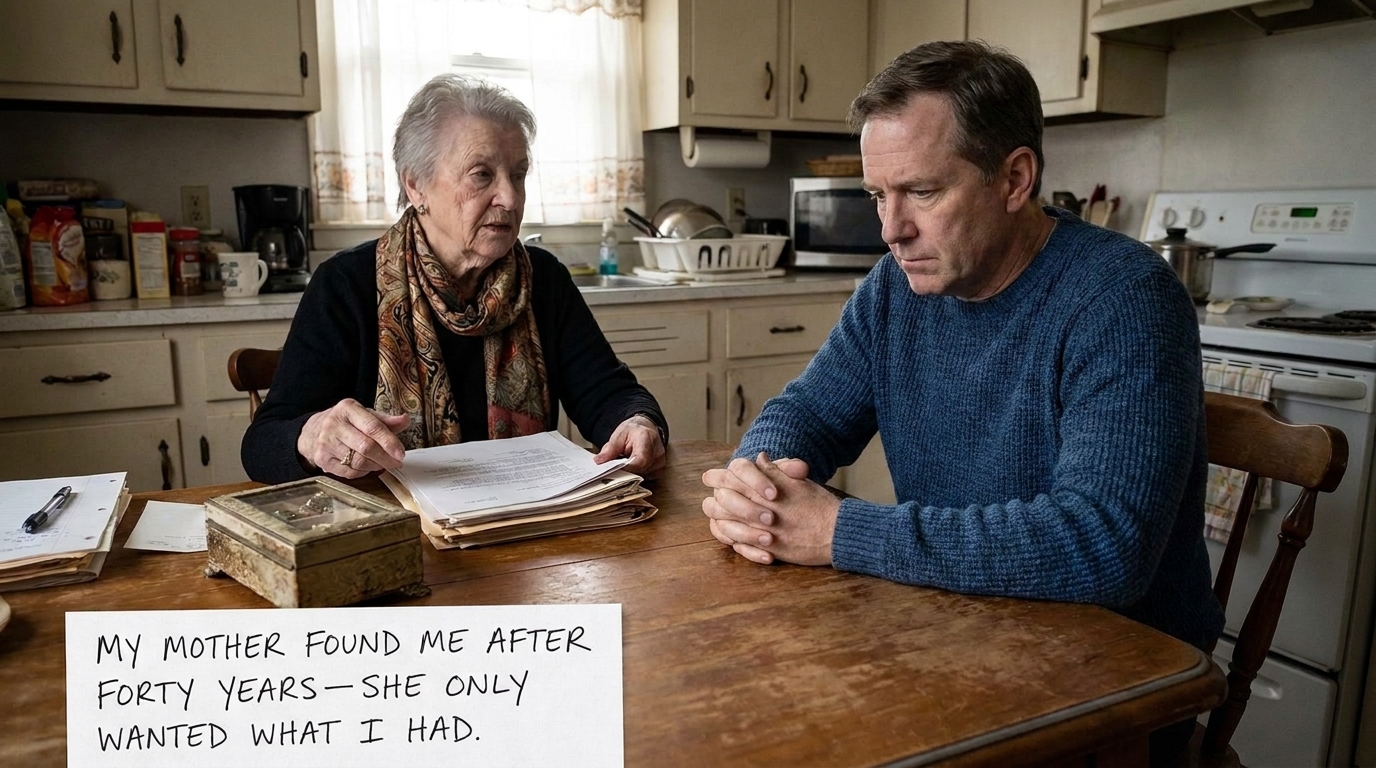
The first time my mother called me “son,” she was standing in the middle of my restaurant kitchen wearing a cream-colored coat that probably cost more than my first car.
She had diamonds around her wrist.
Perfect silver hair.
A leather handbag resting against her hip.
And tears running down her face as if she had been saving them for forty-four years.
I was holding a chef’s knife when she walked in.
For one strange second, I honestly thought she was lost.
My restaurant wasn’t the kind of place where customers wandered into the kitchen. We were one of the busiest farm-to-table restaurants on Chicago’s North Side, and during dinner service, that kitchen moved like a machine.
Pans hit burners.
Servers shouted table numbers.
Someone was chopping onions.
Someone else was swearing about an overcooked steak.
Then this woman appeared beside the stainless-steel counter and stared directly at me.
“Daniel?”
Everything seemed to stop, even though it didn’t.
I lowered the knife.
“Yes?”
She pressed one hand against her chest.
“My God,” she whispered. “You have your father’s eyes.”
That was when I knew.
Before she gave me her name.
Before she opened her purse and showed me the photograph.
Before she said the words I had imagined hearing since I was a child.
My mother had found me.
And I had no idea that within eighteen months, she would take my savings, nearly destroy my marriage, put my restaurant on the edge of bankruptcy, and leave me questioning whether I had ever been loved by her at all.
My mother’s name was Evelyn Vale.
At least, that was the name she gave me.
I had grown up knowing almost nothing about her.
My father, Michael Mercer, raised me alone. Whenever I asked where my mother was, he gave me a different version of the same answer.
“She wasn’t ready to be a parent.”
When I was eight, I asked whether she had died.
He said no.
When I was twelve, I asked whether she had ever tried to contact me.
He looked down at the newspaper and said, “Some people are better left in the past.”
When I was seventeen, I became angry.
I accused him of keeping her away from me. I accused him of poisoning me against a woman I had never met. I said things only a teenager could say with complete confidence and no understanding.
My father listened quietly.
Then he told me the truth.
My mother had left when I was nine months old.
She packed two suitcases while he was working, took money from their joint account, and disappeared.
She did not leave a letter.
She did not ask for photographs.
She did not call on my birthdays.
For years, my father had no idea where she was.
He eventually heard that she had remarried somewhere in Florida. He also heard that she had changed her name.
That was all.
My father never remarried.
He worked construction during the day and repaired appliances in our garage at night. My grandmother watched me until I was old enough to be alone.
We did not have much money, but I never went hungry.
My father attended every school event.
He taught me how to ride a bicycle.
He taught me how to change a tire.
He taught me how to cook scrambled eggs without turning them into rubber.
When I opened my first restaurant at thirty-six, he sat at the best table and cried into his napkin.
He died three years later.
Cancer.
Fast and merciless.
At his funeral, I remember staring at the empty seat beside me and wondering whether my mother knew.
I wondered whether she cared.
I wondered whether she was somewhere looking at the same sky, thinking about the son she had left behind.
Five years after my father died, Evelyn walked into my kitchen.
I took her upstairs to my office.
She sat across from me and removed a photograph from her purse.
It showed a young woman holding a baby.
The woman had long dark hair, large eyes and a nervous smile.
The baby was me.
I recognized the blanket because my father had kept it in a box in his closet.
Evelyn turned the photograph over.
On the back, in faded handwriting, were the words:
Daniel. Six months old. My whole heart.
I stared at those four words until they became blurry.
“My whole heart.”
I had spent my entire life believing I had not mattered enough for her to stay.
Now here was proof that, at least for one moment, I had meant something.
“I know you must hate me,” she said.
“I don’t know you well enough to hate you.”
She nodded as if I had struck her.
“I deserve that.”
I asked the question I had been carrying for forty-four years.
“Why did you leave?”
She looked toward the office window.
Below us, the kitchen continued moving. Plates were being arranged. Orders were being called.
“I was twenty-two,” she said. “I was frightened. Your father and I were fighting constantly. I had no money of my own. No family nearby. I believed I was failing you.”
“So you disappeared?”
“I thought your father could give you a better life.”
“That sounds convenient.”
“It was cowardly.”
Her voice broke.
“I told myself I would come back when I had something to offer. Then one year became five. Five became ten. The longer I waited, the more ashamed I became.”
I wanted to remain angry.
I had earned that anger.
But there was something about seeing her sitting in front of me—older, vulnerable and apparently terrified—that made the anger feel heavier than I expected.
“Why now?” I asked.
She opened her handbag again and pulled out an envelope.
Inside were medical records.
Pancreatic cancer.
Stage three.
At least, that was what the papers appeared to say.
“I don’t know how much time I have,” she said. “Maybe a year. Maybe less.”
I looked up.
“I have no other children, Daniel. No family that matters. I’ve built a successful life, but none of it means anything if I die without knowing you.”
I should tell you something about abandoned children.
Even when we grow into adults, there is a part of us that stays behind.
A small part.
A hopeful part.
A foolish part.
It waits near the door where the parent disappeared.
It waits for footsteps.
It waits for an apology.
It waits for someone to come back and say, “You were worth returning for.”
That part of me was still nine months old.
And Evelyn knew exactly how to speak to it.
I did not bring her home that night.
I told my wife, Rachel, first.
Rachel and I had been married for sixteen years. We had two children, Noah, who was fourteen, and Lily, who was eleven.
Rachel knew every detail of my childhood.
She knew how much I hated Mother’s Day.
She knew I became quiet every year on my birthday.
She knew that when our children were born, I stood beside their hospital bassinets and silently promised I would never leave them.
When I told her my mother had appeared, Rachel stared at me for several seconds.
“Are you sure it’s her?”
“She has photographs.”
“That doesn’t prove anything.”
“She knew things.”
“Things nobody else could know?”
I hesitated.
“She knew my father’s middle name. She knew where they lived before I was born.”
“That could be researched.”
“She has cancer.”
Rachel’s expression softened, but only slightly.
“I’m sorry.”
“She wants to know me.”
“What do you want?”
That question frightened me because I already knew the answer.
“I want to hear her side.”
Rachel reached across the kitchen table and took my hand.
“Then hear it. Just don’t let wanting her make you stop seeing clearly.”
At the time, I thought that sounded unfair.
Later, I realized it was the most important warning anyone ever gave me.
Evelyn returned two days later.
This time, I brought her home.
She arrived with gifts.
A designer handbag for Rachel.
A vintage watch for Noah.
A gold necklace for Lily.
For me, she brought a set of French copper cookware from the 1960s.
I had once mentioned owning a similar set during an interview with a local food magazine.
Evelyn said she had watched every interview she could find.
“I wanted to know the man you became.”
She charmed my children immediately.
She told stories about traveling through Europe.
She said she had owned property in Paris, Lisbon and Palm Beach.
She claimed her late husband had been involved in international shipping and that she had inherited most of his estate.
She knew about art, wine and expensive hotels.
She spoke as if money had never been a problem.
When Lily asked whether she lived in a mansion, Evelyn laughed.
“Not a mansion. Just a home with too many rooms.”
Before leaving, she hugged me.
It was the first time I had ever felt my mother’s arms around me.
I remember closing my eyes.
I remember her perfume.
Jasmine and something smoky.
I remember thinking, So this is what it feels like.
That hug cost me everything.
At first, Evelyn asked for nothing.
That was part of her skill.
She gave.
She paid for dinners.
She bought the children gifts.
She insisted on covering the cost of a weekend trip to Lake Geneva.
She talked about adding me to her estate.
She introduced me to a man named Peter Lang, whom she described as her financial adviser.
Peter wore dark suits, carried two phones and spoke in a calm voice that made every sentence sound official.
One afternoon, Evelyn and Peter came to the restaurant before opening.
They brought documents.
According to them, Evelyn had established a trust worth twelve million dollars. After her death, most of it would come to me.
I did not believe them at first.
Peter showed me account summaries, property documents and letters from attorneys.
He explained that Evelyn’s assets were divided among several companies and investment accounts.
“You won’t need to sell the restaurant,” he said. “This will give you the freedom to expand it.”
Evelyn smiled.
“I thought maybe you could open one in New York.”
I laughed nervously.
“I can barely manage one in Chicago.”
“Then hire people,” she said. “You should spend more time with your family.”
Those words mattered because I felt guilty about how much I worked.
The restaurant had become successful, but success had a cost.
I missed school events.
I worked anniversaries.
Rachel handled most of the parenting while I convinced myself I was building something for all of us.
Evelyn offered a future where I could be present.
A future where I could give my children everything my father had never been able to give me.
That was the real bait.
Not the mansion.
Not the money.
Freedom.
Two months after meeting her, Evelyn called me at six in the morning.
She was crying.
Her accounts had been temporarily frozen.
Peter had discovered a problem involving her late husband’s estate. A tax document had been filed incorrectly years earlier. Until the issue was resolved, she could not access several accounts.
She needed sixty thousand dollars to cover legal fees and prevent one of her properties from being seized.
“I hate asking you,” she said.
I was standing in the restaurant’s storage room with sacks of flour behind me.
“What about Peter?”
“He’s handling everything, but he can’t personally lend me money. It would violate regulations.”
“Can’t you sell something?”
“That could take months.”
I said nothing.
She lowered her voice.
“I wouldn’t ask if I had another choice.”
“How long until you can repay it?”
“Two weeks. Three at most.”
I had sixty thousand dollars in a business reserve account.
It was supposed to cover emergencies.
Equipment repairs.
Payroll shortages.
Unexpected expenses.
I told myself this was temporary.
I told myself I was helping my dying mother.
I told myself that within weeks, the money would return.
I transferred it that afternoon.
Evelyn thanked me repeatedly.
She called me her guardian angel.
She said my father had raised a good man.
Two weeks passed.
Then three.
The money did not return.
Peter explained that the legal issue was more complicated than expected.
There were additional fees.
Evelyn became apologetic and embarrassed.
She showed me emails from attorneys.
She showed me letters with government seals.
She showed me a notice threatening penalties.
The documents looked real.
Later, investigators told me some were copied from genuine legal forms. Others had been created using logos and signatures taken from public websites.
But at the time, they looked convincing.
Especially because I wanted them to be convincing.
The next request was twenty-five thousand.
Then forty.
Then fifteen.
Each time, there was a reason.
A foreign account that required a clearance payment.
A property tax deadline.
An insurance issue.
A hospital treatment not covered by her policy.
She always promised repayment.
She always showed proof.
And whenever I hesitated, she never demanded.
She became quiet.
She said she understood.
She said she had no right to expect anything from me after abandoning me.
That worked better than anger.
She made refusing her feel like I was abandoning her back.
Rachel noticed the first transfer on our joint financial statement.
“What is this?” she asked.
We were in our bedroom.
She was holding her tablet.
I had just returned from the restaurant and smelled like smoke and onions.
“It’s temporary.”
“You sent your mother sixty thousand dollars?”
“She has an estate issue.”
“You’ve known her for ten weeks.”
“She’s paying it back.”
“When?”
“Soon.”
Rachel stared at me.
“Daniel, this is not normal.”
“You don’t know the situation.”
“I know she appeared after forty-four years, told you she was rich, promised you millions and then immediately needed your money.”
“It wasn’t immediate.”
“Ten weeks is immediate.”
“She’s sick.”
“So sick people can’t lie?”
I became defensive.
“What are you accusing her of?”
“I’m asking you to slow down.”
“She’s my mother.”
Rachel’s face changed.
Not anger.
Pain.
“And I’m your wife.”
That should have stopped me.
Instead, I left the room.
Evelyn had already begun turning me against anyone who questioned her.
She never directly criticized Rachel.
She was too clever.
She used concern.
“Rachel seems very protective of your finances.”
“She’s careful.”
“Of course. She didn’t grow up the way you did.”
“What does that mean?”
“Nothing negative. She had stability. Parents who stayed. People like that don’t always understand what family means to those of us who lost it.”
Those of us.
She placed us on the same side.
Two wounded people against a suspicious world.
When I told her Rachel was upset about the money, Evelyn cried.
“I’m ruining your marriage.”
“You’re not.”
“I should leave.”
“You’re not leaving.”
The words came out too quickly.
She looked at me.
“You really mean that?”
I did.
That was the moment she knew she owned me.
Six months after Evelyn entered my life, I had given her one hundred and eighty thousand dollars.
Some came from the restaurant.
Some came from savings.
Twenty thousand came from the home-equity line Rachel and I had opened years earlier for renovations.
I did not tell Rachel about that part.
I changed the password on our online banking account.
That is difficult to admit.
I was not simply a victim.
I lied.
I hid money.
I chose Evelyn’s stories over my wife’s warnings.
When Rachel asked whether there had been more transfers, I said no.
I watched her believe me.
Then I kissed her goodnight.
That lie did more damage than anything Evelyn could have done alone.
Around that time, my mother’s illness seemed to worsen.
She began wearing scarves around her head, even though I had never seen her lose hair.
She canceled plans because of chemotherapy appointments.
Whenever I offered to drive her, she said the hospital provided transportation.
When I asked to speak with her doctor, she claimed medical privacy rules made it complicated.
I accepted these answers because challenging them felt cruel.
Then came the birthday dinner.
My forty-fifth birthday.
Evelyn rented a private room at an expensive hotel.
She invited my family, several employees and two local business owners.
During dessert, she stood and raised a glass.
“I missed forty-four birthdays,” she said. “I refuse to miss another.”
Everyone applauded.
Then she gave me a small box.
Inside was a key.
“To the Palm Beach house,” she said. “It’s yours.”
I looked at her.
“What?”
“I transferred the property into a family trust.”
People around the table gasped.
Rachel did not.
She watched Evelyn carefully.
Evelyn handed me a folder containing what appeared to be a deed.
The property was valued at more than three million dollars.
I stood and hugged her.
The room applauded again.
For one night, I felt chosen.
I felt seen.
I felt as if the empty space inside me had finally been filled.
Three days later, Evelyn called and said the property transfer had triggered a tax obligation.
She needed ninety thousand dollars.
That was when Rachel discovered the truth.
She went to the bank to discuss refinancing our mortgage.
The loan officer mentioned the home-equity balance.
Rachel came to the restaurant while I was preparing for dinner service.
She walked directly into the kitchen.
“Office. Now.”
I had never seen her look like that.
We went upstairs.
She closed the door.
“How much?”
I pretended not to understand.
“How much have you given her?”
I looked away.
Rachel’s voice shook.
“How much, Daniel?”
“One hundred and eighty.”
She covered her mouth.
“It’s coming back.”
“You took money from our house.”
“I was going to replace it.”
“You lied to me.”
“I was protecting you from stress.”
“No. You were protecting yourself from hearing the truth.”
“She gave me a house.”
Rachel laughed once.
It was a cold, broken sound.
“Have you verified that?”
“Peter showed me the paperwork.”
“Have you called the county? Have you spoken to an independent attorney?”
I said nothing.
“You haven’t.”
“I trust her.”
“You don’t know her.”
“She is my mother.”
“She is a stranger who shares your DNA.”
I slammed my hand against the desk.
“You have no idea what this means to me.”
Rachel’s eyes filled with tears.
“You’re right. I don’t know what it feels like to be abandoned by a mother.”
She stepped closer.
“But I know what it feels like to watch my husband abandon his own family for one.”
She left that night.
She took the children to her sister’s house.
I told myself she would calm down.
I told myself Evelyn’s money would arrive, the loans would be repaid, and Rachel would understand.
Instead, everything became worse.
The Palm Beach house did not belong to Evelyn.
I learned that two weeks later.
Rachel hired an attorney without telling me.
The attorney searched the property records.
The house belonged to a retired surgeon and his wife.
They had owned it for nine years.
The deed Evelyn gave me was fake.
When I confronted her, she did not panic.
She looked wounded.
“That property was held through a company.”
“The owners have never heard of you.”
“Then Peter made a mistake.”
“Where is he?”
“In New York.”
“Give me his office address.”
“Daniel, please don’t speak to me as if I’m a criminal.”
“You gave me a fake deed.”
“I gave you what Peter gave me.”
“Call him.”
“He’s in a meeting.”
“Call him.”
She began crying.
Not quietly.
She collapsed into a chair and covered her face.
“I knew this would happen.”
“What would happen?”
“You would turn against me. Just like your father did.”
The mention of my father stopped me.
“What does that mean?”
“He always made me feel unstable. He made me doubt myself.”
“My father raised me.”
“And he made sure you hated me.”
“He barely spoke about you.”
“Silence can poison a child as easily as words.”
For the first time, I saw something cold behind her tears.
It disappeared quickly, but I saw it.
I left her apartment.
The next morning, Peter called.
He apologized for the deed.
He said an administrative assistant had accidentally sent documents for the wrong property.
He promised to correct it.
He spoke calmly and confidently.
I wanted to believe him.
So I did.
That decision cost me another eighty thousand dollars.
By then, the restaurant was struggling.
I had missed payroll twice.
Suppliers were demanding payment.
My business partner, Carlos, confronted me after discovering money had been removed from our reserve account.
Carlos and I had worked together for thirteen years.
He had trusted me with his life.
When I told him the money had gone to a family emergency, he asked to see the documentation.
I refused.
He threatened legal action.
I accused him of caring more about money than people.
He stared at me for a long time.
Then he said, “You don’t sound like yourself anymore.”
He was right.
I sounded like Evelyn.
Every sentence she used on me, I began using on others.
Doubt became betrayal.
Questions became attacks.
Concern became disrespect.
That is what manipulation does.
It does not only change what you believe.
It changes the way you treat everyone who refuses to believe it with you.
The truth finally arrived through a woman named Marissa Cole.
She came to the restaurant on a rainy Tuesday afternoon.
We were closed between lunch and dinner, but she knocked until one of the servers let her in.
Marissa was in her late fifties.
She looked tired.
She asked whether I was Daniel Mercer.
“Yes.”
“Is Evelyn Vale your mother?”
My stomach tightened.
“Who are you?”
She removed her phone and showed me a photograph.
Evelyn stood beside a man I had never seen.
In the photograph, she looked ten years younger.
Her hair was dark.
Her arm was around the man’s shoulders.
“That was my husband,” Marissa said. “His name was Robert.”
I looked at her.
“How did you know my mother?”
“She wasn’t your mother when she knew us. She was his sister.”
I did not understand.
Marissa continued.
“She called herself Elaine. She contacted Robert after their father supposedly died. She said there was an inheritance, but the estate was tied up in court.”
The restaurant seemed to tilt around me.
“How much?”
“Two hundred and thirty thousand dollars.”
I gripped the back of a chair.
“She promised him part of an inheritance?”
“Yes.”
“Was there a financial adviser?”
Marissa’s face tightened.
“A man named Peter.”
I sat down.
Marissa explained that Robert had borrowed against their home.
He emptied retirement accounts.
He believed he was helping his long-lost sister recover family property.
When the money was gone, Elaine disappeared.
Robert spent years trying to prove what happened.
He died of a heart attack before the case went anywhere.
Marissa had recently seen a photograph of Evelyn in an online article about my restaurant’s charity dinner.
She recognized her immediately.
“She is my mother,” I said weakly.
“I believe you.”
“She has cancer.”
“No, she doesn’t.”
“You don’t know that.”
Marissa opened a folder.
Inside were photographs, bank transfers and copies of emails.
The language in those emails was nearly identical to the messages Evelyn had sent me.
Temporary legal issue.
Frozen accounts.
Emergency tax payment.
Repayment within weeks.
Family should trust family.
I felt sick.
“She has used different names for years,” Marissa said. “Elaine Vale. Evelyn Cross. Margaret Ellis. Maybe more.”
“What about Peter?”
“His real name is Patrick Lang. He has worked with her before.”
I shook my head.
“This can’t be true.”
Marissa did not argue.
She placed a card on the table.
It belonged to a federal investigator.
“Call him before she takes anything else.”
After Marissa left, I sat alone in the restaurant for nearly an hour.
I looked at the dining room I had built.
The chairs.
The tables.
The photographs on the wall.
One photograph showed my father standing beside me on opening night.
He wore an uncomfortable suit and the biggest smile I had ever seen.
I remembered all the years I had blamed him for keeping my mother away.
I remembered Evelyn saying he had poisoned me against her.
The truth was the opposite.
My father had protected me.
Even in silence.
And after he died, I opened the door he had spent his life keeping closed.
I called Rachel.
She answered after four rings.
“I need help,” I said.
My voice broke.
She did not say, “I told you so.”
She did not insult me.
She asked one question.
“Are the kids safe?”
“Yes.”
“Then call the attorney.”
I contacted the investigator.
His name was Agent Thomas Reed.
He already knew Evelyn.
Not well enough to arrest her, but enough to understand the pattern.
Several victims had reported similar frauds over the years. The problem was evidence.
Evelyn rarely signed documents herself.
Money moved through companies and intermediaries.
Victims often felt too embarrassed to cooperate.
Some continued defending her even after losing everything.
Agent Reed asked whether I had emails, recordings or financial documents.
I had all of them.
Then he asked whether Evelyn knew I suspected her.
I told him about Marissa.
He frowned.
“She may disappear.”
That same evening, Evelyn called.
Her voice was cheerful.
“I have wonderful news.”
I said nothing.
“The estate issue is finally resolved. Peter has arranged everything.”
“That’s good.”
“There is one final payment.”
Of course there was.
“How much?”
“One hundred and fifty thousand.”
I almost laughed.
She continued quickly.
“Once it clears, the entire trust becomes accessible. You’ll receive everything you gave me, plus the property transfer.”
“I don’t have one hundred and fifty thousand.”
“You could use the restaurant.”
My hand tightened around the phone.
“What do you mean?”
“As collateral. Only for forty-eight hours.”
She wanted the restaurant.
The one thing I had left.
The thing my father had helped me build.
The place where she first called me son.
“I’ll think about it,” I said.
A long silence followed.
Then her voice changed.
Not much.
Just enough.
“You said you would never leave me.”
“I’m not leaving.”
“You sound different.”
“I’m tired.”
“Has Rachel been speaking to you?”
There it was.
The suspicion.
The need to isolate me again.
“She’s the mother of my children.”
“She has always wanted you to choose.”
“No, Evelyn. You wanted me to choose.”
Silence.
I had never called her Evelyn before.
I had always called her Mom.
When she spoke again, the warmth was gone.
“I think we should meet.”
Agent Reed arranged everything.
The meeting took place at a private office inside a downtown bank.
Evelyn believed I was signing documents to use the restaurant as collateral for the final payment.
Agent Reed and another investigator waited in a room nearby.
The office contained hidden cameras.
I wore a microphone under my shirt.
Before entering, Agent Reed reminded me not to accuse her directly.
“We need her to explain the transaction in her own words.”
Peter arrived first.
Dark suit.
Two phones.
Calm voice.
He placed a stack of documents on the table.
Evelyn entered ten minutes later.
She wore the same cream-colored coat she had worn the day we met.
Maybe that was intentional.
Maybe she believed the coat had power.
She kissed my cheek.
“My beautiful boy.”
I felt nothing.
That was the moment I knew she had finally lost me.
Not when I saw the evidence.
Not when I discovered the fake property.
Not when I learned about Marissa’s husband.
She lost me when she called me beautiful and I heard the machinery behind the words.
Peter began explaining the agreement.
The restaurant would guarantee a short-term loan of one hundred and fifty thousand dollars.
Once Evelyn’s accounts were released, the loan would be repaid within forty-eight hours.
“And if it isn’t?” I asked.
Peter smiled.
“That won’t happen.”
“But if it does?”
“The lender could take possession of the business assets.”
“My entire restaurant.”
“Technically.”
Evelyn touched my hand.
“You’re not risking anything.”
I looked at her.
“Where is the money going?”
“To the estate attorney.”
“What is his name?”
She glanced at Peter.
He answered for her.
“Jonathan Price.”
“What firm?”
“Price, Bell and Rowe.”
I had already searched that name.
No such firm existed.
“Can I speak to him?”
“He is handling sensitive matters,” Peter said.
“I’m about to risk my business. I think he can speak to me.”
Evelyn squeezed my hand.
“Daniel, do you trust me?”
The question was perfectly timed.
It always had been.
I looked into her eyes.
“I did.”
Her fingers loosened.
“What does that mean?”
“It means I trusted you.”
Peter closed the folder.
“This meeting may not be productive.”
Evelyn ignored him.
“Who have you been speaking to?”
I said nothing.
“Was it Rachel?”
“No.”
“Then who?”
“Marissa Cole.”
The color left Evelyn’s face.
Only for a second.
Then she recovered.
“I don’t know that name.”
“She knows you as Elaine.”
“I have never used that name.”
“She has photographs.”
“People create things.”
“She has bank records.”
“Daniel, stop.”
“She says you stole from her husband.”
Evelyn stood.
“This is exactly what your father used to do.”
“Do not speak about him.”
“He filled your head with lies.”
“My father never lied about you.”
“He hated me.”
“He protected me from you.”
Her face changed completely.
The softness disappeared.
The dying mother disappeared.
The frightened young woman disappeared.
What remained was contempt.
“Protected you?” she said. “He kept you poor.”
“He kept me loved.”
“You think love built this restaurant?”
“Yes.”
She laughed.
“No, Daniel. Hunger built it. Abandonment built it. I gave you that.”
The words hit harder than I expected.
Maybe because part of them was true.
My pain had driven me.
My fear of being worthless had pushed me to work harder than everyone around me.
Evelyn leaned closer.
“You became successful because I left. You should be thanking me.”
Peter began gathering the documents.
I needed them to keep talking.
“So the trust is real?”
Evelyn looked at me with open disgust.
“You still don’t understand.”
“Explain it.”
“There is always a trust. There is always a property. There is always something people want badly enough to stop asking questions.”
“You never intended to repay me.”
She smiled faintly.
“You gave me the money.”
“Because you said you were dying.”
“You wanted a mother. I gave you one.”
“For a price.”
“Everything has a price.”
Behind the wall, Agent Reed had heard enough.
The door opened.
Two federal agents entered.
Peter froze.
Evelyn did not.
She looked at me.
Not at them.
At me.
“You did this?”
I stood slowly.
“No. You did.”
They arrested Peter first.
Evelyn remained completely still while the agent read her rights.
When he reached for her wrist, she pulled away.
Then she looked at me and said the cruelest thing she had ever said.
“I should have left you where I found you.”
For most of my life, those words would have destroyed me.
But standing in that bank office, I finally understood something.
She had never found me.
She had researched me.
Measured me.
Selected me.
She had studied my success, my family and my wound.
Then she built a mother-shaped trap around it.
I stepped closer.
“You did leave me,” I said. “That was the only honest thing you ever did.”
They took her away.
The investigation uncovered more than we expected.
Evelyn had used at least seven names over twenty-five years.
She had targeted former partners, distant relatives, lonely widowers and people searching for lost family members.
Peter created documents and financial identities.
Together, they convinced victims that inheritances, lawsuits, properties or frozen accounts were waiting just beyond one final payment.
There was always one final payment.
Investigators identified eleven victims.
There were probably more.
Some refused to come forward.
Others were dead.
The supposed medical records Evelyn showed me belonged to a real cancer patient. The name and identifying information had been replaced.
The treatment center she claimed to attend had never heard of her.
The gifts she bought my family were paid for using money from another victim.
Even the copper cookware she gave me had been purchased with my own business credit card after she somehow obtained the number during one of her visits to the restaurant.
Every generous act had been financed by someone she was stealing from.
Including me.
Evelyn pleaded not guilty at first.
She claimed Peter controlled everything.
Peter claimed Evelyn manipulated him.
They turned on each other almost immediately.
The trial lasted three weeks.
Rachel attended only once.
She sat behind me.
Not beside me.
Our marriage had not magically repaired itself because my mother was arrested.
Some damage does not disappear when the villain is removed.
I had lied to Rachel for months.
I had risked our home.
I had drained money meant for our children.
I had treated her concern like betrayal.
I had chosen a fantasy over the woman who had spent sixteen years building a real life with me.
I moved into a small apartment.
I sold my car.
Carlos bought my share of the restaurant temporarily so the business could survive.
That humiliation saved it.
He could have destroyed me legally.
Instead, he gave me a chance to earn my way back.
Rachel and I began counseling.
At first, she barely spoke.
When she did, every sentence hurt because it was true.
“You didn’t trust me.”
“You made me feel like the enemy.”
“You used your childhood to excuse choices you made as an adult.”
The counselor never allowed me to hide behind Evelyn.
Being manipulated explained my behavior.
It did not erase my responsibility.
That lesson was harder than losing the money.
Evelyn was eventually convicted of wire fraud, bank fraud, identity theft and conspiracy.
At sentencing, several victims spoke.
Marissa described watching her husband spend the last years of his life ashamed and desperate.
A retired teacher described losing her home.
A widower explained that Evelyn pretended to love him while draining his retirement account.
Then it was my turn.
I stood at the front of the courtroom.
Evelyn sat behind the defense table.
Her hair was no longer silver.
Without the expensive styling and careful clothes, she looked older.
Smaller.
But not sorry.
I unfolded my statement.
Then I set it aside.
“I spent forty-four years wondering why my mother left me,” I said. “When she returned, I thought I was finally going to receive an answer.”
Evelyn stared straight ahead.
“But she didn’t return to explain the past. She returned because she believed the child she abandoned had grown into someone worth stealing from.”
For the first time, she looked at me.
“She used the word ‘son’ like a key. She opened every locked place inside me and took whatever she could reach.”
The courtroom was silent.
“I used to believe being left meant I wasn’t worthy of love. Now I understand that some people leave because they are incapable of giving it.”
Evelyn’s jaw tightened.
“You took my money,” I said. “You damaged my family. You nearly destroyed the business my father helped me build.”
I paused.
“But you did give me one thing.”
She watched me.
“You gave me the truth.”
The judge sentenced Evelyn to fourteen years in federal prison.
Peter received nine.
The court ordered restitution, though most of the money was gone.
Evelyn had spent it on hotels, clothes, travel and maintaining the illusion of wealth that helped her steal more.
I recovered less than fifteen percent of what I gave her.
The Palm Beach house never existed.
The trust never existed.
The fortune never existed.
But the consequences did.
It took three years to rebuild my life.
Rachel did not forgive me quickly.
She should not have.
We began with coffee.
Then dinners.
Then family weekends.
I returned home after fourteen months.
Even then, things were different.
Trust did not return all at once.
It came back in small deposits.
A shared password.
A bank statement left open on the table.
A promise kept.
A difficult truth spoken before it could become a lie.
Noah remained angry with me longer than anyone.
He had watched me choose Evelyn over his mother.
One afternoon, while we were repairing an old bicycle in the garage, he asked why I had believed her.
I could have blamed the documents.
The fake adviser.
The medical records.
Instead, I told him the truth.
“Because I wanted her to love me.”
He looked down at the bicycle chain.
“Did she?”
“No.”
“Then why did she come back?”
“Because she thought wanting her made me weak.”
Noah wiped grease from his fingers.
“Were you?”
“For a while.”
He looked at me.
“What changed?”
“I remembered who stayed.”
The restaurant survived.
Carlos allowed me to buy back part of my ownership after I repaid what I had taken.
We added a small private dining room and named it Michael’s Room after my father.
A photograph of him hangs near the entrance.
He is wearing the uncomfortable suit from opening night.
Sometimes customers ask who he was.
I tell them he was the man who taught me that love is not what someone promises when they need something.
Love is who shows up when there is nothing to gain.
Marissa became a friend.
Every year, she comes to Chicago on the anniversary of Robert’s death.
She eats at the restaurant, and I refuse to let her pay.
Rachel says that is terrible business.
I tell her some debts should be repaid in meals.
My children are older now.
Noah is in college.
Lily is preparing to graduate from high school.
Rachel and I are still married.
Not because the damage disappeared.
Because we finally learned to stop pretending it had.
We built something more honest in its place.
Evelyn wrote to me twice from prison.
The first letter blamed Peter.
The second blamed me.
She said I had humiliated her.
She said I had allowed strangers to turn me against my own mother.
She said one day I would regret abandoning her.
I burned both letters.
Not because I was angry.
Because I was finished.
For most of my life, I believed closure would come when my mother returned.
I thought she would explain why she left, hold me and somehow repair the child she had abandoned.
Instead, closure came when I understood that I did not need her explanation.
I had spent decades asking why I was not enough for her.
That was always the wrong question.
The question was why she was willing to destroy anyone who loved her.
That answer belonged to her.
Not me.
People sometimes hear my story and say the money was my punishment for being too trusting.
They are wrong.
Trust is not a weakness.
Love is not stupidity.
Hope is not something to be ashamed of.
The shame belongs to the person who turns those things into weapons.
Evelyn believed my need for a mother would keep me loyal forever.
She believed I would protect her because exposing her meant admitting I had been fooled.
She believed shame would silence me, just as it had silenced others.
That was her mistake.
The child inside me wanted his mother.
But the man my father raised wanted the truth.
In the end, the man won.
And the woman who returned to steal my life lost the one thing she valued more than money.
Control.