The first time my wife told me love was not enough, she was standing in our kitchen wearing a dress I had never seen before.
It was dark green, tight around the waist, the kind of dress people wore to restaurants where the menu had no prices. Her hair was curled, her earrings were new, and the perfume in the room did not belong to the woman I had married.
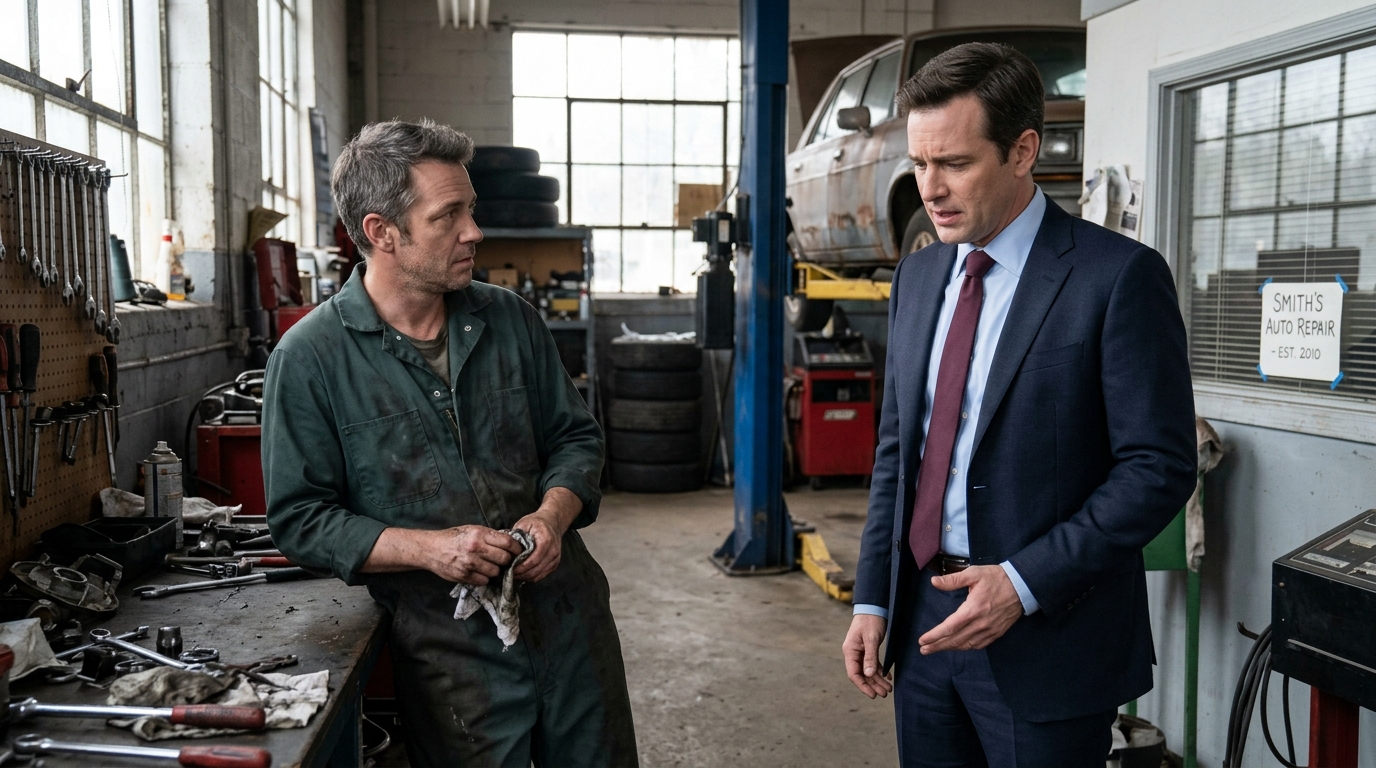
I was still in my work shirt from the garage. There was oil under one fingernail I had missed, and my boots had left a little trail of dust near the back door.
Vanessa looked down at it, then looked at me.
That was when I knew.
Not because she was angry. Anger would have meant there was still something between us. She looked tired of me. Tired of the house. Tired of the bills on the counter. Tired of the man who came home smelling like engines and metal instead of money.
“Caleb,” she said quietly, “I can’t do this anymore.”
I stared at her.
Outside, rain tapped against the kitchen window. One of the cabinet doors was hanging crooked because I had not had time to fix it yet. The refrigerator hummed louder than usual. Everything about that little house suddenly felt embarrassing, like she had invited a stranger in and I was seeing my life through his eyes.
“Do what?” I asked.
She folded her arms, but not because she was cold. She was protecting herself from guilt.
“This,” she said. “Living like this. Waiting for things to get better. Hearing you say next month, next year, someday.”
I almost laughed because if I didn’t, I might break.
“We’re not starving, Vanessa.”
“No,” she said. “We’re surviving. And I’m tired of surviving.”
We had been married for seven years. I met her when she was twenty-two and I was twenty-five, back when I thought hard work was enough to build a life. I had inherited my father’s small repair garage outside Dayton, Ohio. Mercer Auto & Restoration. It was not fancy, but it was honest. My father had built his name by fixing what other people gave up on.
That was how I lived too.
If something broke, I fixed it.
Engines. Transmissions. Doors. Roof leaks. Promises.
But by that night, my marriage had become something I did not know how to repair.
I looked at the dress again.
“Where are you going?”
She looked away.
“Grant invited me to dinner.”
I already knew his name.
Grant Ellison.
Real estate developer. Big smile. Expensive watches. The kind of man who shook your hand like he was deciding what you were worth. He had brought a classic Corvette into my shop three months earlier, not because he needed me, but because somebody told him I was the best restoration mechanic within fifty miles.
Vanessa had been there that day.
I remembered how she laughed when he complimented the little office I had painted myself. I remembered how she stood a little straighter when he asked if she handled the books. I remembered the way he looked around my shop like he was touring a poor neighborhood for charity.
And I remembered something else.
For the first time in years, Vanessa had looked impressed.
Not by me.
By him.
“He invited you to dinner,” I repeated.
“It’s not like that.”
Those five words have probably ended more marriages than any affair ever could.
I took a breath.
“Then what is it like?”
She finally looked at me. Her eyes were wet, but her voice was steady.
“He sees me, Caleb.”
That one hurt more than anything else.
Because I had seen her.
I had seen her when she cried after her mother died. I had seen her when she was too scared to go back to school and I picked up extra shifts so she could finish her business certificate. I had seen her when she wanted new furniture, new clothes, a new car. I had seen every dream she ever placed on our table, and I had spent years trying to build a bridge to it with my bare hands.
But I did not say that.
I just asked, “Are you leaving me?”
She wiped under one eye with her finger, careful not to ruin her makeup.
“I already packed some things.”
I looked past her then. In the hallway, two suitcases stood near the front door.
That was the moment my chest went hollow.
“You packed before talking to me?”
“If I talked to you first, you would try to convince me to stay.”
“Because you’re my wife.”
She shook her head.
“No, Caleb. Because you’re a good man. And that makes this harder.”
I remember staring at her, waiting for the woman I married to come back. The one who used to sit beside me on the floor and eat cheap pizza from the box. The one who once said she loved the smell of sawdust and motor oil because it meant I was building something. The one who promised me she did not need rich, only real.
But that woman was gone.
Vanessa picked up her purse.
Then she said the sentence I carried for years.
“Love doesn’t pay bills, Caleb.”
She walked out into the rain.
And I stood in our kitchen, listening to a car pull into the driveway.
Not my truck.
A black Mercedes.
Grant Ellison did not come to the door. He did not need to.
My wife ran to him.
I watched from the kitchen window as he stepped out with an umbrella. He opened the passenger door for her like she was something precious, something rescued.
Before she got in, she looked back once.
I don’t know what she expected to see.
Maybe she wanted me to chase her.
Maybe she wanted me to yell.
Maybe she wanted proof that I was the small man she had decided to leave.
But I did not move.
The Mercedes backed out of my driveway and disappeared down the road, its taillights bleeding red through the rain.
That night, I sat at the kitchen table until morning.
The bills were still there.
The crooked cabinet was still there.
The house was still there.
Only my wife was gone.
And somehow, the silence was louder than everything.
For the first few months after Vanessa left, people looked at me like I had survived a fire.
They did not know what to say, so they said things that made it worse.
“You’re better off.”
“She’ll realize what she lost.”
“Women like that never stay happy.”
“Keep your head up, buddy.”
I hated all of it.
Because the truth was, I did not feel better off. I felt erased.
Vanessa had not just left me. She had left me publicly.
Grant Ellison was not a quiet man. He put his life on display because display was part of the business. There were newspaper photos from charity galas. Posts from rooftop restaurants. Pictures of Vanessa beside him in dresses I could never have afforded, smiling under chandeliers and holding champagne.
People showed me even when I did not ask.
A customer once walked into my shop, held up his phone, and said, “Hey, isn’t this your ex?”
I wanted to throw the phone across the garage.
Instead, I wiped my hands on a rag and said, “Oil change or brake pads today?”
The divorce was fast because Vanessa wanted it fast.
She did not ask for the garage. She did not ask for the house. She did not ask for much of anything, which somehow made me feel even smaller. It was like she did not want a piece of my life because my life had no value to her.
When she signed the final papers, she came to the courthouse wearing a white coat and sunglasses.
Grant waited outside in the Mercedes.
I had driven there in my father’s old pickup, the one with a cracked dashboard and a heater that only worked when it felt like it.
Afterward, Vanessa stopped me near the courthouse steps.
“You’ll be okay, Caleb.”
I looked at her.
“Don’t do that.”
“Do what?”
“Leave me and then comfort yourself by pretending you care what happens to me.”
Her face tightened.
“I didn’t mean to hurt you.”
“Yes,” I said. “You did. You just needed the hurt to be worth it.”
She had no answer.
That was the last time I saw her for six years.
Not because she disappeared.
Because I stopped looking.
At first, I worked because I had to. Then I worked because stopping gave the pain too much room.
I opened the shop before sunrise. I stayed after dark. I took jobs I used to turn down. Old trucks. Flood-damaged engines. Classic cars nobody else wanted to touch. Farm equipment. Custom fabrication. Anything that needed patience.
That was when I met Marina Cole.
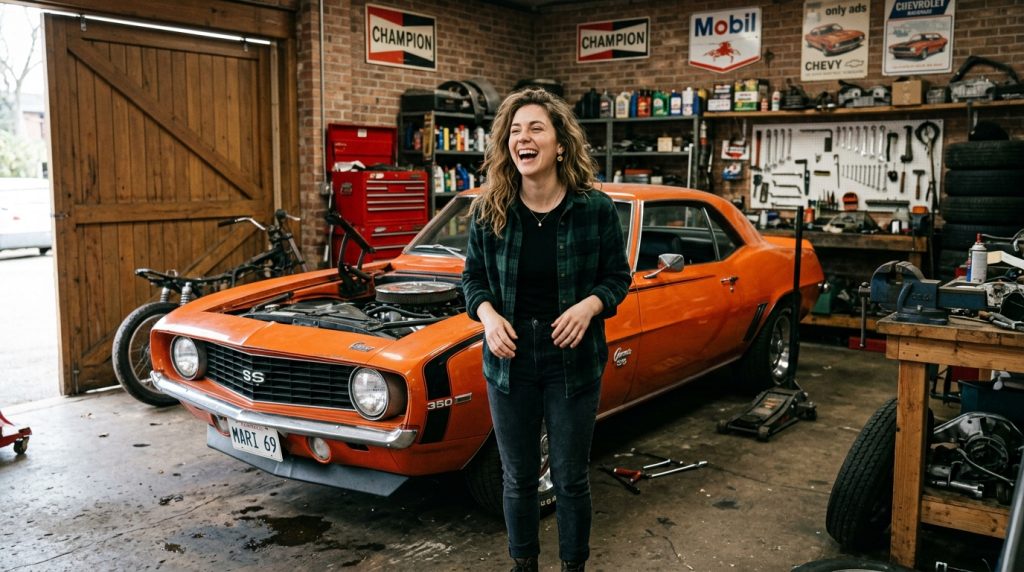
She came into the shop one November morning with a 1968 Camaro on a flatbed and a folder under her arm. She was not dressed like most customers. Steel-toed boots, dark jeans, hair tied back, no jewelry except a plain silver watch.
“You Caleb Mercer?” she asked.
“That depends how expensive this problem is.”
She smiled a little.
“It’s expensive.”
The Camaro had belonged to her father. He had started restoring it before he died, and three different shops had taken her money without finishing it. The engine was half assembled. The frame had hidden rust. The wiring looked like a bowl of black spaghetti.
Most people would have called it hopeless.
I stood there for ten minutes, looking under the hood.
Then I said, “It’s not dead.”
Marina looked at me carefully.
“That’s not what the last guy said.”
“The last guy was lazy.”
That made her laugh.
She hired me.
The Camaro took eight months.
During that time, Marina came by every Friday after work to check progress. She owned a small structural consulting firm, mostly inspections and failure analysis for old commercial buildings. She understood stress points, corrosion, load paths, drainage. I understood machines, metal, restoration, and how to rebuild things without losing their soul.
We started talking.
At first, it was about the car.
Then it was about business.
Then it was about life.
She never pushed. Never flirted in a way that made me uncomfortable. Never looked at my little shop like it was something she needed to rescue me from.
One evening, while we stood beside the Camaro’s freshly rebuilt engine, she said, “You know you’re doing more than repair work here, right?”
I frowned.
“What do you mean?”
“You solve problems other shops don’t even understand. Custom brackets, old frames, structural repairs, metal fatigue. That’s not just mechanic work.”
“It’s what my dad taught me.”
“Then your dad taught you something valuable.”
I almost looked away.
I was not used to hearing that anymore.
A few months later, Marina called me about a job. An old textile warehouse was being converted into apartments, and the contractors had discovered serious steel damage under the loading dock. They needed someone who could fabricate replacement supports without destroying the original structure.
“I told them about you,” she said.
“I fix cars.”
“You fix metal.”
“That’s different.”
“Not as different as you think.”
I took the job because I needed money.
That one job led to another.
Then another.
Within two years, Mercer Auto & Restoration became Mercer Structural Restoration. I kept the garage, but expanded into an old machine shop next door. Marina and I became partners on certain projects, then official partners when the work got too big for handshake agreements.
She handled engineering reports, inspections, client communication.
I handled fabrication, restoration planning, field repairs, and crews.
We did not get rich overnight. That only happens in movies and lies.
We grew slowly. Painfully. One good job at a time.
I hired two men, then five, then twelve. I paid them fairly because I remembered what it felt like to be treated like replaceable labor. We took on old bridges, historic buildings, parking structures, industrial conversions, and luxury developments when they needed someone careful enough not to cut corners.
By the sixth year after my divorce, I had a real office.
Not fancy. Brick walls. Old beams. Good coffee. A conference table Marina found at an estate sale.
The first time I sat in that office after everyone went home, I thought about Vanessa.
Not with longing.
With distance.
I realized I had spent years believing she left because I was not enough.
But maybe she left because she could not recognize enough unless it came wrapped in money.
That was her blindness.
Not my failure.
Grant Ellison walked back into my life on a Tuesday morning.
I knew it was him before I saw him.
Not because anyone announced him.
Because the room changed.
Some people bring warmth when they enter. Some bring noise. Grant brought pressure. He had that kind of presence that made receptionists sit straighter and junior employees question whether their shirts were tucked in.
I was in the back reviewing photos from a water-damaged parking deck when my assistant knocked.
“Caleb? There’s a Mr. Ellison here to see you.”
My pen stopped moving.
Marina, who was sitting across from me with a report open, looked up.
“Ellison as in Grant Ellison?”
I nodded once.
She knew enough about my past not to ask more.
“He says it’s urgent,” my assistant added.
I almost said I was unavailable.
Then something in me settled.
Six years earlier, Grant had sat in his Mercedes in my driveway while my wife left me in the rain. He had not even respected me enough to step out and face the damage he was helping cause.
Now he was in my building asking for me.
“Put him in the conference room,” I said.
Marina closed her folder.
“You want me there?”
“Yes.”
Grant was standing when we entered.
He looked older than the photos I had avoided. Still handsome in the polished way expensive men manage to look handsome. Gray at the temples. Tailored suit. Watch that could have paid my old mortgage for a year.
But there was something wrong.
His smile arrived half a second late.
“Caleb,” he said, extending his hand. “It’s been a long time.”
I looked at his hand.
Then I shook it.
“Mr. Ellison.”
A flicker crossed his face. He expected me to use his first name. Men like him counted familiarity as control.
“This is Marina Cole,” I said. “My business partner.”
Grant shook her hand too.
“I’ve heard good things.”
Marina sat down without smiling.
“That usually means there’s a bad problem.”
Grant laughed lightly.
“Straight to business. I like that.”
I did not sit immediately. I wanted him to feel the room before I gave him comfort.
“What do you need?”
He placed a leather folder on the table.
“I have a development outside Cincinnati. Silver Ridge Estates. Luxury townhomes. Private road, clubhouse, underground parking, retaining walls along the east slope.”
“I know the project,” Marina said.
Grant glanced at her.
“Then you know it’s important.”
“I know it was rushed.”
His smile thinned.
“We had an aggressive schedule.”
“That’s one way to say rushed.”
I sat down.
Grant opened the folder and slid photos toward us.
Cracks in concrete. Water staining. A bowed retaining wall. Settlement lines along a garage floor. Rust bleeding from anchor plates. Soil slumping near a drainage outlet.
Marina leaned forward.
I did too.
The mechanic in me saw broken parts.
The restoration specialist saw something worse.
Movement.
Not cosmetic cracking. Not normal settling. Something was shifting under that development.
“When were these taken?” Marina asked.
“Last week.”
“How long have you known?”
Grant paused.
“That’s complicated.”
“No,” I said. “That’s a number.”
His jaw tightened.
“Three months.”
Marina looked at me.
That answer already told us plenty.
“Residents?” I asked.
“Thirty-eight units occupied. The rest are pending closing.”
“Any evacuations?”
“Not necessary.”
Marina’s eyes sharpened.
“Who said that?”
“Our internal team.”
“An engineer?”
Grant looked annoyed.
“People qualified to assess risk.”
“That was not my question,” she said.
He shifted in his chair.
I opened another photo. It showed water pushing through a joint in the underground parking structure. Not dripping. Pushing.
“This is hydrostatic pressure,” I said. “Where’s the drainage system?”
Grant tapped the folder.
“In the plans.”
“That’s not what I asked.”
He looked at me then, really looked.
For a second, I saw the man from the driveway. The one who had everything and thought men like me existed only to service it.
Then he swallowed his pride.
“That’s why I’m here.”
Marina sat back.
“Say it clearly.”
Grant exhaled.
“We believe the original drainage work was not completed to specification. There may also be an issue with the fill material under portions of the east garage.”
“May be?” I asked.
“We’re investigating.”
“You’re hiding,” Marina said.
Grant turned cold.
“I came here for help, Ms. Cole, not accusations.”
“You came here because firms with bigger names won’t touch this quietly,” she replied. “So you found the one company skilled enough to fix it and small enough, you hoped, to pressure.”
The room went silent.
Grant looked at me.
“I chose your company because you’re good.”
“No,” I said. “You chose my company because you know me.”
His face hardened.
“Caleb—”
“Don’t.”
He stopped.
For the first time since he entered, Grant looked unsure.
I picked up the photo of the bowed wall.
“What do you want from us?”
“I need a repair plan. Fast. Quiet. No panic. No media. No city overreaction. You stabilize the wall, reinforce the garage, correct the drainage, and provide a report saying the property is safe.”
Marina’s expression did not change.
“Before we inspect it?”
Grant hesitated.
“I’m saying we need a path toward that conclusion.”
I almost smiled.
There it was.
Not help.
A signature.
A clean report.
A professional shield.
I slid the photo back to him.
“We don’t sell conclusions.”
His face flushed.
“I am not asking you to lie.”
“Yes,” I said calmly. “You are. You’re just using expensive words.”
Grant leaned forward.
“You don’t understand what’s at stake.”
“People live there.”
“My company employs hundreds.”
“People sleep above that garage.”
“Investors will pull out. Lenders will freeze everything. If this gets mishandled, it destroys years of work.”
Marina’s voice was quiet.
“If that wall fails, it may destroy more than work.”
Grant looked between us, then lowered his voice.
“I will pay whatever your emergency rate is.”
I thought of my old kitchen. The bills on the counter. Vanessa saying love didn’t pay bills.
Then I thought of thirty-eight families sleeping in beautiful townhomes built on a lie.
“Here’s what we can do,” I said. “We inspect the property. Independently. We review all plans, change orders, soil reports, drainage records, inspection logs, and communications with contractors. If there’s immediate danger, we notify the proper authorities.”
Grant’s eyes narrowed.
“That won’t work.”
“Then we’re done.”
He stood.
“You’re making this personal.”
I stood too.
“You made it personal six years ago. I’m making it professional.”
For a moment, I thought he might throw the folder at me.
Instead, he buttoned his suit jacket with stiff fingers.
“I’ll send the documents.”
“Send all of them.”
His mouth twisted.
“You always were stubborn.”
I looked him in the eye.
“No. I just stopped being desperate.”
Grant left without another word.
Through the conference room window, I watched him walk past my employees, past the machines, past the men and women doing honest work with their hands.
The same kind of world Vanessa had been so eager to escape.
Marina stood beside me.
“You okay?”
I took a long breath.
“I don’t know yet.”
She nodded toward the folder Grant had left behind.
“We need to look deeper.”
I already knew.
Because Grant Ellison was scared.
And men like him did not get scared because of cracks in concrete.
They got scared because of what the cracks might reveal.
The files arrived that evening.
Not all of them.
Just enough to pretend.
Grant’s office sent polished plans, inspection summaries, selected photos, and a timeline so clean it looked washed. Marina read for twenty minutes before she said, “This is a presentation, not documentation.”
I was at the other end of the table with a red pen.
“Missing soil compaction results for the east slope.”
“Missing change orders on drainage,” she added.
“No subcontractor correspondence.”
“No original geotechnical warnings.”
I looked up.
“You think there were warnings?”
“I think nobody makes this many omissions by accident.”
The next morning, we drove to Silver Ridge Estates.
It was beautiful in the way expensive places often are beautiful from a distance. Stone entrance sign. Fresh landscaping. Black iron gates. Townhomes with tall windows and clean roofs. A clubhouse with cedar beams and outdoor fire pits.
But beauty can be makeup.
We parked near the east side.
The first thing I noticed was the sound.
Water.
Not where it should have been. Not in a creek or drain. Under pavement. Behind walls. Moving where someone had tried to trap it.
Marina crouched near a crack along the garage entrance.
I walked the retaining wall.
The concrete had a slight belly outward. Not dramatic enough for most people to panic. Enough for me to feel sick.
A young woman came out of one of the townhomes carrying a toddler.
“Are you here to fix the garage?” she asked.
I turned.
“We’re inspecting it.”
She looked relieved.
“My husband keeps saying the cracks are normal, but our front door started sticking two weeks ago.”
Marina and I exchanged a look.
“What unit?” she asked.
“Eighteen.”
Marina wrote it down.
“Any water inside?”
“In the laundry room after heavy rain. They told us it was a plumbing issue.”
Of course they did.
By noon, we had enough concerns to demand full records.
By three, Grant was calling me personally.
“You spoke to residents?”
“They spoke to us.”
“That was not authorized.”
“Neither is gravity,” I said. “It still happens.”
He went quiet.
“You’re enjoying this.”
“No.”
“Don’t lie to me.”
“I’m not enjoying any of this. That’s the difference between us.”
He breathed hard into the phone.
“What do you want?”
“The missing records.”
“I sent records.”
“You sent theater.”
A pause.
Then he said, “Some files are sensitive.”
“People are living in those units.”
“You keep saying that like I don’t know.”
“I keep saying it because you’re acting like you forgot.”
He hung up.
Two hours later, another batch of documents came through.
This time, buried in the middle of a long email chain, I saw her name.
Vanessa Mercer.
Except she was not Mercer anymore.
Vanessa Ellison.
I stared at the screen.
Marina noticed.
“What is it?”
I turned the laptop toward her.
Vanessa’s name appeared under community relations and buyer communications. Her email was copied on complaints from early residents. Water intrusion. sticking doors. uneven floors. cracks near garage columns.
In one thread, a project engineer recommended delaying occupancy permits for east-side units pending further review.
Below that, Grant wrote:
“We are not delaying closings over theoretical concerns.”
Then Vanessa replied:
“I can help soften the language for buyers. We should avoid words like structural, slope, and water pressure.”
I read the sentence three times.
My stomach turned colder each time.
Marina said nothing for a while.
Then she said, “I’m sorry.”
I shook my head.
“She knew.”
“Maybe not everything.”
“She knew enough to hide words.”
That night, I stayed late at the office.
Not because I needed to.
Because I did not want to go home with Vanessa’s name in my head.
At 8:40, the front door opened.
I heard my assistant talking softly, then footsteps in the hall.
When Vanessa appeared in my office doorway, for one strange second, the years folded in half.
She was still beautiful.
But not in the same way.
The shine was there. The coat, the bag, the careful hair. Yet her face carried strain no makeup could cover. Her eyes moved around my office, taking in the brick walls, the framed project photos, the employees’ thank-you notes, the award from the preservation society.
She looked surprised.
That almost made me laugh.
“Caleb,” she said.
I stood behind my desk.
“Vanessa.”
She stepped in slowly.
“This is a nice place.”
“It works.”
Her eyes flickered. She remembered. That was what I always used to say about the old house, the old truck, the old garage.
It works.
She clasped her hands.
“I heard Grant came to see you.”
“You heard or he told you to come?”
Her face tightened.
“I came because I wanted to talk to you.”
“About Silver Ridge.”
“Yes.”
“Then talk.”
She glanced at the chair but did not sit.
“Grant is under a lot of pressure.”
“So are the retaining walls.”
“Caleb.”
“No, don’t Caleb me. Not here.”
Her eyes filled with hurt, and the old version of me almost responded to it. That was the dangerous thing about loving someone once. Some part of your body remembers before your mind can stop it.
She said, “I know things ended badly.”
I laughed once, not because it was funny.
“Badly? Vanessa, you left in another man’s car while I stood in the kitchen.”
She looked down.
“I was unhappy.”
“You were impatient.”
Her head lifted.
“That’s not fair.”
“No,” I said. “Fair was me working fourteen-hour days while you told yourself I had no ambition because my progress didn’t look expensive.”
She flinched.
Good.
Not because I wanted to hurt her.
Because truth should land somewhere.
She took a breath.
“I didn’t come here to fight.”
“Then why did you come?”
She pulled an envelope from her bag.
“These are internal emails. Not all of them. But enough to show Grant tried to fix things.”
I did not reach for it.
“Did he?”
She hesitated.
“We all made decisions with the information we had.”
“That sounds rehearsed.”
“It’s true.”
“Then say this unrehearsed. Did you help hide resident complaints?”
Her face went pale.
“Caleb…”
“Did you?”
Her voice dropped.
“I helped manage communication.”
“You changed words.”
“I made things less alarming.”
“For buyers.”
“For families who had already put everything into those homes,” she snapped. “Do you think panic helps them?”
“Truth helps them.”
“Truth can destroy people.”
“So can walls.”
Silence.
She looked at me then, and for a moment I saw fear. Not fear of losing Grant. Not fear of scandal.
Fear that I was no longer the man she could guide with tears.
“Grant said you’re threatening to report it.”
“If there’s immediate danger, we report.”
“You could ruin us.”
Us.
That word landed like a final signature on our divorce.
I nodded slowly.
“There it is.”
“What?”
“Us.”
Her lips parted.
“You think I came because of money.”
“I think you came because the rich man you left me for finally needs the poor man’s signature.”
She had no answer.
I walked around my desk and took the envelope from her hand.
“I’ll review it.”
Relief flashed across her face.
“But understand this,” I said. “If anything in here proves your company endangered residents, I won’t bury it.”
Her eyes hardened.
“You’ve changed.”
“No,” I said. “I just finally believe myself.”
She turned to leave.
At the doorway, she stopped.
“I did love you, Caleb.”
I looked down at the envelope.
“Maybe. But not enough to respect me.”
She left.
This time, no Mercedes waited outside my window.
But I still heard the echo of one.
The envelope Vanessa brought did not save Grant.
It buried him.
At first, it looked helpful. Emails about budget approvals. Contractor delays. Drainage redesigns. Notes showing that Grant had asked questions and received vague answers.
But Marina saw the problem before I did.
“She gave you the middle of the story,” she said.
“What do you mean?”
“She included emails where Grant looks concerned after the damage started. But look at the dates.”
I leaned closer.
The first warnings about drainage failures were not from three months ago.
They were from two years ago.
Before occupancy.
Before sales closed.
Before families moved in.
Marina opened another file from our own document request. It was a scanned memo from a geotechnical consultant. The east slope contained unstable fill from a previous excavation site. The consultant recommended either removal and replacement or deep foundation redesign.
Attached to that memo was a note from Grant’s construction director:
“Cost increase unacceptable. G.E. wants alternate language.”
G.E.
Grant Ellison.
Then came another email.
Vanessa was copied.
The revised buyer-facing statement described the issue as “routine site moisture management.”
Routine.
Moisture.
Management.
Three soft words standing where a warning should have been.
I pushed back from the table.
For years, I had imagined Grant as the man who stole my wife.
Now I saw him more clearly.
He had not stolen anything.
He had simply offered Vanessa a world where every ugly thing could be renamed until it sounded beautiful.
Debt became leverage.
Delay became strategy.
Danger became concern.
Lies became language.
And love became not enough.
The next morning, we issued our preliminary report.
It stated that the east retaining wall and portions of the underground parking structure showed signs of active movement and water pressure. It recommended immediate independent structural review, temporary restrictions on garage access, resident notification, and municipal involvement.
Grant called seventeen minutes after receiving it.
I put him on speaker with Marina present.
“You had no right to send this to the city,” he said.
“We had a professional obligation.”
“You work for me.”
“No,” I said. “We were evaluating whether we could work for you. Now we can’t.”
“You self-righteous son of a—”
Marina cut in.
“Mr. Ellison, threats should be directed to counsel.”
He ignored her.
“Caleb, listen to me. You don’t know what you’re doing. Once this starts, it doesn’t stop.”
“That’s usually how truth works.”
“You think this makes you better than me?”
“No. I think not hiding it makes me able to sleep.”
He lowered his voice.
“I can make your company regret this.”
I looked across the table at Marina. She was calm, but her pen had stopped moving.
“You already tried to make me regret being myself once,” I said. “It didn’t work then either.”
I hung up.
The city ordered emergency inspections within forty-eight hours.
By the end of the week, the underground parking area was closed. Three east-side units were temporarily evacuated. Local news picked up the story after residents began talking. Grant’s company issued a statement full of polished concern and empty responsibility.
Then the documents leaked.
Not from me.
Not from Marina.
I never found out who sent them.
But I know this: once people saw the emails, the story changed.
It was no longer about unexpected structural problems.
It was about warnings ignored.
Reports softened.
Buyers misled.
Families placed at risk so closings could continue.
Grant Ellison stopped smiling in public.
His investors sued. Residents sued. The city opened an investigation. State regulators got involved because public safety reports may have been misrepresented.
Vanessa’s name appeared in articles too.
Not as the villain.
Not at first.
But as the executive who helped manage buyer communication during the period when complaints were minimized.
I did not celebrate.
That surprised some people.
One of my crew members slapped a newspaper on my desk and said, “Man, your ex is getting what she deserves.”
I looked at the photo of Vanessa walking into a courthouse beside Grant.
She was wearing sunglasses again.
Like the day of our divorce.
But this time, they did not look stylish.
They looked like armor.
I folded the paper.
“Nobody gets what they deserve without other people getting hurt around them.”
He frowned.
“You feel bad for her?”
I thought about that.
“No,” I said. “But I don’t enjoy watching fires just because I didn’t start them.”
The repairs at Silver Ridge became bigger than anyone wanted to admit.
Grant’s company was removed from direct control by court order during the safety work. An independent receiver took over emergency decisions. Mercer Structural Restoration was asked to help stabilize portions of the site because we already knew the conditions.
I almost refused.
Marina asked me one question.
“Are you refusing because it’s wrong for the company, or because it hurts?”
I hated that question.
Because it was a good one.
The residents still needed help. The walls still needed support. The water still needed somewhere to go. My feelings did not get to matter more than their safety.
So we took the job under court supervision, with full transparency and independent oversight.
No private favors.
No hidden reports.
No Grant.
For three months, our crews worked through mud, rain, cold mornings, and long nights. We installed temporary shoring. Opened failed drains. Removed bad fill. Reinforced the retaining wall. Helped design permanent corrections with Marina’s engineering team.
Residents brought coffee. Kids watched from behind temporary fencing. One older man named Mr. Alvarez shook my hand every Friday and said, “Thank you for not treating us like numbers.”
That mattered more to me than any check.
One afternoon, I was standing near the east slope when Vanessa arrived.
No cameras were there. No Grant. No sunglasses.
Just Vanessa in a beige coat, standing outside the construction fence like she was unsure whether she had the right to speak.
I walked over.
“Are you allowed to be here?” I asked.
She gave a sad little smile.
“I’m not sure where I’m allowed to be anymore.”
I said nothing.
She looked past me at the workers.
“You fixed it.”
“We’re fixing it.”
“You always did that.”
“What?”
“Fixed things other people broke.”
I looked at her carefully.
Years ago, that sentence would have pulled me toward her. Now I heard the need inside it.
She was not complimenting me.
She was looking for a place to put her wreckage.
“How much did you know?” I asked.
Her face changed.
Maybe she had expected anger. Maybe she had expected softness.
She got a question instead.
“Enough,” she whispered.
The wind moved between us.
“I told myself Grant understood things I didn’t,” she said. “Engineering, reports, legal language. I told myself my job was just communication.”
“But you knew the words mattered.”
She nodded, and tears spilled down her cheeks.
“I knew.”
It was the first honest thing she had said to me in years.
“I was so afraid of going backward,” she continued. “Back to bills. Back to small rooms. Back to feeling like life was closing in. Grant made everything feel safe because it was expensive. I thought expensive meant solid.”
I glanced back at the cracked pavement being cut open behind us.
“It doesn’t.”
“No,” she said. “It doesn’t.”
For a moment, neither of us spoke.
Then she looked at me in a way I recognized.
Not exactly love.
Regret wearing love’s old clothes.
“I made the biggest mistake of my life leaving you.”
I looked down at my hands.
They were dirty from the site. Scratched. Older than they had been when she left. Stronger too.
“Maybe,” I said.
She stepped closer.
“Caleb—”
“No.”
She stopped.
I did not raise my voice. I did not need to.
“No?” she repeated.
“No to whatever you’re about to ask from the man you remember.”
Her mouth trembled.
“I wasn’t going to ask anything.”
“Yes, you were.”
She wiped her face.
“I lost everything.”
I looked at her then.
“No. The people who bought these homes almost lost everything. You lost what was built on top of a lie.”
Her eyes closed.
That one hurt her.
It was supposed to.
Not because I wanted revenge.
Because sometimes mercy without truth is just another cover-up.
She whispered, “Do you hate me?”
I thought about the kitchen. The rain. The Mercedes. The years I spent measuring myself against a man who turned out to be hollow steel and bad concrete.
“No,” I said.
Her eyes opened.
“I don’t hate you. I don’t love you either. Not the way you want. I think I finally put you down.”
She cried harder then, but quietly.
I almost reached for her shoulder.
Almost.
Then I remembered the man I had been and the man I had become.
I kept my hands at my sides.
“I hope you tell the truth,” I said. “Not because it will save you. Because it may save what’s left of you.”
I walked back through the gate.
Behind me, Vanessa stayed by the fence for a long time.
Then she left.
Grant Ellison came to me one last time before the hearings began.
He did not come to my office.
He waited outside my old garage.
Mercer Auto & Restoration was still there, though we used it mostly for specialty work now. I kept my father’s sign above the door because some things should not be replaced just because they are old.
It was late evening. I had gone there alone to work on an old pickup engine, something simple enough to quiet my mind.
When I stepped outside, Grant was leaning against a black SUV.
Not a Mercedes this time.
I wondered if he had sold it.
He looked thinner. His suit was still expensive, but it hung differently on him.
“Caleb,” he said.
I locked the shop door.
“You shouldn’t be here.”
“I won’t take much time.”
“You have lawyers for talking.”
“I’m not here as Ellison Development.”
“No?”
He looked at the old garage sign.
“I understand now why Vanessa hated this place.”
My jaw tightened.
He smiled faintly.
“Not because it was ugly. Because it was honest. People who lie for a living don’t like honest rooms.”
I did not respond.
He pushed away from the SUV.
“I built too fast.”
“You endangered people.”
“I know.”
I studied him.
Those two words sounded unfamiliar coming from him. Not polished. Not useful. Just tired.
“Then say that in court.”
He looked at me.
“I might go to prison.”
“You might.”
“You don’t care?”
I thought about it.
“I care that the residents are safe. I care that my company told the truth. I care that my employees still believe their names mean something when they sign a report.”
“And me?”
“You’re not my responsibility.”
He gave a small laugh.
“Vanessa said almost the same thing.”
That surprised me.
“She’s cooperating,” he said. “Giving them emails. Meeting notes. Everything.”
I looked away toward the dark road.
Part of me was relieved.
Part of me was sad.
Most truths are not clean. They arrive covered in damage.
Grant said, “You know, when she first talked about you, I thought you were weak.”
I looked back at him.
“She said you were kind. Patient. Loyal. Worked too much. Never knew when to quit on something broken.”
His face shifted.
“I mistook that for weakness.”
“A lot of people do.”
He nodded.
“I need help.”
There it was again.
Years later.
The rich man had come to me for help.
But this time, he was not asking for a false report.
At least, I hoped not.
“What kind?”
He swallowed.
“My daughter lives in one of the west units.”
I stared at him.
“Your daughter?”
“From my first marriage. She and her husband bought before the public offering. I gave them a discount.” His voice cracked slightly. “They have a baby.”
For the first time, I saw Grant Ellison not as a rival, not as a villain, not as a man in a Mercedes, but as something much smaller.
A father who had built danger under his own child’s feet.
“She’s safe,” I said. “West units tested better. We’re still monitoring drainage, but she’s not in the evacuation zone.”
His eyes shone under the parking lot light.
“You’re sure?”
“I don’t say sure unless I can stand behind it.”
He nodded slowly.
“I believe that.”
That was probably the first real respect he had ever given me.
It came too late to matter much.
“I can ask Marina to send the latest resident safety summary through the official channel,” I said. “No private favors. No hidden conversation.”
“I understand.”
He turned to leave, then stopped.
“For what it’s worth, I didn’t win.”
I said nothing.
He looked back at the garage.
“I thought I took your life and made mine bigger. But everything I built needed lies to hold it up.”
His voice dropped.
“You had less. But what you had was real.”
Then he got into the SUV and drove away.
I stood under my father’s old sign for a while.
The night smelled like cold pavement and motor oil.
For the first time in years, the memory of that Mercedes in the rain did not hurt the same way.
It was just a car.
Just a night.
Just the beginning of a road I never would have chosen, but somehow had survived.
The hearings lasted months.
Grant pleaded guilty to several charges tied to misrepresentation and endangerment. Not everything stuck. People with money rarely fall as far as they should. But he fell enough.
His company collapsed under lawsuits and debt.
Vanessa testified.
I did not watch live. Marina read the summary and told me only what mattered.
“She told the truth,” she said.
I sat with that for a moment.
“Good.”
“That’s all?”
“That’s all I have room for.”
Vanessa was not charged as heavily as Grant, but her reputation was gone. She lost the house, the social circle, the charity boards, the beautiful life that had been built like Silver Ridge itself: polished outside, unstable underneath.
A year later, a letter came to my office.
No return address, but I knew her handwriting.
I almost threw it away.
Instead, I opened it alone.
Caleb,
I know I have no right to ask you for forgiveness.
So I won’t.
I only want to say what I should have said years ago.
You were never small.
I was.
I measured life by the wrong things. I called your patience weakness. I called your honesty lack of ambition. I called your simple life a failure because I was too afraid to admit I did not know how to be grateful.
When I left, I told myself I was choosing a better future.
But really, I chose a mirror that made me look important.
You were the last honest place I had, and I walked out of it.
I am sorry.
Vanessa
I read it twice.
Then I folded it and placed it in my desk drawer.
Not because I needed to keep it.
Because I did not need to burn it.
That is how I knew I was free.
That evening, Marina and I walked through the finished Silver Ridge site. The court-appointed receiver had renamed it Ridgeview Commons after repairs were complete and ownership changed. It was less luxurious now. Less theatrical. More honest.
The east wall had been rebuilt. Drainage corrected. Monitoring systems installed. Residents had full reports, real updates, and a say in the process.
Mr. Alvarez saw me and waved from his porch.
His granddaughter was drawing with chalk on the sidewalk.
A bright yellow sun.
A blue house.
A crooked stick figure family.
I stopped and looked at it longer than I expected.
Marina stood beside me.
“You okay?”
I nodded.
“Yeah.”
She smiled.
“You always say that when you’re thinking too much.”
“My father used to say buildings and people fail the same way.”
“How’s that?”
“Slowly at first. Then all at once. Unless someone catches the cracks early.”
Marina looked at the rebuilt wall.
“And did someone catch yours?”
I turned to her.
The sun was going down behind the townhomes, lighting the windows gold. For a second, I thought about how badly I once wanted a life that looked impressive from the outside.
Now I wanted something different.
A life that could survive inspection.
“Yeah,” I said. “Eventually.”
Years ago, my wife left me for a rich man because she thought money meant safety.
Years later, that rich man came to me for help because everything he built was falling apart.
People called it karma.
Maybe it was.
But I think karma is not always thunder and punishment.
Sometimes karma is quieter than that.
Sometimes it is the day the people who looked down on you have to look up and ask for your name.
Sometimes it is watching the life they chose expose itself without you lifting a hand.
And sometimes it is realizing that the person who abandoned you did not take your worth with them.
They only took their chance to share it.
Vanessa once told me love did not pay bills.
She was right.
Love alone does not pay bills.
But neither does greed pay for peace.
And when everything cracked open, the rich man’s money could not buy what he needed most.
Trust.
A clean name.
A person willing to tell the truth.
I still keep my father’s old sign above the garage.
Mercer Auto & Restoration.
Most days, I work from the new office now. Bigger projects. Bigger crews. Better coffee.
But sometimes, when the world gets too loud, I go back to that little garage and fix something with my hands.
An engine.
A hinge.
A broken frame.
Not because I have to.
Because it reminds me who I was before someone tried to make me ashamed of it.
And who I became after I refused to stay broken.
END