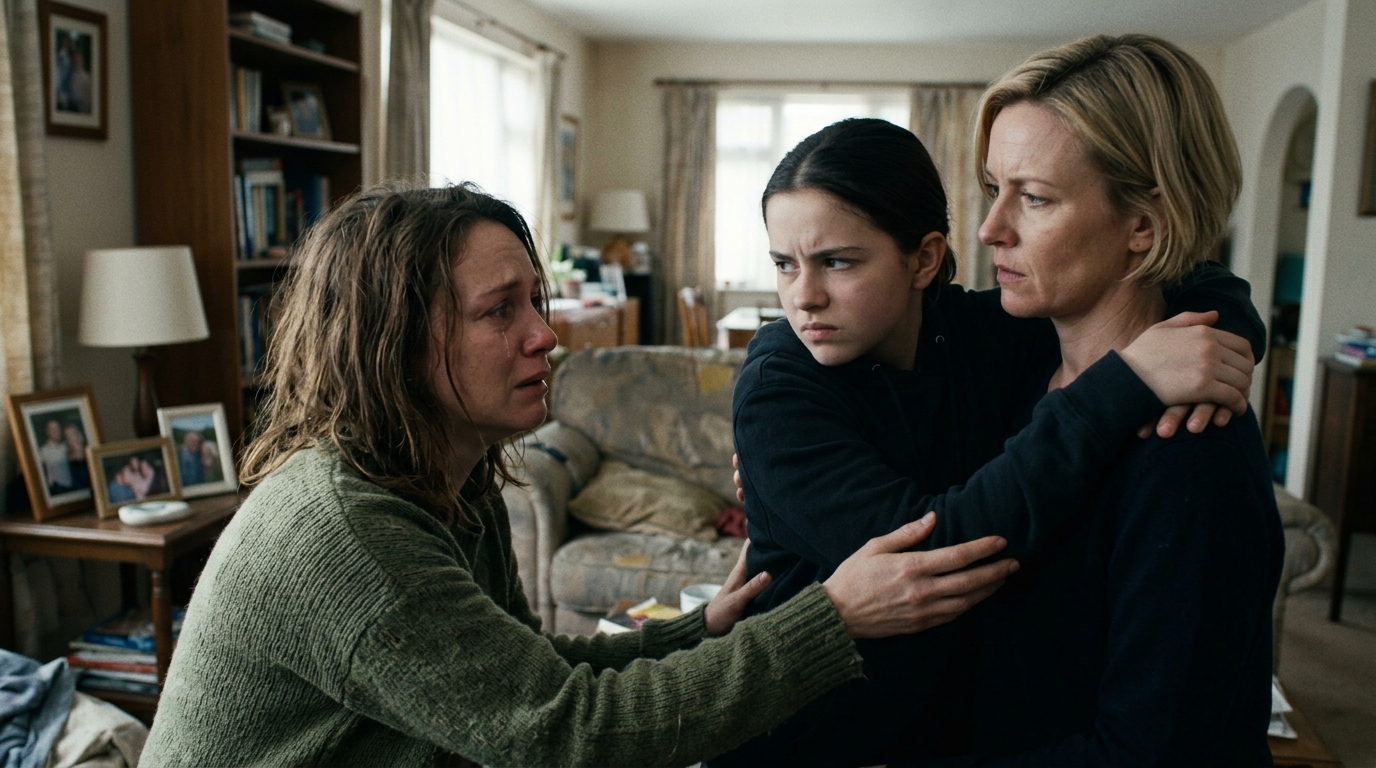
The first words my sister’s daughter ever said to me were:
“Mom told me you tried to steal me when I was a baby.”
She said it beside my mother’s casket.
There were nearly fifty people inside the funeral home that afternoon, but for a moment, I could not hear any of them. Not the low organ music. Not the whispered condolences. Not the rain tapping against the stained-glass windows.
I could only look at the eighteen-year-old girl standing in front of me.
Sophie Hayes had my eyes.
Not eyes that merely resembled mine. They were the same unusual gray-blue color my father used to call storm glass. Then she turned her head slightly, and I saw something that made my body forget how to breathe.
A small crescent-shaped birthmark behind her left ear.
I knew that mark because the doctor had shown it to me seconds after my daughter was born.
Before they took her away.
Before my mother entered the room and told me my baby had stopped breathing.
Before my older sister Rachel held my hand while I screamed.
I had spent eighteen years believing my daughter was dead.
Sophie folded her arms and looked at me with the kind of coldness people usually reserve for strangers who have hurt someone they love.
“You should leave,” she said. “My mother doesn’t want you here.”
Across the room, Rachel was watching us.
My older sister looked almost exactly as I remembered her. Perfect posture. Careful makeup. Dark hair pinned neatly at the back of her neck. Not one strand out of place. She crossed the room slowly, placed a protective hand on Sophie’s shoulder, and smiled at me the way people smile when other people are watching.
Then she leaned close enough that only I could hear her.
“Stay away from my daughter.”
I should have walked out.
Instead, I looked once more at that birthmark.
And for the first time in eighteen years, the grief I had buried began clawing its way back to the surface.
My mother’s name was Margaret Carter.
To everyone in Briar Glen, Ohio, she had been a devoted church volunteer, a loyal neighbor, and the kind of woman who never missed a funeral, a casserole drive, or a Sunday service.
To me, she was the woman who had held my shoulders down while I begged to see my dead baby.
At least, that was what I believed for eighteen years.
I left Briar Glen when I was seventeen. I did not come back for Christmas, birthdays, graduations, or family reunions. If Rachel sent cards, I threw them away unopened. If my mother called, I let the phone ring until silence returned.
Then the funeral home called.
“Emily Carter?” a woman asked. “I’m sorry to inform you that your mother passed away Tuesday morning.”
I stood in the break room at the hospital records office where I worked in Columbus, holding a paper cup of coffee that suddenly tasted like dust.
For a few seconds, I said nothing.
Then I asked, “Was she alone?”
The woman paused.
“No,” she said gently. “Your sister was with her.”
Of course Rachel was with her.
Rachel had always been the daughter who stayed. The daughter who behaved. The daughter who knew which fork to place beside the plate and how to smile through anything.
I almost did not go.
But grief is strange. Sometimes it pulls you toward people you swore you would never face again, not because you forgive them, but because some part of you needs to see the last door close.
So I drove three hours back to Briar Glen in the rain.
The town looked smaller than I remembered. The diner on Main Street had a new sign. The pharmacy had become a coffee shop. But the funeral home was exactly the same—white columns, brass handles, and flower arrangements placed in a line like proof that the dead had been loved.
Rachel met me near the entrance.
For one brief second, I saw my sister. Not the woman who had become a stranger, but the girl who used to braid my hair before school and sneak me extra frosting from birthday cakes.
Then her face tightened.
“Emily,” she said.
“Rachel.”
She kissed my cheek for the people behind us, but her body remained stiff.
“You came.”
“She was my mother.”
Rachel’s eyes flicked toward the room where the casket stood. “She asked for you at the end.”
I hated that the words hurt.
“What did you tell her?” I asked.
Rachel looked at me. “That you had made your choice a long time ago.”
There it was. Not even five minutes home, and she was already rewriting the story.
I stepped past her before I could say something I would regret in front of half the town.
My mother looked smaller in the casket. Death had softened her face in a way life rarely had. Her hands were folded over a rosary, and for a moment, I remembered those same hands buttoning my winter coat when I was six.
Then I remembered those hands taking my baby.
I stood there longer than I intended.
People came to me quietly.
“Your mother loved you.”
“She talked about you often.”
“She always hoped you would come home.”
I nodded because that was what people do at funerals. They accept kind lies from strangers because correcting them would only make the room colder.
Then I saw her.
Sophie.
She stood near a display table filled with family photographs. Eighteen years old, maybe five-six, with soft brown hair and those impossible gray-blue eyes.
I knew she had to be Rachel’s daughter. I had heard about her in old messages I never returned. Sophie’s dance recital. Sophie’s honor roll. Sophie’s college acceptance.
Rachel’s miracle baby.
The child she claimed to have adopted through a private arrangement after years of infertility.
I had seen one photo of Sophie years earlier, mailed by someone in town who thought I deserved to know my sister had become a mother. I had torn the photo in half because I was twenty-one and still too angry to breathe.
But seeing Sophie in person was different.
She looked like me at seventeen.
Not completely. There was Rachel in her too, or at least the influence of Rachel. The posture. The controlled expression. The careful way she watched a room before deciding what to say.
But the eyes were mine.
I was still staring when Sophie walked toward me.
“You’re Emily,” she said.
Her voice held no warmth.
“I am.”
“Mom told me you tried to steal me when I was a baby.”
The words landed so hard I almost stepped backward.
“What?”
Sophie’s mouth tightened. “She said you had problems after your own baby died. She said you got confused and became obsessed with me.”
I looked across the room at Rachel.
She was watching.
Of course she was watching.
“I never tried to steal you,” I said quietly.
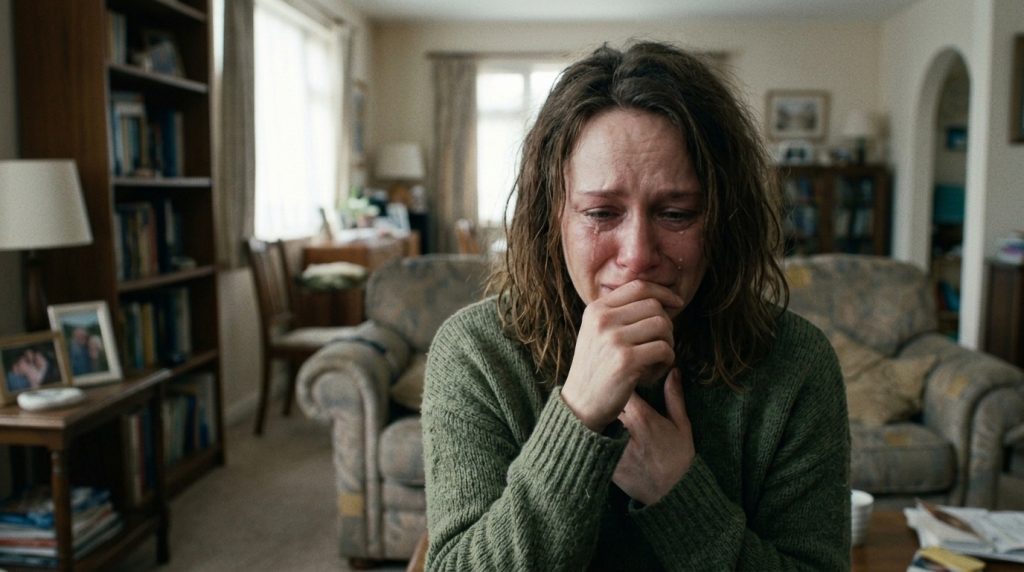
Sophie gave a humorless laugh. “That’s not what my family says.”
My family.
The words cut deeper than they should have.
Before I could answer, Rachel was beside us.
“Sophie,” she said softly. “Go check on Daniel, sweetheart.”
Sophie hesitated, still glaring at me, then walked away.
Rachel waited until her daughter was out of earshot.
“You do not speak to her about the past,” she said.
“Why does she think I tried to steal her?”
Rachel’s face remained calm, but her eyes turned hard. “Because you were sick, Emily.”
“I was grieving.”
“You were unstable.”
“My baby died.”
Something flickered across her face. Not guilt exactly. Fear.
Then it disappeared.
“Yes,” she said. “And everyone suffered because of it.”
The funeral continued. People cried. The pastor spoke about forgiveness and family. Rachel stood in the front row with Sophie and Daniel, her husband, while I sat three rows behind like a guest who had wandered into the wrong service.
After the burial, everyone returned to my mother’s house.
That house sat at the end of Birch Lane, with white shutters and a maple tree in the front yard. I had spent my childhood there. I had also spent the worst night of my life there after coming home from the hospital without my child.
The inside smelled like furniture polish and coffee. People filled the living room, balancing paper plates of food and speaking in low voices.
I walked past them and studied the framed photographs along the hallway.
Rachel and Sophie at the lake.
Sophie on her first day of kindergarten.
Sophie in a Halloween costume.
Sophie holding a spelling bee trophy.
Sophie at prom.
But nothing before she was three or four weeks old.
No hospital photo.
No newborn photo in Rachel’s arms.
No pregnant Rachel.
No adoption day photo.
I picked up the earliest picture. Rachel sat on the porch holding a sleeping baby wrapped in a yellow blanket. The baby already had round cheeks and open, alert eyes.
Rachel appeared behind me.
“Looking for something?”
I set the photo down. “I just realized I’ve never seen pictures from when Sophie first came home.”
Her smile was instant and empty. “We lost some boxes during a move.”
“You never moved from this town.”
“I moved for a while before Daniel and I married. You would know that if you had cared to stay in touch.”
Before I could reply, Sophie entered the hallway.
“Mom?” she said.
Rachel’s whole body changed. Softer voice. Softer face.
“Yes, honey?”
“Grandma’s lawyer called. He said he’ll come by tomorrow.”
Rachel nodded. “Thank you.”
Sophie looked at me once, then turned away.
That night, I stayed in my old bedroom because the rain had turned into a storm and the roads were bad. Rachel hated the idea, but too many relatives were present for her to refuse without looking cruel.
Around midnight, I woke to voices in the hall.
Rachel and Sophie.
“She scares me,” Sophie said.
“I know,” Rachel replied.
“Why did Grandma want her here?”
A pause.
Then Rachel said, “Your grandmother had regrets. Old people get sentimental near the end.”
“Did Emily really try to take me?”
Rachel’s answer came without hesitation.
“Yes.”
I sat up in bed.
“She lost her own baby,” Rachel continued. “And grief broke something in her. For a while, she convinced herself you belonged to her.”
My hands curled into fists around the blanket.
Sophie whispered, “That’s sick.”
“I know. But you’re safe. I won’t let her hurt you.”
Their footsteps moved away.
I did not sleep again.
Before dawn, I packed my bag. I told myself I was leaving. I had survived eighteen years by staying away from this house, and nothing good would come from opening old wounds.
Then I noticed the porcelain bird on my mother’s dresser.
It was small, white, and chipped near the wing. When I was little, my mother used to hide spare buttons inside it. Once, she hid my father’s wedding ring there after he died because she could not bear to look at it.
I picked it up.
Something rattled.
Inside was a tiny brass key.
I knew immediately what it opened.
My mother’s sewing box.
The box sat at the back of her closet beneath folded quilts. Dark wood. Brass latch. Always locked.
When I turned the key, the lid lifted with a soft click.
At first, I saw ordinary things. Thread. Measuring tape. Old needles. Fabric scraps.
Then I saw a small envelope tucked beneath the lining.
My name was written on it.
Emily.
Inside was a hospital bracelet.
Mine.
My full name. Emily Rose Carter.
Date of birth. Hospital number. Admission date.
August 14.
My daughter’s birthday.
My hands began shaking before I saw the second bracelet.
Baby Girl Carter.
The identification numbers matched mine.
Beneath the bracelets was a folded discharge form from St. Agnes Maternity Center.
I read the final line three times.
Infant female discharged in stable condition.
Stable condition.
Not deceased.
Not transferred.
Not gone.
Alive.
I sank onto the floor of my mother’s closet, clutching the paper so tightly it crumpled at the edges.
My baby had never died.
And somewhere upstairs, Rachel was sleeping peacefully in the same house where she had taught my daughter to hate me.
At seventeen, I knew almost nothing about raising a child.
But I knew I loved mine.
Her father was a boy named Caleb Morris, and I use the word father only because biology requires a name. He was nineteen, charming in the lazy way careless boys can be charming, and completely gone by the time I was four months pregnant.
When I told him, he stared at me like I had handed him a bill he did not want to pay.
“I can’t do this,” he said.
I remember asking, “Can’t or won’t?”
He did not answer.
By the next week, he had left town to work with his uncle in Kentucky. I never saw him again.
My mother reacted worse.
She sat at the kitchen table with both hands pressed flat against the wood, as if holding herself down.
“You are seventeen,” she said.
“I know.”
“You are still in high school.”
“I know.”
“What will people say?”
That was my mother’s first fear. Not my health. Not the baby. People.
Rachel was different.
At least, I thought she was.
She was twenty-four then, already married once and divorced quietly before the wedding photos had even faded. She had recently found out she might never carry a child, but she never told me directly. I only overheard pieces. Doctor. Scar tissue. Low chance. Maybe impossible.
When she learned I was pregnant, she came to my room and sat beside me on the bed.
“You don’t have to be scared,” she said.
I cried into her shoulder until her blouse was wet.
She helped me hide the pregnancy at first. Oversized sweaters. Doctor appointments two towns away. Prenatal vitamins tucked into an aspirin bottle.
Then she started buying things.
A tiny yellow blanket.
White socks.
A stuffed rabbit with one floppy ear.
My mother hated it.
“You are encouraging fantasy,” she told Rachel.
Rachel snapped back, “No, I’m encouraging her not to hate her child.”
Those words made me love her more than anyone in the world.
By my seventh month, I had a plan. Not a perfect plan. Not even a good plan. But a plan.
I would finish school through home study. I would work part-time at the grocery store. I would share my room with the baby until I could afford an apartment.
Was I naive? Yes.
Was I terrified? Every day.
But I never once thought of giving her away.
Then labor came early.
It was raining that night too. I remember that because my mother kept complaining about the roads while I curled in the back seat, gripping Rachel’s hand.
“Why aren’t we going to County General?” I asked.
“St. Agnes is better for privacy,” my mother said.
“It’s far.”
“It’s already arranged.”
That word stayed with me.
Arranged.
St. Agnes Maternity Center stood outside a town called Mercer Ridge. It was smaller than a hospital, more like an old clinic converted from a house. The walls were pale green. The waiting room smelled like bleach and lavender.
A nurse named Lorraine Bell checked me in.
She had kind eyes and silver threaded through her dark hair. She told me I was doing fine. She told me to breathe. She told me my baby had a strong heartbeat.
Rachel stayed beside me through every contraction.
“You’re almost there,” she whispered.
At 3:42 in the morning, my daughter was born.
I heard her cry.
People who have never had a child sometimes think a newborn’s cry is just noise. It is not. It is proof. It is announcement. It is the universe saying, she is here.
The doctor lifted her briefly.
“A girl,” he said.
I started crying so hard I could barely see.
They placed her on my chest for a few seconds. She was warm and slippery and furious, with one tiny fist pressed against her cheek.
“She has a birthmark,” the doctor said gently.
He turned her head just enough for me to see the small crescent behind her left ear.
I touched it with one finger.
“Hi,” I whispered. “I’m your mom.”
Then something went wrong.
At first, I saw the nurse’s face change. Then the doctor said something sharp. Then there was movement, pressure, voices.
I was bleeding too much.
Rachel was pushed back.
My mother was crying.
Someone took the baby from my chest.
“No,” I said. “Wait.”
Lorraine leaned over me. “Emily, we need to take care of you.”
“My baby.”
“She’s okay,” Lorraine said. “She’s okay.”
Those were the last words I heard before everything went black.
When I woke, the room was dim.
My body felt hollowed out.
My mother sat beside the bed. Rachel stood near the window with her arms wrapped around herself.
“Where is she?” I asked.
My mother’s eyes filled with tears.
No.
I knew before she spoke.
“No,” I said.
“Emily,” she whispered.
“Where is my baby?”
Rachel began crying.
My mother took my hand. “She stopped breathing.”
The room tilted.
“No.”
“They tried everything.”
“No, I heard her cry.”
“I know.”
“I held her.”
“I know, sweetheart.”
I tried to sit up, but pain tore through me. “I want to see her.”
My mother looked at Rachel.
Rachel covered her mouth.
“Where is she?” I screamed.
My mother began crying harder. “Please don’t make this harder.”
That sentence became the wall I hit for years.
Please don’t make this harder.
I asked for a death certificate. My mother said it would come later.
I asked about burial. She said the clinic had arrangements because I had been unconscious.
I asked for the blanket. Rachel gave me the yellow one she had bought, but it did not smell like my daughter. It smelled like detergent.
Two days later, I went home with empty arms.
No funeral.
No grave.
No photograph.
No footprint card.
Nothing.
For weeks, I walked around my mother’s house like a ghost. Milk came in for a baby I did not have. My body healed around an absence. At night, I heard phantom crying and woke with my hands searching the blankets.
Rachel stayed at first.
She cooked soup. Brushed my hair. Sat on the edge of my bed while I cried.
“I should have held her longer,” I said once.
Rachel looked away.
“You were sick,” she replied.
“I should have fought.”
“You couldn’t.”
A month later, I found a folded paper in my mother’s purse. It had my name on it, and words like guardianship, temporary, medical authorization.
When I asked her about it, she snatched it from my hand.
“What is this?”
“Hospital paperwork.”
“Why does it say guardianship?”
Her face went white.
Then she slapped me.
It was the only time my mother ever hit me.
The next morning, she called my aunt in Indiana. By the end of the week, I was sent away “to recover.”
Rachel hugged me on the porch.
“You’ll understand one day,” she whispered.
I did not understand.
Six months later, someone mailed me a photograph with no return address.
Rachel stood outside my mother’s house holding a baby girl.
On the back, someone had written:
Rachel’s adopted daughter, Sophie.
I stared at that picture until the paper bent in my hands.
Then I threw up in the sink.
I called my mother. She said Rachel had adopted privately and that I needed to stop turning everything into my tragedy.
I called Rachel. She did not answer.
I wrote one letter.
I was angry. Seventeen. Broken in a way I did not know how to explain.
I wrote:
I never want to see any of you again.
Rachel kept that letter for eighteen years.
Not because it hurt her.
Because one day she would use it as a weapon against my daughter.
I did not confront Rachel immediately after finding the bracelets.
That was the hardest thing I had ever done.
The seventeen-year-old inside me wanted to storm upstairs, drag her out of bed, and scream until the walls shook.
But the thirty-five-year-old woman sitting on my mother’s closet floor knew better.
Rachel had already built a story.
Emily was unstable.
Emily was obsessed.
Emily tried to steal Sophie once.
If I screamed, Rachel would win before the truth even had a chance to stand up.
So I took pictures of everything.
The bracelets.
The discharge form.
The envelope.
The inside of the sewing box.
Then I returned the box to the closet and slid the papers into my bag.
At breakfast, Rachel behaved as if nothing had changed.
She wore a cream sweater and poured coffee into my mother’s blue mugs. Sophie sat beside her, scrolling through her phone. Daniel, Rachel’s husband, read messages from the funeral home director.
Daniel was not what I expected.
He had a tired kindness about him. A man who apologized when he stepped around you. He had married Rachel when Sophie was three, so he had not been there when Sophie was born.
At least, that was what I remembered hearing.
“Emily,” he said gently. “I’m sorry about your mother.”
“Thank you.”
Rachel did not look at me.
The doorbell rang at nine.
A man in a gray suit stood on the porch holding a leather folder.
“Thomas Whitaker,” he said. “I was Margaret’s attorney.”
Rachel stiffened slightly.
Mr. Whitaker greeted everyone, then turned to me.
“Ms. Carter, your mother left something specifically for you.”
Rachel set down her coffee.
“What?”
He looked uncomfortable. “Margaret instructed that this envelope be delivered to Emily privately.”
“My mother had no secrets from me,” Rachel said.
Mr. Whitaker’s expression suggested otherwise.
He asked me to step into the dining room.
Rachel tried to follow.
“Only Emily,” he said.
For the first time that morning, Rachel’s mask cracked.
Inside the dining room, Mr. Whitaker handed me a sealed envelope with my mother’s handwriting across the front.
Emily, when I am gone.
My hands shook as I opened it.
The letter was six pages long.
My mother’s handwriting grew messier with each page, as if the confession became heavier as she wrote it.
My dearest Emily,
There is no gentle way to tell you the truth, because I removed gentleness from your life when you were seventeen.
Your daughter did not die.
I stopped reading.
I pressed one hand over my mouth and bent forward because the room had begun to spin.
Mr. Whitaker said nothing.
After a moment, I forced myself to continue.
My mother wrote that Rachel had come to her during my pregnancy, desperate and broken after being told she might never have a child. Rachel believed I was too young to raise a baby. My mother believed the same.
They told themselves it would be temporary.
Temporary until I healed.
Temporary until I finished school.
Temporary until I became stable.
But temporary became permanent the moment Rachel held my daughter.
My mother signed temporary kinship guardianship papers while I was unconscious. She claimed she had authority because I was a minor and medically incapacitated.
The clinic allowed it.
Or at least did not stop it.
My mother said Rachel took the baby two days later. She went to stay with a friend in another county and returned months later, telling people she had adopted a baby through a private arrangement.
When my mother tried to question her, Rachel threatened to tell everyone that my mother had signed the papers.
My mother wrote:
I let your sister convince me that stealing your choice was the same as protecting your child.
I told you your baby died because I was afraid you would fight us.
By the time I realized what I had done, Rachel had made sure Sophie loved her and feared you.
I was too cowardly to undo the damage while I was alive.
At the bottom of the final page, my mother had written one name.
Lorraine Bell.
The nurse.
She remembers.
I folded the letter carefully and looked at Mr. Whitaker.
“Did you know what was in this?”
“No,” he said. “But your mother came to me six months ago. She wanted to make a formal statement. I advised her to go to the authorities. She said she could not do it while Sophie was still in school.”
“That was her excuse?”
His face softened. “I think she was afraid.”
I almost laughed.
Everyone had been afraid.
My mother was afraid of scandal.
Rachel was afraid of losing the baby.
And I was the one who paid for all of it.
When I stepped back into the kitchen, Rachel was waiting.
“What did she give you?” she asked.
I looked at Sophie.
Then Daniel.
Then Rachel.
“Not here.”
Rachel’s eyes narrowed.
I walked toward the back porch. She followed.
Outside, the rain had stopped, but the yard was soaked and gray. The maple tree dripped steadily onto the grass.
I turned to my sister.
“Did my baby die?”
Rachel stared at me.
The silence was so long I heard a car pass two streets away.
Finally, she said, “You were seventeen.”
That was not an answer.
But it told me everything.
“Did my baby die?” I asked again.
Rachel’s jaw tightened.
“You had no money, no husband, no plan, and no idea what it meant to raise a child.”
“My daughter,” I said.
“I gave her a life.”
The words came out so calmly that for a second I could only stare at her.
“You told me she was dead.”
Rachel looked through the kitchen window toward Sophie.
“Because you would have fought.”
“Yes,” I whispered. “I would have.”
“And you would have lost.”
I stepped back as if she had struck me.
Rachel folded her arms. “Do you know what Sophie had because of me? Piano lessons. Summer camps. A father who stayed. A mother who knew how to put her first.”
“You mean a mother who lied to her every day.”
Her face hardened. “Biology is not motherhood.”
“No,” I said. “But neither is kidnapping.”
For the first time, Rachel flinched.
Then her eyes turned cold.
“Be careful.”
“Or what?”
“Or Sophie will know exactly why we kept her from you.”
“You mean your version.”
“My version is the only one she knows.”
I thought of Sophie’s face at the funeral. The disgust. The certainty.
“What did you tell her?”
Rachel leaned closer.
“That you were unstable. That after your baby died, you became fixated on her. That you tried to take her from me when she was small.”
“I never did that.”
“Doesn’t matter. She believes me.”
I looked at my sister, and for the first time, I understood something that frightened me more than her lie.
Rachel did not think she had stolen my child.
She thought she had won her.
I found Lorraine Bell through an old nursing license registry and two phone calls I probably should not have made from my work contacts.
She lived in a retirement community outside Dayton, two hours from Briar Glen.
I drove there the next morning before Rachel woke.
Sophie saw me leaving.
She stood on the porch in pajama pants and an oversized sweatshirt, arms folded.
“Running away again?” she asked.
Her words hurt because they had Rachel’s fingerprints all over them.
“No,” I said. “I’m trying not to.”
She looked confused for half a second.
Then the hardness returned.
“Whatever story you’re telling yourself, my mom is a good person.”
“I’m sure she has been good to you.”
That answer seemed to unsettle her.
I got in my car before I said too much.
Lorraine Bell lived in apartment 214 of a quiet red-brick building with flower boxes along the windows. She opened the door with the chain still latched.
When I told her my name, all the color drained from her face.
“I wondered when someone would come,” she said.
“May I talk to you?”
“I don’t know anything that will help you.”
“You knew my daughter survived.”
Lorraine closed her eyes.
For a moment, I thought she would shut the door.
Then she unlatched the chain and let me in.
Her apartment smelled like peppermint tea and old books. Framed photographs lined the shelves—children, grandchildren, a young Lorraine in white nursing shoes.
She lowered herself into an armchair.
“You have your father’s eyes,” she said.
“My daughter does too.”
Lorraine looked down at her hands.
“I’m sorry.”
The words were small, but I could tell they were not empty.
I sat across from her and showed her the hospital bracelet.
Her hands trembled when she touched it.
“I remember that night,” she said. “Not every birth stays with you, but yours did.”
“Why?”
“Because something felt wrong.”
She told me my daughter had been healthy. Early, but healthy. Good lungs. Strong cry.
“You hemorrhaged,” Lorraine said. “We were focused on keeping you alive. Your mother had paperwork. Temporary guardianship, medical release, kinship care. You were a minor, and she said you had agreed.”
“I never agreed.”
“I know that now.”
“Did you know then?”
Lorraine’s eyes filled. “I suspected. But suspicion is not the same as proof, and St. Agnes was not the kind of place where nurses were encouraged to ask too many questions.”
I asked what she meant.
She looked toward the window.
“Private births. Young mothers. Families with money or influence who did not want questions. Not always illegal, but not always clean either.”
“Who took my baby?”
Lorraine swallowed.
“Your mother signed the discharge papers. But your sister carried the baby out.”
I pressed my fingers into my palm until my nails hurt.
“Did Rachel say anything?”
Lorraine nodded slowly.
“She kept saying, ‘She’ll thank us one day.’”
My stomach turned.
Lorraine stood with effort and walked to a small desk. She opened a folder and removed a plastic sleeve.
“I kept this when the clinic closed,” she said. “I told myself it was because records were being mishandled. But maybe I kept it because I knew someone would need it.”
Inside was a copy of the original nursery ledger.
My name.
Baby Girl Carter.
Time of birth: 3:42 a.m.
Condition: Stable.
Markings: Crescent-shaped birthmark behind left ear.
Released to: Margaret Carter, temporary guardian.
Beside it, in another handwriting:
Rachel Carter present. Infant transferred with family.
I stared at the page until the letters blurred.
Lorraine said, “The official file was changed later. The line about the birthmark disappeared. Your sister’s name disappeared. The discharge wording changed.”
“Who changed it?”
“I can’t prove that.”
“But you know.”
Lorraine said nothing.
I asked if she would write a statement.
She hesitated.
“Mrs. Bell,” I said, “my daughter thinks I abandoned her. She thinks I tried to steal her. She has been taught to hate me for a lie I never knew I was living.”
Lorraine’s face crumpled.
“I thought you knew,” she whispered. “For years, I thought you had given the baby to your sister and regretted it later. If I had known they told you she died…”
She covered her mouth.
I did not comfort her.
I did not have room in me to comfort anyone who had slept at night while my daughter grew up in another woman’s arms.
But when she returned with paper and began writing her statement, I thanked her.
On the drive back to Briar Glen, I pulled into a gas station parking lot and cried so hard I could not see the steering wheel.
Not because I finally had proof.
Because proof did not give me back the first word, the first step, the first fever, the first lost tooth, the first day of school.
Proof did not give me back eighteen birthdays.
When I returned to my mother’s house, a police cruiser was parked at the curb.
Rachel stood on the porch with Sophie behind her.
An officer approached my car.
“Ma’am, are you Emily Carter?”
“Yes.”
“We received a report that you made threats regarding a minor.”
I looked past him at Rachel.
Her expression was sad and composed.
Like a mother protecting her child.
Sophie stared at me with fear in her eyes.
And that was when I understood Rachel’s next move.
She was not going to deny the truth.
She was going to make sure no one believed I was sane enough to tell it.
I did not get arrested.
Rachel had been careful. She had not claimed I committed a crime. She had claimed I was emotionally unstable and making frightening statements about taking Sophie away.
The officer asked questions.
I answered calmly.
No, I had not threatened anyone.
No, I had not said I would take Sophie.
Yes, I had discovered documents related to an old family matter.
No, I did not want to discuss them on the lawn.
Rachel stood nearby with one arm around Sophie.
Every few seconds, Sophie glanced at me as if I might suddenly lunge at her.
That hurt more than the officer’s questions.
After the police left, Daniel asked Rachel, “What the hell is going on?”
Rachel’s face changed.
“Not outside.”
Inside the house, she tried to take control before anyone else could speak.
“Emily is confused,” she said.
I almost laughed.
There it was.
The foundation of every lie she had ever told.
Emily is confused.
Rachel turned to Sophie. “This is what I warned you about.”
I placed the hospital bracelet on the kitchen table.
Sophie stared at it.
“What is that?” she asked.
“My hospital bracelet from the night I gave birth.”
Rachel sighed. “Emily.”
I placed the second bracelet beside it.
“And this was my daughter’s.”
Daniel stepped closer.
Rachel’s voice sharpened. “Do not touch that.”
He looked at her. “Why?”
No answer.
I slid the discharge form across the table. “It says the baby was discharged alive.”
Sophie’s face went pale.
Rachel reached for the paper, but Daniel picked it up first.
He read silently.
Then he looked at his wife.
“Rachel?”
She shook her head, already crying.
Not broken crying. Controlled crying. Tears arranged for maximum effect.
“She has been carrying this delusion for years,” Rachel said. “After her baby died, she kept insisting there was a mistake.”
“That is not true,” I said.
Sophie stood. “Then why did you leave?”
The question was so simple.
So impossible.
“Because I was sent away.”
“Mom said you ran.”
“Your grandmother sent me to Indiana.”
“Because you were unstable.”
“Because I found paperwork I was not supposed to see.”
Rachel slammed her hand on the table.
“Enough!”
The room went silent.
For the first time, Sophie looked startled by her mother.
Rachel lowered her voice immediately. “I’m sorry. But I will not let her poison this family.”
I opened my bag and removed my mother’s letter.
“Then let Sophie read Grandma’s confession.”
Rachel moved so fast her chair scraped the floor.
“No.”
Daniel turned to her. “Why not?”
“Because my mother was ill at the end. She was confused.”
“She was lucid enough to update her will,” Daniel said.
Rachel shot him a look.
That was the first moment I realized Daniel had doubts.
Small ones.
But real.
Sophie stared at the letter.
“What does it say?”
I held it out.
Rachel stepped between us.
“You are not reading that.”
Sophie’s face flushed. “I’m eighteen.”
“You are grieving.”
“So are you.”
Rachel’s mouth tightened.
Then she reached into a drawer and pulled out an envelope.
“If we are reading old letters,” she said, “maybe Sophie should read yours.”
My stomach dropped before I even saw it.
She removed the letter I wrote at seventeen.
The one after I had been sent away.
The one filled with rage and grief.
Rachel read aloud.
“I never want to see any of you again.”
Sophie flinched.
Rachel looked at me with quiet triumph.
“You wrote that.”
“I did.”
“You abandoned this family.”
“I was seventeen, Rachel. I had just been told my baby was dead.”
Sophie whispered, “You said you never wanted to see them again.”
“Because they would not give me a grave,” I said. “Because they would not give me a death certificate. Because every time I asked for answers, they told me I was unstable.”
Rachel softened her voice. “Sweetheart, listen to how she talks. Everything is someone else’s fault.”
I looked directly at Sophie.
“I am not asking you to call me anything. I am not asking you to believe me today. I am asking you to read the documents.”
Sophie shook her head. Tears filled her eyes.
“No.”
“Sophie—”
“No. You don’t get to come here after Grandma dies and blow up my life because you found some old papers you don’t understand.”
Rachel reached for her hand.
This time, Sophie let her take it.
“I’m not your daughter,” Sophie said.
Then she walked out.
The words broke something in me, but I did not show it.
Rachel waited until Sophie was upstairs.
Then she leaned across the table and whispered, “You can dig all you want. I raised her. She loves me. And by the time you finish proving the truth, she will hate you for destroying her life.”
Daniel looked at Rachel like he no longer recognized her.
“Is it true?” he asked.
Rachel turned on him. “How dare you?”
“That’s not an answer.”
“I adopted Sophie before I met you.”
“Then show me the papers.”
The silence that followed was different from all the others.
Rachel looked away.
Daniel’s face changed slowly.
“Rachel,” he said. “Where are the adoption papers?”
She walked out of the kitchen.
That night, I slept in my car outside a motel because I could not stay in that house another minute.
At 2:13 a.m., my phone buzzed.
A text from an unknown number.
This is Daniel. Sophie wants proof. Rachel has a safe in the study. I know where she keeps the key.
A second message came through.
Come tomorrow at noon.
For the first time since I found the bracelet, I felt something other than grief.
Not hope.
Not yet.
But the smallest crack in Rachel’s wall.
The next day, Sophie opened the door herself.
She looked exhausted. Her eyes were swollen, and her hair was tied into a messy knot at the back of her head.
Rachel’s perfect influence had slipped from her face for the first time.
“Mom went to the church,” she said.
She still called Rachel Mom.
I told myself not to flinch.
Daniel stood behind her.
“I don’t know what we’re going to find,” he said. “But I need to know.”
We went into Rachel’s study.
It was the only room in the house that had never belonged to my mother. Rachel had taken it over years ago, replacing old wallpaper with gray paint and installing built-in shelves. Everything was labeled. Organized. Controlled.
Daniel removed a key taped beneath the bottom drawer of Rachel’s desk.
Sophie watched him open the safe.
Inside were folders.
Bank papers.
Insurance documents.
Property records.
And one blue folder with no label.
Daniel pulled it out.
Rachel had kept everything.
That was the arrogance of people who believe they will never be questioned. They do not destroy evidence. They hide it carefully, convinced hiding is enough.
The first document was an unsigned adoption petition.
Unsigned.
Unfiled.
Never completed.
Daniel sat down slowly.
“No,” he whispered.
Sophie took the paper from him.
“What does this mean?”
“It means there was no adoption,” I said quietly.
She shook her head. “No. Maybe this was a draft.”
The next document was worse.
Temporary Guardianship Authorization.
Signed by Margaret Carter.
Not by me.
My name appeared only as minor biological mother.
Rachel Carter was listed as temporary caregiver.
Temporary.
That word sat on the page like a cruel joke.
Sophie pressed one hand against her stomach.
Daniel reached for her, but she stepped away.
There were more papers.
A falsified affidavit claiming Sophie had been born during a confidential private arrangement.
A typed statement from a midwife whose name I did not recognize.
A birth record request with Rachel’s handwriting in the margins.
Then we found the letters.
My mother had written to Rachel again and again.
Rachel, this has gone too far. Emily believes her child is dead. You must tell her.
Rachel, you promised this was temporary.
Rachel, she asks about a grave. I cannot keep doing this.
Rachel, return the baby before the lie becomes something we cannot survive.
Sophie read them one by one, her breathing growing uneven.
Then she found Rachel’s reply.
One page.
Handwritten.
No apology.
No fear.
Just possession.
Mother,
You had your chance to raise your daughters. Do not tell me how to raise mine.
Emily cannot care for herself, let alone a child.
Sophie is safe. Sophie is loved. Sophie is mine now.
Emily believes she is dead.
Leave it that way.
Sophie dropped the letter.
The room went silent.
Daniel covered his mouth.
I stood very still because if I moved, I thought I might fall apart.
Sophie looked at me.
For the first time, she did not look angry.
She looked terrified.
“Did you name me Sophie?” she asked.
The question tore through me.
“No,” I whispered.
“What did you name me?”
I could barely speak.
“Grace.”
Her lips parted.
“I named you Grace because I thought if I had you, maybe my life could still become something good.”
Sophie turned away, and her shoulders began to shake.
I wanted to hold her.
Every cell in my body screamed to hold her.
But she was not ready for that.
So I stayed where I was.
Daniel was the one who touched her shoulder.
Then the front door opened.
Rachel called from the hallway, “Sophie?”
No one moved.
Rachel entered the study and froze.
Her eyes went to the open safe.
Then the letters on the floor.
Then Sophie’s face.
“Sophie,” Rachel said carefully. “Step away from her.”
Sophie looked at her.
“You told me she tried to steal me.”
Rachel’s face softened into that practiced motherly grief.
“She is trying to confuse you.”
Sophie lifted the letter.
“Is this your handwriting?”
Rachel did not answer.
“Is it?”
Rachel’s eyes filled. “I did what I had to do.”
Daniel stood. “You lied to me too.”
“I protected our family.”
“Our family?” His voice broke. “You let me raise a child whose mother was alive and grieving three hours away.”
Rachel turned on me.
“You think this makes you her mother?”
“No,” I said. “The truth does not erase the years you raised her.”
That answer seemed to anger her more than shouting would have.
Rachel looked back at Sophie.
“I was there when you were sick. I packed your lunches. I sat through every recital. I helped with every science project. I stayed.”
Sophie cried silently.
Rachel stepped closer.
“She gave birth to you. I raised you.”
Sophie whispered, “Why did you tell her I died?”
Rachel’s face twisted.
“Because she would have taken you.”
“I was hers.”
“You were a baby. You needed a mother.”
“I had one.”
Rachel slapped her.
The sound cracked through the room.
For one second, nobody moved.
Rachel stared at her own hand, horrified.
Sophie touched her cheek.
Daniel stepped between them. “Get out.”
Rachel began sobbing then. Real or fake, I could not tell anymore.
“Sophie, baby, I’m sorry.”
Sophie backed away.
“Don’t call me that.”
Rachel reached for her.
Sophie moved behind Daniel.
I saw Rachel understand, in that moment, that something had shifted beyond her control.
But Rachel had survived eighteen years by controlling the story.
She was not finished.
Sophie agreed to take a DNA test two days later.
She refused to go with me alone, so Daniel came. We used a legal testing service, not a drugstore kit. Chain of custody. Identification. Everything done properly.
When the results came back, Sophie asked to read them privately.
I waited outside the office, sitting on a plastic chair, staring at the beige wall.
Daniel stood by the window.
No one spoke.
Finally, the door opened.
Sophie stepped out holding the papers.
Her face looked older.
“It says greater than 99.9 percent probability,” she said.
I nodded because my voice was gone.
She looked at me.
“So every birthday I had was another year you thought I was in the ground.”
I covered my mouth.
“I’m sorry,” she whispered.
That was when I broke.
Not when I found the bracelet.
Not when Rachel admitted it.
Not when I saw the DNA result.
I broke when my daughter apologized to me for the lie someone else built around both of us.
Sophie did not suddenly call me Mom.
She did not move into my arms and say she had known all along.
Real life is not that merciful.
For three days after the DNA results, she barely spoke to anyone.
She stayed in her room at Daniel’s house. Rachel had been asked to leave temporarily, and for the first time since Sophie was a baby, she was not sleeping under the same roof as the girl she had built her whole life around.
I did not push.
I texted once.
I am here whenever you want to talk. No pressure.
She responded six hours later.
I don’t know what to call you.
I stared at that sentence for a long time before answering.
Emily is okay.
Her reply came almost immediately.
That feels wrong now.
I cried over that more than I expected.
The next morning, Sophie asked to meet at a café outside town.
She arrived with Daniel and sat across from me, twisting a napkin in her hands.
“I’m angry at you,” she said.
I nodded.
Daniel looked at her, surprised.
Sophie’s eyes filled.
“I know that’s not fair. But I’m angry that you’re real. Because if you’re real, then everything else is real too.”
“I understand.”
“I hate that you look like me.”
My throat tightened.
“I’m sorry.”
“And I hate that I want to know things.”
“What things?”
She looked down.
“What was my first name?”
“Grace.”
She nodded, though I had already told her.
“Did you hold me?”
“For a few seconds.”
“Did I cry?”
“Yes.”
“Was I ugly?”
I laughed through tears before I could stop myself.
She almost smiled.
“No,” I said. “You were very loud and very red and absolutely perfect.”
A tear slid down her cheek.
She wiped it angrily.
“I still love her,” she said.
Rachel.
“I know.”
“I don’t know how to stop.”
“You don’t have to stop today.”
Sophie looked at me then. Really looked.
“Shouldn’t you hate that?”
“I hate what she did,” I said. “But if she gave you love, then I am grateful you had love. I just wish it had not been stolen from me.”
Sophie cried quietly.
That was our beginning.
Not a hug.
Not forgiveness.
Just the first honest conversation.
Meanwhile, Rachel was losing control.
She called Sophie constantly. Left voicemails. Sent photos from childhood. Birthday parties. Halloween costumes. Disney trips. Piano recitals.
Then she sent a message to relatives.
Emily is exploiting Sophie’s grief and Margaret’s death. Please pray for our family.
By afternoon, half the town had heard some version of it.
Rachel had one more card to play.
Sophie’s eighteenth birthday party.
It had been planned for weeks at my mother’s house. Rachel had invited relatives, church friends, neighbors, former teachers. It was supposed to celebrate Sophie becoming an adult.
And, as I learned from Daniel, Rachel planned to announce that Margaret’s house would belong to Sophie.
Not because Rachel owned it.
She did not.
But because she believed public emotion could corner everyone into letting her control the outcome.
The day before the party, I went to see Rachel.
She was staying in a guest room at a friend’s house, but she agreed to meet me at the church parking lot.
She looked tired.
For the first time, she looked all of her forty-two years.
“Cancel the party,” I said.
“No.”
“Tell Sophie the truth privately. All of it. Without excuses.”
“She is confused.”
“She has DNA results.”
Rachel’s mouth tightened. “DNA does not raise a child.”
“No. But lies do not become truth just because they lasted a long time.”
She looked away.
“I loved her,” she said.
“I know.”
That surprised her.
I continued, “That is what makes this so cruel. You loved her enough to raise her, but not enough to tell her the truth.”
Rachel’s eyes filled.
“You got pregnant by accident,” she whispered. “I prayed for a baby until prayer became humiliating. Then you had one you couldn’t even take care of.”
“She was not a prize for whoever wanted her more.”
“You would have ruined her life.”
“Maybe,” I said. “Maybe I would have struggled. Maybe I would have needed help. But that choice was not yours.”
Rachel’s tears disappeared.
“You are not taking my daughter.”
I felt strangely calm.
“She is not property, Rachel.”
“She will choose me.”
“Then let her choose after knowing the truth.”
Rachel opened her car door.
“She already knows enough.”
But she didn’t.
Not yet.
The party began at six on Saturday evening.
My mother’s house glowed with string lights and candles. There were balloons near the porch and a cake in the dining room with Sophie’s name written in blue frosting.
For a moment, standing outside, I imagined another life.
A life where I had planned her birthdays.
A life where I knew her favorite cake.
A life where I was not walking into my daughter’s eighteenth birthday as evidence against the woman she called Mom.
Lorraine Bell arrived with her written statement and a folder tucked under one arm.
Daniel brought the DNA report.
Mr. Whitaker came with my mother’s letter and the will.
I did not want a public confrontation.
I truly did not.
But Rachel had invited the town into the lie.
And then she handed them microphones.
After cake, Rachel stood near the fireplace and tapped a spoon against her glass.
“Everyone,” she said, smiling. “Thank you for being here to celebrate my beautiful daughter.”
Sophie stood near Daniel, tense and pale.
Rachel continued, voice trembling perfectly. “This has been a difficult week for our family. We lost my mother. And we have faced… painful attacks from someone who has misunderstood our past.”
Every eye shifted toward me.
Rachel looked directly at me.
“But tonight is not about bitterness. Tonight is about the child I raised. The child I protected. The child I chose.”
Sophie whispered, “Mom, don’t.”
Rachel ignored her.
“And I want everyone here to know that no matter what lies are being spread, Sophie is my daughter. She always has been. She always will be.”
People murmured.
Rachel’s voice broke.
“Some people think giving birth makes you a mother. I believe love does.”
She reached for Sophie.
Sophie did not move.
Rachel’s face flickered.
Then she said the sentence that ended everything.
“Emily was sick then, and she is sick now.”
The room went silent.
Daniel stepped forward. “Rachel, stop.”
But I knew she would not.
Rachel looked at the guests. “Years ago, after losing her baby, Emily became obsessed with Sophie. My mother and I protected this child then, and I will protect her now.”
Sophie turned white.
I walked forward.
My hands were shaking, but my voice was steady.
“No,” I said. “You protected a lie.”
Rachel laughed once. “Here we go.”
I looked around the room. People I had known since childhood stared back. Some with pity. Some with suspicion. Some with discomfort because truth at a party is always unwelcome.
I placed the hospital bracelets on the table.
“This is mine,” I said. “And this is the bracelet of the baby girl I gave birth to on August 14, eighteen years ago.”
Rachel stepped toward me.
Daniel blocked her.
I placed the discharge form beside it.
“This says my daughter was discharged alive.”
Lorraine stepped forward.
“I was the attending nurse,” she said.
A murmur moved through the room.
Rachel’s face went pale.
Lorraine’s voice shook, but she continued. “That baby was healthy. She was removed under temporary guardianship paperwork. The mother was never informed.”
Rachel snapped, “You are an old woman trying to feel important.”
Lorraine flinched.
Sophie’s face hardened.
“Don’t,” she said.
I placed my mother’s confession on the table.
“This is Margaret’s statement.”
Mr. Whitaker stepped forward. “I can confirm Margaret Carter gave this to me before her death.”
Then Daniel held up the blue folder.
“There was never a completed adoption,” he said.
The room erupted.
Rachel shook her head. “Daniel, you do not understand.”
“I understand that you lied to me for fifteen years.”
Sophie walked to the table and picked up the final paper.
The DNA result.
Her hands trembled.
She turned to the room.
“This test says Emily is my biological mother.”
Someone gasped.
Rachel began crying again.
“Sophie, please.”
Sophie faced her.
“You told me she tried to steal me.”
Rachel reached for her. “Because I was afraid.”
“You told me she abandoned us.”
“I was your mother.”
“You told her I was dead.”
That sentence silenced the entire house.
Rachel had no answer.
Sophie’s voice cracked.
“Every year on my birthday, she thought I was dead.”
Rachel whispered, “I gave you everything.”
Sophie shook her head. “You took everything first.”
Rachel looked at me, and the hatred in her eyes was pure.
I stepped closer.
“You did not save my daughter,” I said quietly. “You stole the chance for her to know both of us.”
Rachel lunged for the papers then, but Daniel caught her wrist.
Not violently. Just enough.
Enough for everyone to see.
Enough for the mask to fall.
The party ended without music.
People left in silence, carrying plates of untouched cake and the shame of having believed Rachel for too long.
Sophie left with Daniel.
She did not look back at Rachel.
My sister stood alone in the living room surrounded by eighteen years of photographs.
For the first time, none of them protected her.
People think revenge feels like fire.
It does not.
At least, not the kind that matters.
Watching Rachel lose control did not make me feel powerful. It made me feel tired.
The evidence went to state investigators. The legal process became complicated, just as Mr. Whitaker warned it would. Margaret had signed temporary guardianship papers. St. Agnes had closed years earlier. Some records were missing. Some people were dead.
But Rachel’s own letters were not missing.
Neither was the falsified affidavit.
Neither was Lorraine’s statement.
Neither was the DNA result.
Rachel was investigated for falsifying records, fraudulently obtaining identity documents, and concealing the original guardianship arrangement. Whether every charge would hold was uncertain, but one truth became impossible for her to escape.
She had told a mother her living child was dead.
Daniel filed for separation.
He told me once, quietly, that the hardest part was realizing he had loved Sophie honestly inside a lie he never knew existed.
“I keep wondering if that makes me guilty too,” he said.
“It doesn’t.”
He looked unconvinced.
Sophie stayed with him.
Not with me.
And as much as that hurt, I understood.
She needed ground that did not shift every time she stood on it. Daniel had been lied to as well. He was not perfect, but he had loved her without stealing her.
Rachel tried to see Sophie many times.
At first, Sophie refused.
Then she agreed to one meeting with a counselor present.
I do not know everything they said. Sophie never told me all of it, and I never asked.
What she did tell me was this:
“She said she loved me.”
I nodded.
“She said you would have ruined my life.”
I waited.
Sophie looked out the café window.
“I asked her how she knew that. She said she just knew.”
Her voice trembled.
“Then I realized she didn’t steal me because she knew I’d be better with her. She stole me because she wanted me.”
I reached across the table, then stopped.
Sophie noticed.
After a second, she placed her hand near mine.
Not holding it.
Near it.
That was enough for that day.
The will was read two weeks after the birthday party.
Rachel expected the house to go to her. She had been living there, managing my mother’s affairs, acting as if inheritance were just another thing she could control by standing closest to it.
But my mother had changed the will.
The house was left to Sophie in trust until she turned twenty-five, with Daniel and Mr. Whitaker as co-trustees.
Rachel received nothing but a small savings account and a letter.
I never saw what my mother wrote to her.
I did not want to.
Rachel moved out of the house on a Thursday morning.
I watched from across the street as she carried boxes to her car. For a moment, she saw me.
The old Rachel would have said something sharp. Something designed to cut.
This Rachel only looked away.
People in town stopped inviting her to things.
Church committees replaced her.
Neighbors who once praised her devotion now crossed grocery aisles to avoid conversation.
I should have felt satisfied.
Instead, I thought about seventeen-year-old Rachel hearing she might never have a baby. I thought about what grief can become when no one stops it. I thought about the terrible distance between wanting something and believing that wanting makes it yours.
None of that excused her.
But it kept me from becoming her.
Sophie and I began meeting every Wednesday.
At first, the conversations were awkward.
She asked about medical history. Allergies. My father. Whether gray-blue eyes ran in the family.
I asked about college. Her favorite books. Whether she still played piano.
She did.
Rachel had taught her.
That hurt too, but I learned to let it.
One afternoon, Sophie brought a notebook.
“I wrote questions,” she said.
“Okay.”
She opened it.
“What was the weather like when I was born?”
“Raining.”
She smiled faintly. “Of course.”
“You were born angry about it.”
“I was not.”
“You were very loud.”
She wrote that down.
“What did I weigh?”
“Six pounds, one ounce.”
“Was anyone happy?”
The question nearly broke me.
I swallowed.
“I was.”
Her pen stopped moving.
“I was scared,” I continued. “And young. And I had no idea what I was doing. But when I heard you cry, I was happy. Happier than I had ever been.”
Sophie wiped her cheek with her sleeve.
“Did you ever have other kids?”
“No.”
“Why?”
I looked down at my coffee.
“For a long time, grief took up too much room. Then life kept going, and I told myself maybe motherhood was something I had lost forever.”
She nodded slowly.
“I’m sorry.”
“You do not have to apologize for what they did.”
“I know. But I’m still sorry you were alone.”
That was the first time she reached for my hand.
Months passed.
Not everything became easy.
Sometimes Sophie pulled away after a good day because closeness made her feel disloyal to Rachel. Sometimes I cried in my car after seeing mothers and daughters at the mall arguing casually about dresses, because even their arguments had a history I did not have.
Sometimes Sophie asked something innocent, and I had to say, “I don’t know,” because Rachel had been there and I had not.
First word?
I don’t know.
First step?
I don’t know.
Favorite bedtime story?
I don’t know.
Eighteen years is not a gap.
It is a country.
We could not cross it in a day.
But we started building bridges.
On my thirty-sixth birthday, Sophie asked me to meet her at the café where we always sat.
She was already there when I arrived, nervous and smiling in a way that reminded me painfully of myself at her age.
There was a small wrapped box on the table.
“Happy birthday,” she said.
“You didn’t have to get me anything.”
“I know.”
I opened it carefully.
Inside were two photographs.
The first was old.
Rachel holding Sophie as a newborn on my mother’s porch.
For a second, I could not breathe.
Sophie touched the edge of the photo.
“I almost threw it away,” she said. “Then I realized it’s still part of my life. But I didn’t want her to be the only person who had a picture of me as a baby.”
Underneath was another photograph.
New.
Sophie and me outside the café, taken by Daniel a week earlier. We were sitting close but not touching, both squinting a little in the sun.
On the back, Sophie had written:
She took the beginning from us.
She does not get to take the rest.
I pressed the photo to my chest.
When I looked up, Sophie was crying too.
“I don’t know how to do this,” she said.
“Neither do I.”
“I still get angry.”
“Me too.”
“I still miss her sometimes.”
“I know.”
“That doesn’t mean I forgive her.”
“No.”
“And it doesn’t mean I don’t want you.”
The room blurred.
Sophie took a shaky breath.
Then she said the word I had buried eighteen years earlier.
“Mom.”
It was not loud.
It was not dramatic.
No music swelled. No one in the café turned to look.
But for me, the world stopped.
Because the first time I heard my daughter cry, they took her from my arms.
The first time I heard her call someone Mom, it was not me.
But this time, the word belonged to both of us.
I reached for her, and she let me hold her.
Not like a child.
Not like the baby I lost.
Like the young woman who survived the lie and still chose to walk toward the truth.
My sister stole my daughter’s first word, her first step, and eighteen birthdays.
She stole bedtime stories, school mornings, scraped knees, and Christmas mornings.
She stole the right to hear my daughter laugh from the back seat of my car.
She stole years I will never get back.
But she did not steal tomorrow.
And after eighteen years of mourning a grave that never existed, tomorrow was more than I ever thought I would have.