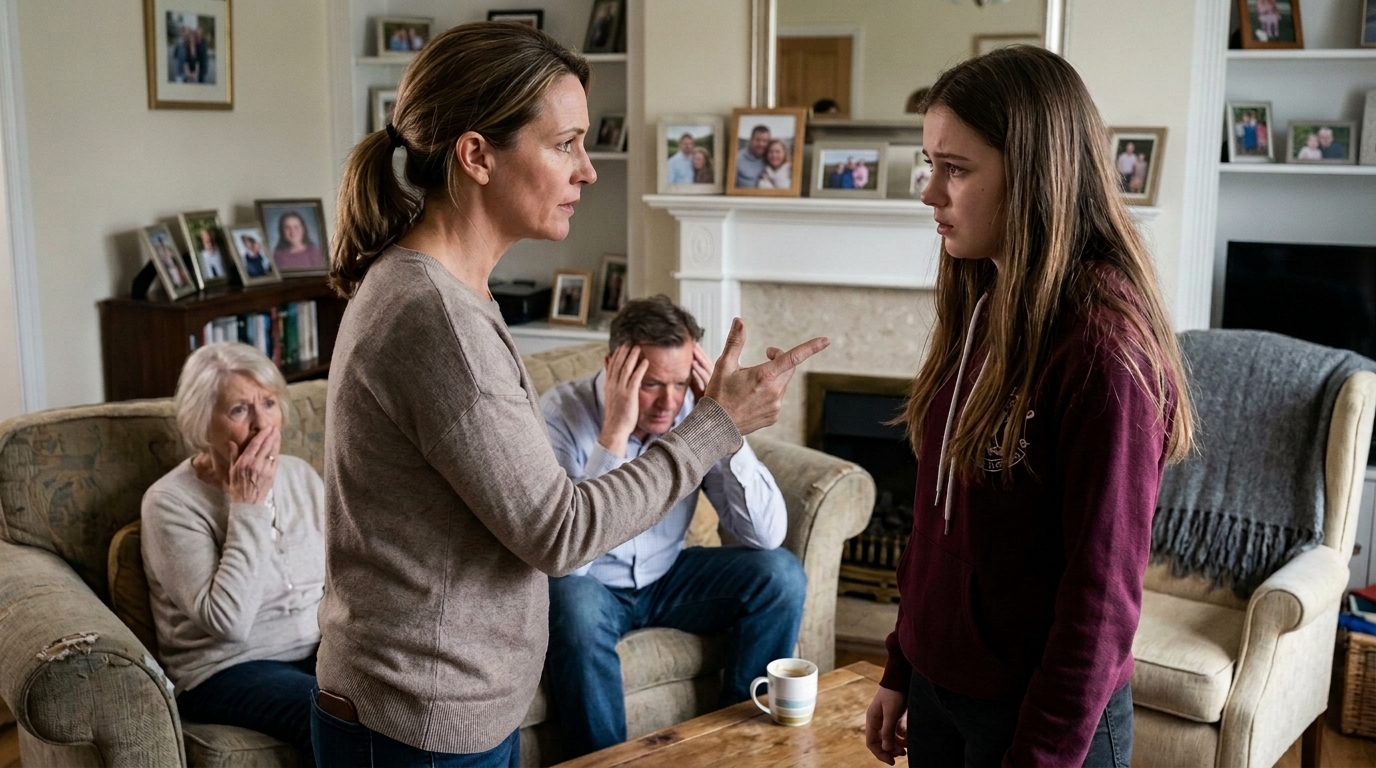
The day my daughter told a judge I was confused, unstable, and no longer capable of managing my own life, she cried so beautifully that even I almost believed her.
Vanessa sat at the other table in a navy-blue dress, holding a tissue against the corner of one eye. Her hair was smooth. Her makeup was perfect. Her voice trembled at exactly the right moments.
“I don’t want to take away my mother’s independence,” she said. “I’m trying to protect what she has left.”
Then she turned and looked at me.
Not for long.
Just long enough for everyone in the courtroom to see the pain on her face.
She looked like a daughter watching her mother disappear.
I looked like a frightened old woman who didn’t understand why she was there.
That was exactly how Vanessa had planned it.
Six months earlier, I would have laughed if someone had warned me about her.
Vanessa was the child who called every morning.
She was the one who remembered birthdays, sent flowers, organized family dinners, and posted photographs of us online with captions like:
Family is everything.
My son, Daniel, rarely posted anything. He lived in Tennessee, worked long hours as a civil engineer, and sometimes went three or four days without calling.
Vanessa lived fifteen minutes away.
When my husband, Robert, became sick, she was constantly at our house.
She brought food. She drove him to appointments when I was too tired. She sat beside his hospital bed and held his hand.
Everyone praised her.
At church, people told me how fortunate I was.
“You raised a wonderful daughter, Margaret.”
I believed them.
I said it myself.
Robert and I had been married for forty-four years. We lived in the same two-story house in Westerville, Ohio, for thirty-one of them.
It wasn’t a mansion.
It was a comfortable brick home with a maple tree in the front yard, a narrow kitchen, and a back porch Robert had rebuilt twice because he was never satisfied with the first version.
We had raised both children there.
The hallway still had faint pencil marks showing their heights at different ages. Vanessa’s stopped at sixteen because she said they embarrassed her. Daniel’s continued until college because Robert kept measuring him as a joke.
After Robert died, the house became painfully quiet.
The silence was not peaceful.
It followed me from room to room.
I would wake in the night and reach across the bed before remembering there was no one there.
The morning after the funeral, I found one of Robert’s coffee cups beside the sink. I held it for nearly twenty minutes because washing it felt like admitting he was not coming back.
Vanessa found me standing there.
She took the cup gently from my hands.
“You don’t have to do anything today,” she told me.
Then she wrapped her arms around me.
For the first few weeks, she became the center of my life.
She arranged meals. She answered phone calls. She sorted sympathy cards into neat piles.
When I forgot where I had placed the checkbook, Vanessa found it under a stack of funeral paperwork.
When I missed a dental appointment, she called and rescheduled it.
When I cried in the grocery store because Robert’s favorite cereal was on sale, she guided me outside and drove me home.
I was grieving.
I was distracted.
I was not incapable.
But Vanessa began telling people a different story.
At first, I didn’t notice.
She would make small comments.
“Mom’s having a difficult day.”
“Mom gets overwhelmed easily now.”
“She’s been forgetting things.”
Those statements were not entirely false.
That was what made them dangerous.
Grief had made me forgetful.
I misplaced my glasses. I entered rooms and forgot why I was there. I once left a load of laundry in the washer for two days.
But I still paid my bills.
I still drove.
I still cooked, read novels, attended church, and managed the household Robert and I had built together.
One afternoon, about six weeks after the funeral, Vanessa arrived carrying a folder.
“I made a list of everything we should organize,” she said.
She placed it on the kitchen table.
Bank accounts.
Insurance policies.
Utilities.
Property taxes.
The will.
I looked at her.
“Why do you need all of this?”
“I don’t need it. You need it.”
“I already know where everything is.”
Her expression softened.
“Mom, I’m not criticizing you.”
“It feels like you are.”
She reached across the table and touched my wrist.
“You’ve been through something terrible. Let me help.”
That phrase would become her answer to everything.
Let me help.
It sounded loving.
It sounded harmless.
I didn’t understand that each time I allowed her to help, I surrendered another small piece of control.
The first thing she took over was the mail.
She said I was receiving too many scam letters and confusing them with legitimate bills.
That happened once.
One envelope looked like an official Medicare notice, but it was an advertisement for supplemental insurance. I showed it to her because I thought it was funny.
A week later, she placed a large basket near the front door.
“Put everything in here,” she said. “I’ll sort it.”
I agreed.
Then she asked for online access to the electric company account so she could set up automatic payments.
I agreed to that too.
Then the gas company.
Then the property taxes.
Then my credit-card account.
Each request seemed practical.
Each explanation made sense.
When Daniel called, I told him how wonderful his sister had been.
There was a pause on the phone.
“She has access to your credit cards?”
“Only to help with payments.”
“You don’t need help with payments.”
“I appreciate your concern, Daniel, but I know what I’m doing.”
“I didn’t say you didn’t.”
“That is exactly what you implied.”
We argued.
Afterward, I called Vanessa.
She listened patiently and then sighed.
“Daniel has always hated that you trust me.”
“That’s not true.”
“Mom, he moved away. I stayed.”
There was no anger in her voice.
That made it sound reasonable.
“I’m the one here every day,” she continued. “But somehow he thinks he can call twice a week and make decisions.”
“He isn’t making decisions.”
“He’s trying to make you suspicious of me.”
I denied it, but the conversation stayed with me.
From then on, when Daniel asked questions, I became defensive.
Vanessa never told me to stop speaking to him.
She didn’t have to.
She simply made every conversation with him feel like an attack on the daughter who was caring for me.
That summer, Vanessa began photographing us together.
At lunch.
At the hair salon.
In the backyard.
She posted the pictures online.
Taking care of my beautiful mama.
Grief has hard days, but we face them together.
People responded with hearts and prayers.
Some called her an angel.
One evening, I saw a comment from an old friend of hers.
You are such an amazing daughter. Your mom is lucky to have you.
Vanessa replied:
It’s not always easy, but I would never abandon her.
I stared at the word abandon.
No one had abandoned me.
But Vanessa was slowly creating a story in which I was helpless, she was heroic, and anyone who questioned her was cruel.
I didn’t understand why.
Not yet.
The first time I became truly afraid was because of a necklace.
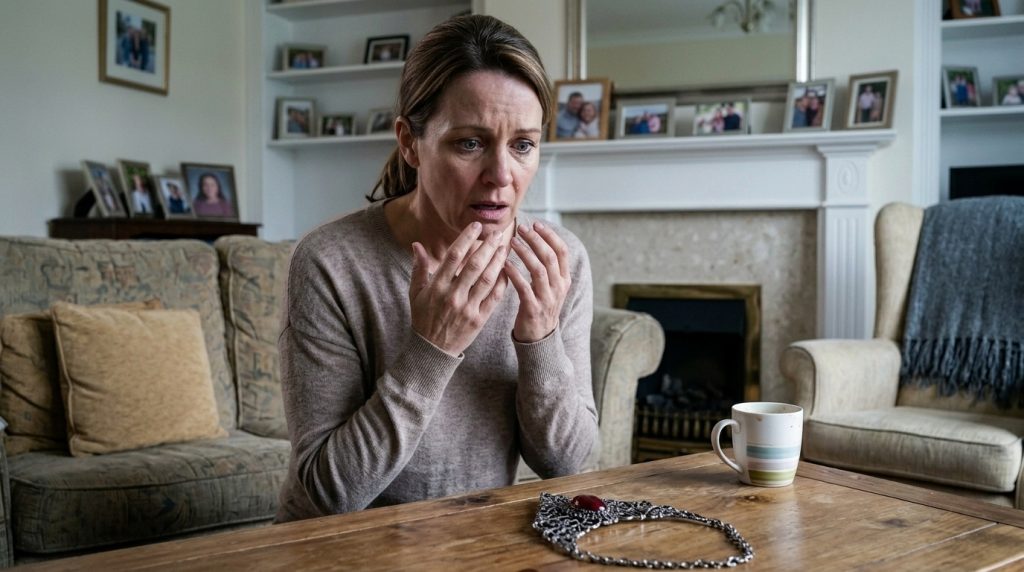
It had belonged to my mother.
A thin gold chain with a small oval pendant. Inside was a photograph of my parents taken before my father left for Korea.
I kept it in the top drawer of my dresser.
One Sunday, I planned to wear it to church.
The box was empty.
I searched every drawer.
Then the bathroom.
Then the jewelry cabinet.
I called Vanessa.
She arrived twenty minutes later.
“What happened?”
“My mother’s necklace is gone.”
She followed me upstairs.
We looked everywhere I had already searched.
Finally, she sat beside me on the bed.
“Mom, you gave that necklace to me.”
I turned toward her.
“No, I didn’t.”
“Yes, you did.”
“When?”
“About a month ago.”
I studied her face.
She looked concerned, not guilty.
“You said you wanted me to have it.”
“I would remember that.”
Her eyes filled with sadness.
“Mom.”
The way she said it made my stomach tighten.
“What?”
“You’ve forgotten other things lately.”
“Not something like this.”
“You were crying when you gave it to me. You said Grandma would want it to stay in the family.”
I stood up.
“Bring it back.”
“Of course.”
“Today.”
She nodded.
But before leaving, she touched my shoulder.
“I think we should talk to your doctor.”
For the first time, a question entered my mind that I had never asked before.
What if she was right?
What if I had given her the necklace?
What if grief had damaged something in me?
That night, I stood in front of the bathroom mirror and tried to remember the conversation Vanessa described.
I imagined the necklace in my hand.
I imagined placing it in hers.
Nothing came.
But absence is difficult to prove, even to yourself.
By morning, I was no longer certain of anything.
And that uncertainty was exactly what Vanessa needed.
Vanessa returned the necklace the next afternoon.
She placed it on the kitchen table inside a velvet box.
“I don’t want you thinking I took something,” she said.
“I never said you stole it.”
“You didn’t have to.”
Her voice broke slightly.
I immediately felt guilty.
“I’m sorry.”
She looked away.
“I’m trying so hard to help you.”
“I know.”
“Sometimes it feels like I’m being punished for being the only one here.”
That sentence ended the argument.
I apologized again.
Over the next several weeks, more strange things happened.
My pharmacy called to say a prescription was ready, but I had not requested a refill.
Vanessa said she had ordered it because I was almost out.
A utility bill arrived with an overdue notice, even though she had told me everything was set to automatic payment.
She blamed a computer error.
A neighbor mentioned seeing Vanessa carrying boxes from the house.
Vanessa said they were old clothes I had donated.
I did not remember donating any clothes.
When I asked her about it, she smiled.
“You told me to clear the hall closet.”
“I said you could take Robert’s winter coats to church.”
“That’s what I did.”
“Nina said there were several boxes.”
Vanessa’s expression changed.
Only slightly.
But I noticed.
“Why is Nina watching my car?”
“She isn’t.”
“Then why is she reporting to you?”
“She was concerned.”
“About what?”
I didn’t know how to answer.
Vanessa leaned against the counter and folded her arms.
“This is exactly what I mean.”
“What do you mean?”
“You’re becoming suspicious of people who care about you.”
The conversation turned before I realized what was happening.
I had asked about boxes.
Within two minutes, I was defending my mental health.
That became a pattern.
Whenever I questioned Vanessa, the question itself became evidence against me.
If I asked where my mail was, I was confused.
If I objected to a payment, I was paranoid.
If I became angry, I was emotionally unstable.
If I stayed calm, she said I was withdrawing.
There was no correct response.
Vanessa began attending my doctor’s appointments.
The first time, I welcomed it.
My blood pressure had been high since Robert’s death, and I thought a second person might help me remember the doctor’s instructions.
During the appointment, Dr. Cooper asked how I was sleeping.
“Poorly,” I answered.
Vanessa added, “She called me at two in the morning last week.”
“I had a nightmare.”
“She didn’t remember calling the next day.”
“That isn’t true.”
Vanessa turned toward me.
“You asked why I was tired.”
“I knew I called you. I didn’t know we spoke for forty minutes.”
Dr. Cooper looked at his computer.
“Have you noticed any other memory concerns?”
Vanessa hesitated.
It was a performance.
She looked at me as though seeking permission.
Then she said, “A few.”
I felt heat rise into my face.
“She is exaggerating.”
Vanessa lowered her voice.
“Mom, I’m not trying to embarrass you.”
She told him about the necklace.
She told him I had missed an appointment.
She told him I had misplaced my checkbook.
She did not explain that the appointment occurred three days after my husband’s funeral.
She did not mention that the checkbook had been under paperwork she had rearranged.
She offered facts without context.
Dr. Cooper suggested a cognitive screening.
I agreed because refusing would have looked worse.
I passed.
Not perfectly.
I struggled to remember one of five words after several minutes. I mixed up the date by one day. I took longer than expected to draw the hands on a clock.
Dr. Cooper said grief, depression, lack of sleep, and anxiety could affect concentration.
He recommended a follow-up in six months.
Vanessa heard only the parts she wanted.
On the drive home, she said, “At least now we know we need to watch this.”
“Watch what?”
“Your memory.”
“He said grief can affect concentration.”
“He also said we should follow up.”
“In six months.”
She reached over and squeezed my hand.
“We’ll handle it together.”
A few days later, Daniel called.
He sounded tense.
“Mom, did you sign a power of attorney?”
I stood in the kitchen holding the phone.
“What?”
“Vanessa told me you signed one.”
“She brought some documents.”
“What documents?”
“I don’t know. Insurance. Banking.”
“Did you read them?”
“Of course I read them.”
But as soon as I said it, I knew that was not entirely true.
There had been several papers.
Vanessa explained each one quickly. She placed small yellow tabs beside the signature lines.
I had read portions.
Not all.
“Mom, I need you to find copies.”
“Why?”
“Because Vanessa said she can make financial decisions for you.”
“She’s helping with the accounts.”
“That is not the same thing.”
His voice was sharper than it needed to be.
I became angry.
“You have no idea how much she has done for me.”
“I know what she tells people she has done.”
“What is that supposed to mean?”
“It means she called me yesterday and said you shouldn’t be living alone.”
I felt the room shift.
“She said what?”
“She asked whether I would support moving you into assisted living.”
I gripped the edge of the counter.
“She never mentioned that to me.”
“Find the documents.”
When I confronted Vanessa, she did not deny the call.
“I was asking a hypothetical question.”
“Why?”
“Because you fell last month.”
“I slipped in the garden.”
“You were alone.”
“I stood up.”
“You could have broken your hip.”
“You told Daniel I shouldn’t live here.”
“I told him we should discuss future options.”
“It is my future.”
She exhaled slowly.
“I knew you would react like this.”
“Like what?”
“Defensively.”
I wanted to scream.
Instead, I said, “Bring me copies of everything I signed.”
“I already gave you copies.”
“No, you didn’t.”
“Yes, Mom. I put them in the desk drawer.”
We walked into Robert’s study.
The drawer was empty.
Vanessa stared at it.
“You must have moved them.”
“I did not.”
She opened another drawer.
Then another.
“Maybe you threw them away.”
“I would not throw away legal documents.”
She turned toward me.
Her face was calm.
Too calm.
“Then where are they?”
That question frightened me more than an accusation would have.
I didn’t know.
And once again, she had transformed something she had done into another thing I had supposedly forgotten.
The following morning, I drove to the bank.
I did not tell Vanessa.
A young employee named Aaron helped me review the accounts.
There had been three transfers from my savings account over the previous month.
Six thousand dollars.
Four thousand five hundred.
Eight thousand.
All transferred into my checking account and then paid toward a business credit card I did not recognize.
“This card is connected to your online profile,” Aaron said.
“I don’t own a business card.”
He turned the computer screen toward me.
The account had been opened in my name.
The authorized user was Vanessa Hale.
My hands began shaking.
“I did not open this.”
Aaron’s expression became careful.
“Do you have a joint account holder or financial power of attorney?”
“My daughter helps manage the account.”
“Is she authorized to open credit in your name?”
“No.”
He asked whether I wanted to speak to the branch manager.
I said yes.
Before the manager arrived, my phone rang.
Vanessa.
I stared at her name.
Aaron looked away politely.
I answered.
“Where are you?” she asked.
“At the bank.”
There was a short silence.
“Why?”
“I wanted to check something.”
“You could have asked me.”
“It’s my account.”
“I know that.”
Her voice remained gentle.
But underneath it, I heard something new.
Fear.
Then she said, “Don’t sign anything until I get there.”
That was the moment my doubt began to harden into suspicion.
Not certainty.
Not yet.
But suspicion.
I looked at Aaron and said, “Please freeze online access to all of my accounts.”
Vanessa arrived twelve minutes later.
She walked through the bank doors smiling.
By then, the branch manager was sitting beside me.
Vanessa hugged me before taking the empty chair.
“What’s going on?”
The manager explained the unauthorized credit account.
Vanessa frowned.
Then she looked at me with concern.
“Mom, we opened that together.”
“No, we didn’t.”
“Yes, we did. It was part of the home-repair financing.”
“What home repairs?”
“The roof estimate.”
“We didn’t repair the roof.”
“We were preparing in case you decided to.”
The manager asked, “Did Mrs. Hale authorize the charges?”
Vanessa hesitated.
“She may not remember the details.”
I stared at her.
There it was.
The weapon she had been building.
Any evidence against her could be dismissed because I supposedly could not remember.
I stood.
“I want every account frozen. I want new passwords, and I want Vanessa removed.”
Vanessa’s face tightened.
“Mom, you’re upset.”
“I am very upset.”
“Let’s go home and talk.”
“No.”
People were watching.
Her expression softened immediately.
She lowered her voice.
“You’re making a scene.”
That sentence brought me back to childhood.
My own mother had used it whenever I cried in public.
I almost sat down.
Then the manager said, “Mrs. Hale has the right to change access to her accounts.”
Vanessa looked at him.
Then at me.
For one second, the caring daughter disappeared.
Her eyes became flat.
Cold.
Then she smiled again.
“Of course she does.”
She left before the paperwork was finished.
That evening, she called Dr. Cooper.
I did not know that until later.
She told him I had become paranoid, accused her of stealing, and caused a disturbance at the bank.
She did not mention the credit card.
She did not mention the transfers.
By the end of the week, she had convinced several relatives that I was deteriorating rapidly.
And she was only beginning.
Three days after the bank incident, Vanessa returned with a woman named Melissa Grant.
Melissa introduced herself as a geriatric care manager.
I did not invite her into my home.
Vanessa did.
“We’re worried about you,” she said.
“Who is we?”
“Daniel. Dr. Cooper. Me.”
“Daniel does not think I need a care manager.”
Vanessa looked at Melissa.
“See what I mean?”
Melissa remained professional.
She asked whether we could sit down.
I told her no.
Vanessa followed me into the kitchen.
“Mom, this is not helping.”
“Helping what?”
“Your situation.”
“What situation?”
She leaned closer.
“You accused me of stealing.”
“You opened credit in my name.”
“You signed the application.”
“I did not.”
“I have the documents.”
“Then show them to me.”
She looked away.
“I don’t carry them around.”
“Leave my house.”
Melissa stepped toward the doorway.
“I think we should go.”
Vanessa’s eyes filled with tears.
“Mom, please.”
“Get out.”
She reached for my arm.
I pulled away.
“Don’t touch me.”
Her phone was on the counter.
I did not notice the screen was facing upward.
I did not notice the red recording symbol.
Later, Vanessa edited that argument.
She removed the questions about the credit card.
She removed her refusal to show me the documents.
She kept only my raised voice.
Leave my house.
Get out.
Don’t touch me.
Played without context, I sounded hostile and irrational.
She sent the recording to Daniel.
He called immediately.
“What happened?”
“She brought a stranger into my house.”
“Why?”
“To evaluate me.”
“She said you threatened her.”
“I told her to leave.”
“She said you shoved her.”
“I pulled my arm away.”
Daniel was quiet.
Then he asked, “Did she show you the credit-card application?”
“No.”
“I’m coming home.”
“You don’t need to.”
“Yes, I do.”
He arrived two days later.
Vanessa refused to meet with him.
She sent a message saying she was emotionally exhausted and needed distance.
That made Daniel even more suspicious.
We searched the study together.
He found a copy of the power of attorney in a file marked Home Insurance.
My signature was on the last page.
The document gave Vanessa broad authority over banking, property, and medical decisions.
I recognized the signature.
It was mine.
I had signed it.
But I had not understood what it was.
“I feel like a fool,” I said.
Daniel sat across from me at Robert’s desk.
“You were grieving.”
“That is not an excuse.”
“It isn’t your fault that your daughter lied to you.”
I looked at him.
“You warned me.”
“I asked questions. That’s all.”
“And I accused you of being jealous.”
“You were protecting her.”
“I was choosing her.”
He lowered his eyes.
That hurt more than if he had agreed.
I reached across the desk.
“I’m sorry.”
He squeezed my hand.
Then he asked, “Did Dad ever say anything about her finances?”
I thought back.
A few months before Robert died, he and Vanessa had argued in the garage.
I heard only parts of it.
Robert said, “I will not put the house against another loan.”
Vanessa answered, “You don’t understand how close I am.”
Later, I asked him what happened.
He dismissed it as a disagreement about one of her property investments.
At the time, Vanessa was buying older homes, renovating them, and reselling them.
She appeared successful.
She drove a luxury SUV and spoke confidently about investment opportunities.
I had never considered that she might be in trouble.
Daniel opened Robert’s old laptop.
The password was the name of our first dog.
Inside, he found emails between Robert and a financial adviser.
Robert had been asking about Vanessa’s business.
One message contained a sentence that made me feel sick.
She has asked Margaret twice about changing the will and once about borrowing against the house. Margaret believes these are casual conversations. I do not.
Robert had known.
Not everything.
But enough to be concerned.
“Why didn’t he tell me?” I asked.
“Maybe he planned to.”
“He had months.”
“He also knew you would defend her.”
That was true.
I would have told him he was being too hard on her.
I might even have warned Vanessa.
Daniel contacted an attorney named Laura Chen.
She agreed to meet us the following morning.
Laura reviewed the power of attorney and the bank records.
She said we could revoke Vanessa’s authority immediately.
She also advised us to file fraud reports and monitor my credit.
We signed the revocation documents that day.
For the first time in months, I felt as though I had done something concrete.
Then Vanessa changed the battlefield.
Two weeks later, a process server came to my door.
Vanessa had filed a petition asking the probate court to appoint her as my emergency guardian.
The filing claimed I suffered from cognitive decline, paranoia, emotional instability, and an inability to manage finances safely.
She attached statements from Melissa, the care manager.
A letter from Dr. Cooper saying further evaluation was recommended.
The edited recording of our argument.
Copies of several unpaid bills.
Photographs of spoiled food in my refrigerator.
I stared at the photographs.
The food had not been there when I last cleaned the refrigerator.
Daniel looked at them too.
“She staged this.”
I remembered Vanessa coming to the house while I was at church.
She still had a key then.
The petition claimed I had accused family members of theft without evidence.
It did not mention the unauthorized credit account.
It said I had recently transferred large amounts of money without understanding why.
Vanessa had made those transfers.
Now she was using them as proof that I could not manage my finances.
It was elegant in a terrible way.
She had created the problems and then presented herself as the solution.
The court scheduled a hearing.
Until then, a temporary order restricted the sale or transfer of major assets.
Vanessa asked to be appointed temporary guardian immediately.
Laura stopped that request.
But the damage was already spreading.
Relatives called me carefully, as though speaking to a child.
My younger sister, Patricia, asked whether I was taking my medication.
A woman from church offered to arrange meal deliveries.
One longtime friend said, “Vanessa is doing what she thinks is best.”
I asked whether she had seen the bank records.
She had not.
She had seen Vanessa cry.
That was enough.
The most painful moment came when I attended church alone.
Two women stopped speaking as I approached.
One of them touched my arm.
“You look well today, Margaret.”
Today.
I smiled, walked into the restroom, and cried in a locked stall.
Vanessa had not only taken money.
She had taken ownership of my identity.
I was no longer Margaret Hale, the woman who worked thirty-two years at an elementary school, cared for a sick husband, raised two children, and managed her own life.
I was now Vanessa’s confused mother.
Every decision I made was examined through that story.
Daniel stayed with me.
He cooked dinner badly and left cabinet doors open, just as he had when he was seventeen.
His presence helped.
But I could see the worry in his face.
One night, he sat at the kitchen table reading through Robert’s emails again.
“Dad knew she might try something,” he said.
“He knew she wanted money.”
“No. This feels more specific.”
He showed me the message about the will.
Below it was another line.
I have taken precautions in case I am not here to protect Margaret.
“What precautions?” I asked.
Daniel searched the laptop.
There was nothing else.
No attachment.
No explanation.
Three days later, on what would have been Robert’s seventy-first birthday, an email arrived in Daniel’s inbox.
It had been scheduled months earlier.
The subject was:
For Daniel, if necessary.
Daniel called me into the study.
His face had gone pale.
The email contained only a few sentences.
Son, I hope this message reaches you after the danger has passed.
If Vanessa ever tries to take control of your mother’s life or property, look inside the kitchen clock.
Do not confront her until you know what you have.
We stared at each other.
Then we walked into the kitchen.
The clock hung above the doorway.
Robert bought it at an estate sale fifteen years earlier. It was round, dark wood, and slightly too large for the wall.
Daniel removed it.
The back panel had four screws.
Inside, behind the battery compartment, was a small black memory card.
My husband had known enough to leave us evidence.
The question was what he had captured.
Daniel inserted the memory card into his laptop.
There were dozens of video files.
Most showed ordinary moments in our kitchen.
Robert reading the newspaper.
Me washing dishes.
Vanessa making coffee.
The camera had a wide view of the table, counter, and back door.
I remembered Robert installing a new home-security system after several break-ins in our neighborhood. He told me one camera faced the kitchen entrance.
I had forgotten about it.
Vanessa apparently had too.
The earliest files were from seven months before Robert’s death.
We watched them in order.
At first, there was nothing unusual.
Then we found a recording made while Robert and I were at a medical appointment.
Vanessa entered the kitchen with Eric Lawson, her boyfriend.
I knew Eric but had met him only a few times.
He worked in commercial real estate and always spoke as though every conversation was delaying an important transaction.
On the recording, Vanessa placed a folder on the table.
Eric opened it.
“The lender is not extending again,” he said.
“I know.”
“You said your father would help.”
“He changed his mind.”
“Then talk to your mother.”
“She does whatever he says.”
Eric tapped the folder.
“We need two hundred twenty thousand within ninety days.”
My throat tightened.
Vanessa sat down.
“When he’s gone, things will be different.”
Daniel paused the video.
Neither of us spoke.
He pressed play again.
Eric asked, “How sick is he?”
Vanessa looked toward the doorway.
“Six months. Maybe less.”
I stood up so quickly the chair scraped the floor.
“I can’t watch this.”
Daniel closed the laptop.
We sat in silence.
My daughter had known her father was dying.
While she sat beside his hospital bed holding his hand, she had also been calculating when his death might give her access to our money.
I walked to the sink.
Outside, leaves moved gently across the backyard.
For some reason, I remembered Vanessa at eight years old, crying because a bird had flown into our window.
She made Robert bury it in the garden.
I could not connect that child to the woman on the recording.
“Keep going,” I said.
Daniel looked at me.
“Are you sure?”
“No. But keep going.”
The next significant recording was made two weeks after Robert’s funeral.
Vanessa and Eric stood in the kitchen.
Eric opened the refrigerator.
“There’s nothing to eat.”
“She barely eats.”
“Is she as bad as you said?”
“She’s grieving. She loses things. She forgets appointments.”
“That’s not the same as incompetent.”
“It can look the same.”
I felt cold.
Eric shut the refrigerator.
“And the power of attorney?”
“I’ll get it.”
“What about your brother?”
“Daniel trusts everyone except me.”
“That doesn’t answer the question.”
“He lives six hours away. By the time he understands what’s happening, it will be done.”
Eric asked what “done” meant.
Vanessa lowered her voice.
“The accounts first. Then the house.”
“And your mother?”
“She can’t stay here alone.”
“Where would she go?”
“There’s a place outside Newark. It’s cheap.”
Daniel stopped the recording.
His jaw tightened.
I stared at the frozen image of Vanessa standing in my kitchen.
“She had already chosen a place.”
Daniel said nothing.
We continued.
Another recording showed Vanessa sorting papers at the table.
She held up the power-of-attorney document.
Eric asked, “Does she know what she signed?”
Vanessa laughed.
“She knows I’m helping.”
That laugh stayed with me.
It was not loud.
It was not cruel in an obvious way.
It was casual.
As though deceiving me required no emotional effort at all.
In another video, Eric warned her about moving money too quickly.
Vanessa said she needed to cover interest payments before her business collapsed.
Eric asked whether the loans were really in her name.
“Some,” she said.
“What does that mean?”
“It means some aren’t.”
“Vanessa.”
“I used Mom’s credit. She had better rates.”
“You used her Social Security number?”
“She would have given it to me.”
“That isn’t the same as asking.”
“She is going to leave everything to me anyway.”
“To you and Daniel.”
“Daniel doesn’t deserve half.”
Eric walked out of the camera’s view.
Vanessa remained at the table.
She whispered something.
Daniel increased the volume.
We listened again.
Vanessa said:
“Once the court gives me control, it won’t matter what she remembers. Nobody believes an old woman over the daughter taking care of her.”
My son closed the laptop.
I expected to cry.
I didn’t.
Something inside me became very quiet.
For months, I had questioned my memory, my judgment, and my own character.
I wondered whether grief had made me difficult.
Whether I had unfairly accused the daughter who loved me.
Now I knew the truth.
Vanessa had not acted impulsively.
She had studied my weaknesses.
She understood that grief could be made to look like dementia.
She understood that age could make people dismiss me.
Most of all, she understood that I loved her enough to doubt myself before I doubted her.
That was the part she used most effectively.
Daniel called Laura.
She came to the house that evening.
We showed her selected recordings.
She watched without interrupting.
When the video ended, she leaned back.
“This changes everything.”
“Can we use it in court?” Daniel asked.
“We need to establish the recording system, preserve the original files, and notify the court properly. There may be evidentiary arguments, but even if the judge does not admit every recording immediately, this is enough to request a full financial investigation.”
“What about the guardianship hearing?”
“We proceed carefully.”
I looked at her.
“Carefully?”
“Vanessa cannot know what we have.”
“Why not?”
“Because she may destroy records, move funds, or change her story.”
“She already knows the bank accounts are frozen.”
“She may believe that is all you know.”
Laura copied the files and arranged for a digital-forensics specialist to preserve the memory card.
She contacted the bank’s fraud department.
She also requested records related to every credit account opened in my name.
Over the next week, the scale of the theft became clearer.
Vanessa had opened four credit accounts using my information.
She had forged my signature on two loan guarantees.
She had transferred money from my savings to cover expenses for her real-estate company.
She had attempted to obtain a home-equity line of credit against my house.
The application was pending.
In total, the known losses exceeded one hundred forty thousand dollars.
That did not include the jewelry or property removed from the house.
Nina, my neighbor, came over after Daniel spoke to her.
She brought security footage from her doorbell camera.
It showed Vanessa loading boxes into her SUV on three separate occasions.
One box contained the silver tea service Robert’s mother had given us.
Another appeared to contain framed artwork.
Nina looked embarrassed.
“I should have said more.”
“You did say something.”
“I let her convince me you had donated it.”
“So did I.”
Laura asked Nina to make a statement.
Then she warned us again not to confront Vanessa.
That became difficult when Vanessa called.
Her voice was warm.
“Mom, I wanted to see how you’re feeling.”
I looked at Daniel.
He nodded toward the recorder Laura had given us for documenting future conversations.
“I’m fine,” I said.
“I know the hearing is stressful.”
“Yes.”
“I wish Daniel wasn’t making this harder.”
“He’s trying to help.”
“He’s filling your head with things.”
“What things?”
“That I’m stealing. That I’m trying to put you somewhere.”
I forced myself to breathe slowly.
“Are those things untrue?”
“Of course they are.”
“Then why did you open a credit card in my name?”
A pause.
“We’ve discussed that.”
“No. You told me I signed something I don’t remember signing.”
“Because you did.”
“I want to see it.”
“I’ll bring it to court.”
“Why not bring it now?”
Her voice changed.
Not dramatically.
Just enough.
“Because every time I come there, Daniel creates a confrontation.”
“He isn’t in the room.”
Another pause.
Then she returned to the gentle voice.
“Mom, I love you. Everything I’m doing is to keep you safe.”
I looked at the kitchen clock lying on the table beside me.
“I know,” I said.
It was the first deliberate lie I had told my daughter.
I hated how easily it came.
But Vanessa had taught me something.
Sometimes people mistake honesty for weakness because they have never faced someone who knows the truth and chooses to wait.
The guardianship hearing took place on a gray Monday morning.
I wore a cream-colored blouse and the necklace that had belonged to my mother.
Daniel sat behind me.
Laura sat at my side.
Across the aisle, Vanessa looked exhausted but elegant.
She had chosen a modest dress and almost no jewelry.
Her attorney began by describing her as a devoted daughter forced into an impossible situation.
He spoke about my grief.
My missed appointment.
The argument with Vanessa.
The unpaid bills.
The money transferred from my accounts.
Every event was technically real.
The interpretation was false.
That was Vanessa’s greatest talent.
She rarely invented facts when she could distort them.
Melissa, the care manager, testified first.
She said I had appeared suspicious and agitated during her visit.
Laura asked whether I had invited her.
“No.”
“Did Mrs. Hale ask you to leave?”
“Yes.”
“Did she have the right to ask you to leave her home?”
Melissa hesitated.
“Yes.”
“Did you evaluate her cognitive ability?”
“No.”
“Then your conclusion is based primarily on a brief encounter during which you entered her home without her prior agreement?”
Vanessa’s attorney objected.
The judge allowed the question.
Melissa admitted that was correct.
Dr. Cooper testified next.
He said I had shown mild difficulty with short-term recall but had passed the screening.
He had not diagnosed dementia.
Under questioning, he acknowledged that grief and sleep deprivation could affect the results.
Then Vanessa testified.
She began with stories about my life with Robert.
She described how I had cared for him.
How difficult his death had been.
How I sometimes forgot to eat.
Her voice broke.
“I promised my father I would take care of her.”
I looked at her.
Robert had never asked her to make that promise.
But no one else knew that.
She described the day at the bank.
She said I became confused about an account we had opened together.
She claimed I had grown suspicious of neighbors and relatives.
She said Daniel was exploiting my fear because he resented her role in the family.
Then her attorney played the edited recording.
My own voice filled the courtroom.
Leave my house.
Get out.
Don’t touch me.
Several people turned toward me.
I felt their judgment.
Vanessa wiped her eyes.
“I know she doesn’t mean it,” she said. “She is not herself.”
The judge asked whether she believed I should remain in my home.
“For now,” Vanessa answered carefully. “With proper supervision.”
“And if that is not possible?”
She looked down.
“Then I’ve researched several safe communities.”
I knew which community she meant.
The cheap facility outside Newark.
Her attorney asked why she wanted financial authority.
“To protect her savings and the house my father worked his entire life to provide.”
Laura stood.
“Mrs. Lawson—”
“Hale,” Vanessa corrected.
“My apologies. Ms. Hale, are you experiencing financial difficulties?”
Vanessa looked at her attorney.
He objected on relevance.
Laura explained that Vanessa was asking for control of my assets.
The judge allowed the question.
Vanessa folded her hands.
“My business has experienced temporary challenges.”
“How much debt do you currently have?”
“I don’t know the exact number.”
“More than fifty thousand dollars?”
“Yes.”
“More than one hundred thousand?”
Her attorney objected again.
The judge instructed her to answer.
Vanessa said, “Possibly.”
“More than two hundred thousand?”
She swallowed.
“Yes.”
A murmur moved through the room.
Laura placed copies of the bank records on the evidence screen.
“Did you transfer eighteen thousand five hundred dollars from your mother’s savings?”
“No.”
“Are you an authorized user on the business card that received those payments?”
“I helped my mother open that card.”
“Why would a retired school secretary need a business credit card?”
“It was for home expenses.”
“What business expenses?”
“I don’t remember.”
Laura let the silence sit.
Then she asked, “Did you use your mother’s Social Security number to open additional accounts?”
“No.”
“Did you attempt to obtain a line of credit against her home?”
“No.”
“Did you discuss moving her into a facility outside Newark?”
Vanessa’s face changed.
“Daniel must have gone through my private messages.”
“Please answer the question.”
“I looked at several options.”
“Before or after filing this petition?”
“Before.”
“How long before?”
“I’m not sure.”
“Two weeks after your father’s funeral?”
Vanessa looked toward her attorney.
The judge said, “Answer.”
“I may have looked then.”
Laura returned to our table.
For one second, I thought she might end there.
Instead, she picked up a small remote.
“Your Honor, we would like to present newly discovered evidence and request that the guardianship petition be suspended pending investigation.”
Vanessa’s attorney stood immediately.
“What evidence?”
Laura handed documents to the clerk.
She explained that Robert had installed a security camera in the kitchen as part of the home-security system.
The original memory card had been preserved by a forensic specialist.
The recordings contained statements directly related to the petition and the management of my finances.
Vanessa looked at me.
Not at Laura.
At me.
Her face lost all color.
That was when she understood.
She remembered the clock.
Her attorney asked for time to review the files.
Laura said one short section should be played because it related directly to Vanessa’s testimony.
The judge watched both attorneys.
Then he allowed a limited excerpt.
The screen on the wall brightened.
My kitchen appeared.
Vanessa stood beside the table.
Eric was near the refrigerator.
The date showed the recording had been made two weeks after Robert’s funeral.
Eric asked where I would go if I could no longer stay in the house.
Vanessa answered:
“There’s a place outside Newark. It’s cheap.”
The courtroom became completely silent.
The video continued.
Eric asked about Daniel.
Vanessa said:
“He lives six hours away. By the time he understands what’s happening, it will be done.”
Her attorney moved closer and whispered something.
Vanessa did not respond.
Then Laura played the second clip.
Vanessa sat alone at the kitchen table, speaking to Eric off-camera.
“Once the court gives me control, it won’t matter what she remembers. Nobody believes an old woman over the daughter taking care of her.”
The clip ended.
No one moved.
Vanessa stared at the dark screen.
The expression on her face was not guilt.
It was calculation.
Even then, she was looking for a way out.
Her attorney requested a recess.
Laura objected and asked the judge to deny the guardianship petition immediately.
The judge did not rule at once.
He asked Vanessa one question.
“Is that your voice?”
She looked at her attorney.
Then she said, “The recording is out of context.”
The judge repeated the question.
“Is that your voice?”
“Yes.”
He suspended the hearing.
He ordered that Vanessa have no access to my financial accounts or property.
He directed the court investigator to refer the evidence to law enforcement and adult-protective services.
He also ordered a full accounting of every transaction Vanessa had made under the power of attorney.
As the judge left, the room filled with whispers.
Vanessa stood.
I expected her to avoid me.
Instead, she walked directly toward our table.
Daniel stepped between us.
She looked past him.
“Mom, you don’t understand.”
I remained seated.
“What don’t I understand?”
“Eric pressured me.”
“The court heard your voice.”
“I was trying to save my business.”
“With my money.”
“I was going to pay it back.”
“And the house?”
Her eyes filled with tears.
This time, they were not perfectly controlled.
“You have no idea what it’s like to lose everything.”
I looked at her.
“My husband died.”
Her mouth closed.
“I do know what it is like,” I said. “The difference is that I didn’t decide to survive by destroying you.”
She began crying.
People watched us.
For years, the sight of Vanessa crying would have weakened me.
That morning, it did not.
Not because I had stopped loving her.
Because I finally understood that loving someone did not require believing every tear they produced.
The investigation lasted eight months.
Each week uncovered something new.
Vanessa had used my identity to secure loans for two failed property renovations.
She had sold several pieces of my jewelry through an online marketplace.
My mother’s necklace had been listed but not yet sold.
She returned it after I noticed it missing because she feared I would contact the police.
She sold Robert’s silver watch three weeks after his funeral.
She also sold the tea service, two paintings, and a collection of old coins Daniel and Robert had gathered together.
The unauthorized transactions totaled more than one hundred forty thousand dollars.
With interest, legal expenses, and stolen property, the damage was much higher.
Eric cooperated with investigators.
He claimed Vanessa had told him I agreed to help with the business.
The recordings showed he knew that was not entirely true.
Still, he provided emails, text messages, and financial records in exchange for consideration in his own case.
Vanessa blamed him.
Then she blamed Robert.
She told investigators her father had always favored Daniel and left her desperate to prove herself.
Then she blamed me.
She said I had promised her the house.
I had once said the house would belong to both children someday.
Vanessa interpreted every future inheritance as money already owed to her.
Her real-estate license was suspended.
Clients disappeared.
Friends who had praised her online stopped calling.
Some removed their comments from her old posts.
A few apologized to me.
Most did not.
People are often uncomfortable admitting that they helped a lie become believable.
My sister Patricia came to my house carrying a pie.
She placed it on the kitchen table.
“I should have called you,” she said.
“You did call.”
“I mean I should have listened.”
I poured coffee.
She looked older than she had a year earlier.
“I thought Vanessa was being responsible.”
“So did I.”
“But I believed her over you.”
I sat across from her.
“Yes.”
She began to cry.
I did not rush to comfort her.
I loved my sister, but I had spent months protecting other people from the discomfort of what they had done.
I no longer believed forgiveness required immediate relief.
Finally, I said, “You can do better next time.”
She nodded.
That became the foundation of our repaired relationship.
Not pretending nothing happened.
Doing better next time.
The criminal case received local news coverage.
The headlines called it elder exploitation.
I disliked the term at first.
It made me sound fragile.
Then a woman named Evelyn contacted me through Laura’s office.
She was seventy-three.
Her grandson had taken control of her pension checks and convinced relatives she was confused.
Another man, eighty-one, told me his caregiver had emptied an account while he recovered from surgery.
Their stories were different from mine but carried the same pattern.
The thief created dependence.
The victim became isolated.
Any protest was dismissed as confusion.
I stopped being ashamed of the label.
The shame belonged to the person who exploited trust, not the person who offered it.
Vanessa eventually accepted a plea agreement.
Forgery.
Identity theft.
Theft from an elderly person.
Misuse of a power of attorney.
Her attorney argued that she had no prior record, that she had been under severe financial pressure, and that she suffered from anxiety and depression.
All of that may have been true.
None of it returned what she took.
Before sentencing, I was allowed to give a statement.
I spent days writing it.
The first version was angry.
The second was too gentle.
The final version was honest.
I stood in court and looked at my daughter.
She wore a gray suit.
No cameras were allowed, but several reporters sat behind her.
I began:
“My daughter did not only steal money from me.
“She stole my confidence in my own mind.
“She took ordinary moments of grief and used them as evidence that I was incapable.
“She told people I could not be trusted so that no one would believe me when I discovered what she had done.
“For months, I woke every morning wondering whether I was losing myself.
“That fear was worse than the financial loss.
“I loved Vanessa before she was born. I loved her when she was difficult, ambitious, generous, selfish, frightened, and proud.
“I still love her.
“But love is not permission.
“Love does not require me to deny the truth.
“And being her mother does not mean I must volunteer to become her victim.”
Vanessa cried quietly.
I continued.
“I do not ask the court to punish her because I hate her.
“I ask the court to hold her responsible because I am no longer willing to protect her from the consequences of choices she made repeatedly and deliberately.”
When I finished, the judge thanked me.
Vanessa received a prison sentence, followed by probation and restitution requirements.
It was not the longest sentence possible.
Some people said it was too short.
Others said prison was too harsh for a mother to accept for her daughter.
They did not understand.
I did not sentence Vanessa.
Her choices did.
As officers prepared to lead her away, she turned toward me.
“Mom.”
I looked at her.
“Please don’t let this be the last time I see you.”
I could not answer.
Not because I wanted to hurt her.
Because I did not know what the truthful answer was.
For months after the sentencing, I remained in the house.
I thought leaving would mean Vanessa had won.
She had planned to sell it.
So I told myself I had to stay.
But the house no longer felt like a victory.
Every room contained two memories.
The original memory and the one Vanessa had placed over it.
The kitchen was where Robert danced badly while cooking breakfast.
It was also where my daughter planned to take my life apart.
The study was where Daniel completed college applications.
It was also where I found the document that gave Vanessa power over me.
The bedroom was where Robert and I whispered after the children were asleep.
It was also where I stood questioning whether I had given away my mother’s necklace.
One morning, I realized I was keeping a house I no longer wanted just to prove that no one could force me to leave.
That was not freedom.
That was another kind of imprisonment.
I called Daniel.
“I’m selling.”
He was quiet.
“Are you sure?”
“Yes.”
“You don’t have to.”
“I know.”
That was why I could do it.
The house sold to a young couple with two children.
On the final day, I walked through each room.
In the hallway, I stopped beside the pencil marks showing Daniel’s and Vanessa’s heights.
The new owners had said they would probably paint.
I almost asked them to preserve the marks.
Then I decided memories did not need to remain on someone else’s wall to be real.
I moved into a small townhome near Daniel and his wife, Rachel.
Not next door.
I made that clear.
I wanted my own life, not a different child managing it.
The townhome had two bedrooms, a sunny kitchen, and a small patio where I planted lavender.
I chose every piece of furniture myself.
I opened new bank accounts.
I hired an accountant.
I placed legal documents in a safe-deposit box and gave copies to both Daniel and Laura.
I also changed my will.
That decision took longer than I expected.
Part of me wanted to remove Vanessa entirely.
Another part remembered the child who buried the bird in our garden.
The teenager who sat beside me all night when my own mother died.
The young woman who called after her first property sale and shouted, “I did it, Mom.”
Those memories were real too.
A person can betray you without every loving moment becoming false.
That is one of the hardest truths I learned.
Vanessa had loved me.
She had also decided her need for money mattered more than my safety.
Both things could exist.
In the new will, I left most of my estate to Daniel, several grandchildren, and an organization that supports victims of elder fraud.
For Vanessa, I left one item.
A framed photograph taken when she was six.
We were at a county fair.
She was holding my hand and looking up at me, laughing.
On the back, I wrote:
This is the daughter I will always love.
I only wish she had remembered the mother who loved her first.
I did not write it to punish her.
I wrote it because I wanted one honest thing to remain between us.
A year after the hearing, I began volunteering twice a week at a community legal clinic.
I answered phones.
I helped organize records.
Sometimes I sat with older people who were frightened to report relatives.
They often said the same things I once said.
“He’s my son.”
“She’s under pressure.”
“He promised to pay it back.”
“I don’t want to destroy the family.”
I never told them what decision to make.
I said, “You did not create the danger by naming it.”
That sentence helped me too.
Daniel and I repaired our relationship slowly.
He had anger he did not know how to express.
Not only at Vanessa.
At me.
One evening, while we were eating dinner, he said, “You always believed her first.”
I put down my fork.
“I know.”
“When we were kids, if she cried, you assumed I had done something.”
I remembered more examples than I wanted to admit.
“She knew how to tell a story,” I said.
“That isn’t an excuse.”
“No.”
I apologized without defending myself.
It did not fix everything.
But it gave us a place to begin.
Vanessa wrote letters from prison.
I did not open the first three.
Daniel kept them in a drawer.
The fourth arrived near Christmas.
I opened it.
She wrote that she was sorry.
She described therapy sessions and financial classes.
She said she understood why I testified.
Then, near the end, she wrote:
I hope one day you can admit Dad made me feel like I had to prove my worth.
I folded the letter.
She was still placing responsibility outside herself.
But there was another sentence after it.
Even if he did, I chose what I did to you.
That was the first sentence that sounded like accountability.
I wrote back.
Only one page.
I told her I was safe.
I told her I hoped she would continue therapy.
I told her forgiveness and reconciliation were not the same thing.
And I told her I was not ready to see her.
She replied that she understood.
Perhaps she did.
Perhaps she had finally learned that my boundaries were not symptoms of confusion.
Two years after the hearing, I spoke at a small community event about financial exploitation.
There were no reporters.
No courtroom.
No family members whispering behind me.
Just folding chairs, weak coffee, and about thirty people who wanted to learn how to protect themselves or someone they loved.
Afterward, a woman approached me.
She appeared to be in her early sixties.
“My daughter says I’m becoming forgetful,” she said.
“Are you?”
“Sometimes.”
“So am I.”
She smiled nervously.
“She wants access to my accounts.”
“Do you want her to have access?”
“I don’t know.”
“Then don’t sign anything until you do know.”
Her eyes filled with tears.
“What if she gets angry?”
I thought about Vanessa sitting at my kitchen table.
I thought about the judge.
The clock.
The recording.
Then I said, “Someone who loves you may feel disappointed by a boundary. But someone who needs to control you will treat the boundary as betrayal.”
She nodded slowly.
Before leaving, she asked whether I had forgiven my daughter.
People asked me that often.
They expected a simple answer.
Yes or no.
But forgiveness was not a door I walked through once.
Some days, I remembered Vanessa’s voice on the recording and felt nothing but anger.
Other days, I remembered her as a little girl asleep against my shoulder and felt a grief deeper than anger.
I told the woman the truth.
“I am learning to forgive her without giving her back the power to hurt me.”
That was the best answer I had.
Vanessa was released after serving part of her sentence.
She moved into a supervised residence and found administrative work outside real estate.
We began speaking by phone once a month.
The first conversations were awkward.
She apologized too often and sometimes sounded as though she expected praise for apologizing.
I did not give it.
I listened.
Over time, her words changed.
She stopped saying, “I’m sorry you felt afraid.”
She began saying, “I made you afraid.”
She stopped saying, “Eric pressured me.”
She began saying, “I used Eric’s pressure as permission.”
She stopped asking when I would trust her again.
She began asking what respectful contact looked like.
I noticed the difference.
I did not confuse improvement with repair.
Trust returns slowly, if it returns at all.
The first time I agreed to see her, we met in a public garden.
Daniel drove me but waited in the car.
Vanessa sat on a bench near a fountain.
She looked older.
Not dramatically.
But the polished perfection was gone.
She stood when she saw me.
For several seconds, neither of us moved.
Then she said, “Hi, Mom.”
“Hello, Vanessa.”
We sat.
She did not cry.
I appreciated that.
She asked about my home.
I asked about her job.
We discussed ordinary things.
Then she took a small box from her bag.
Inside was Robert’s silver watch.
“I found it through the dealer who bought it,” she said. “I’ve been paying him every month.”
I held the watch.
The leather strap was worn where it had always rested against Robert’s wrist.
“I thought it was gone,” I said.
“I know.”
She looked toward the fountain.
“I can’t return everything.”
“No.”
“I can’t return the time.”
“No.”
“I don’t know how to live with what I did.”
I closed the box.
“You live with it by becoming someone who would never do it again.”
She nodded.
Then she asked, “Do you still love me?”
I looked at my daughter.
For years, she had used my love as proof that I would forgive anything.
Now she was asking because she finally understood love was not the same as access, permission, or protection from consequences.
“Yes,” I said. “I love you.”
She began to cry.
Quietly.
I continued.
“But my love is no longer something you can use against me.”
She wiped her face.
“I know.”
We sat together for another twenty minutes.
When I left, I did not hug her.
I was not ready.
But I took the watch with me.
That evening, I placed it beside Robert’s photograph.
For the first time, I felt that the story had truly ended.
Not because everything was restored.
It wasn’t.
Not because Vanessa had become the daughter she once pretended to be.
Change takes longer than one apology, one sentence, or one returned watch.
The story ended because I no longer measured my life by what Vanessa had taken.
I had my home, even though it was a different one.
I had my son.
I had work that mattered.
I had my judgment.
Most importantly, I had my own voice.
Vanessa believed age had made me invisible.
She thought grief had made me weak.
She thought that if she told the story confidently enough, everyone would see me through her eyes.
For a while, they did.
For a while, even I did.
But the truth does not disappear simply because someone more polished speaks first.
Sometimes it waits.
Inside a bank statement.
Inside a neighbor’s camera.
Inside an old kitchen clock.
Vanessa thought growing older had made me weak.
What she never understood was that losing everything I trusted had finally taught me how to stand without it.
End